
Harvard Bibliography Generator Checks
Compare generated entries with your university’s Harvard variant, including author order, dates, titles and punctuation.
Need help organising your sources? Online Academic Help provides bibliography help for UK undergraduate and postgraduate students. We review reference lists, source details and formatting against your university’s required guide. Our support covers Harvard, APA, MLA, Chicago, Vancouver, IEEE, OSCOLA and MHRA. We explain how to write a bibliography, review generated references and help you connect source records with citations while keeping your own research and interpretation at the centre of the work.
Building a bibliography takes more than collecting links. Online Academic Help supports students with source identification, reference list organisation and formatting against the guide set by their university.
Whether you are learning how to write a bibliography or reviewing a finished dissertation, start with the required style, the source types and the details needed to retrieve each publication.
Our bibliography help focuses on verifiable references and clear explanations. This page describes guidance and checking services; it does not provide an online generator.
Compare generated entries with your university’s Harvard variant, including author order, dates, titles and punctuation.
Check imported records for missing authors, incorrect document types and duplicate publications.
Review APA reference entries and their matching author–date citations using your prescribed guide.
Confirm publication metadata against the original work, publisher record or university catalogue.
Connect each citation with the correct source entry and identify missing or inconsistent references.
Use tool output as a draft and learn which formatting decisions need a manual check.
A harvard bibliography generator can arrange source details, but Harvard is a family of author–date conventions rather than one universal template. Your institution’s handbook determines the final format.
Use a harvard style reference list guide to check initials, publication years, title presentation and access information. Record the actual edition of the book or article version you used.
A book reference generator UK students use may import a different edition or omit an editor. Compare the result with the title and copyright pages before adding it to your bibliography.
Use the guide named in your module handbook or university library portal.
Match author surnames and publication years between the text and source list.
Distinguish an authored book from a chapter in an edited collection.
Apply the prescribed alphabetical order, italics, punctuation and indents.
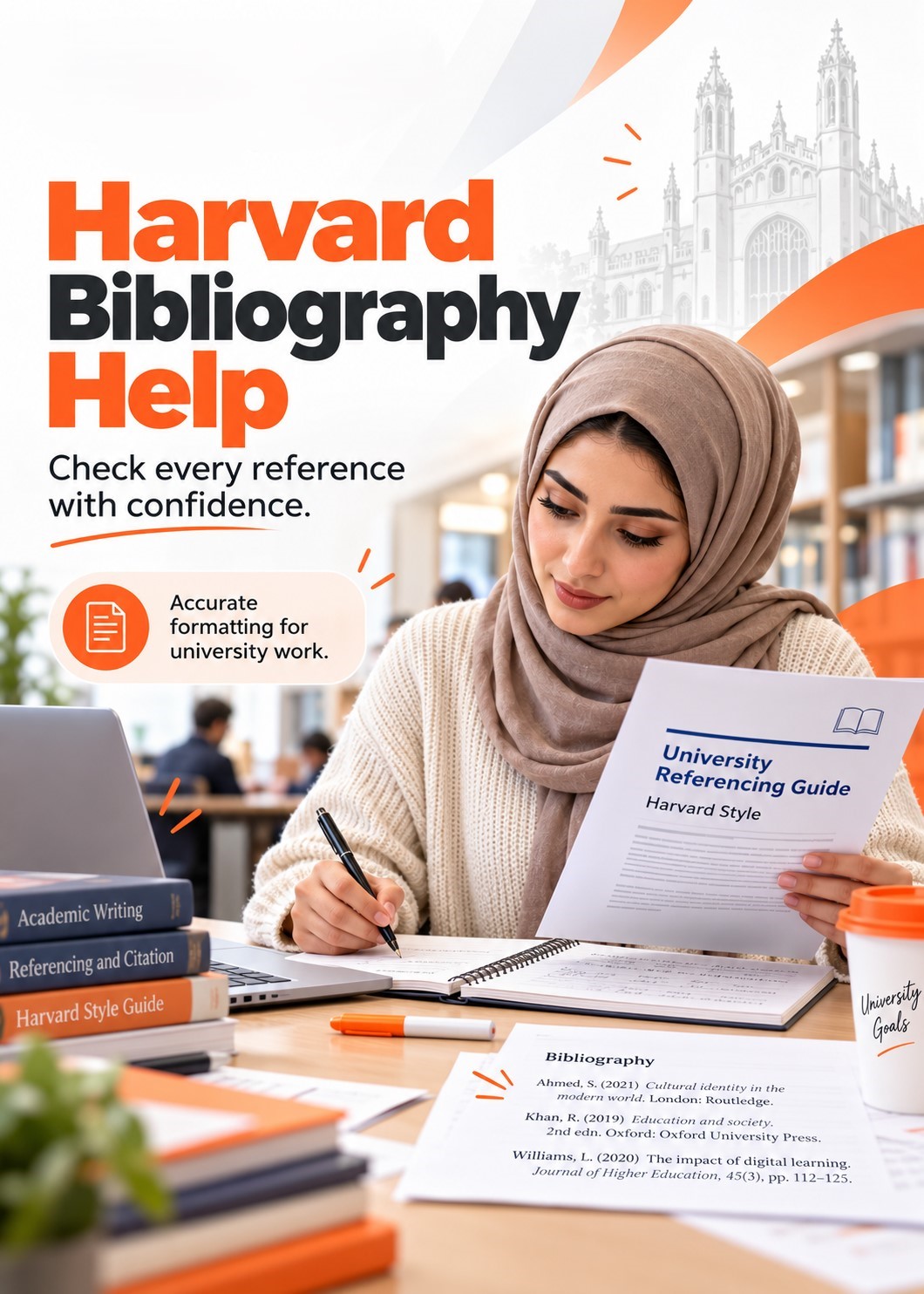
Review Harvard bibliography entries against your university guide, checking authors, publication dates, titles and editions.
Students searching for a bibliography generator UK option need a tool that supports their assigned style and a process for checking its output. Location alone does not make a generator compatible with a university handbook.
A free bibliography maker may help with routine entries, while a reference list generator can organise a growing source collection. Neither guarantees that imported source details are complete.
If you use Cite This For Me bibliography features or another provider, verify the source data and selected style. Online Academic Help is an independent support service and is not affiliated with those tools.
Confirm that all required bibliographic fields have been captured.
Check source existence and formatting even when a tool produces a polished result.
Review third-party output for incorrect editions, dates and author names.
Compare a DOI record with the article you actually consulted.
Check authorship, webpage title and publication information before importing a URL.
Use the assigned handbook to resolve differences between generator output and local requirements.
An apa bibliography maker usually produces entries for an APA reference list. Check whether your assessment explicitly requests a bibliography or uses that word informally for a list of cited works.
For a scholarly journal article or peer reviewed paper, verify author names, publication year, article title, journal title and the relevant volume, issue, page range or article number. Include a DOI when required by the style.
Check that each parenthetical citation identifies the correct reference.
Select the appropriate format for a book, chapter, article, report or webpage.
Review journal names, article titles, volume details and DOI links.
Add page numbers or suitable alternative locators as required.
Identify the organisation responsible for reports without named individual authors.
Check italics, sentence case, author presentation and hanging indents against the required guide.
A dissertation reference list helper can make chapter-by-chapter checking easier. Sources cited in a literature review, research methodology, discussion or appendix must remain identifiable across the complete document.
We help researchers review reference consistency while they retain responsibility for source selection, interpretation and the final research manuscript.
Confirm whether the assessment needs cited works only or consulted material as well.
Find citations without entries and entries that do not match the text.
Apply one approved system throughout the document.
Distinguish duplicate imports from separate editions or publications.
Acknowledge borrowed frameworks, instruments, datasets and established methods.
Keep author spellings, dates and source titles consistent across chapters.
An annotated bibliography combines a source reference with a short account of its content, relevance or limitations. The assignment brief determines whether annotations should summarise, evaluate or reflect.
Our annotated bibliography formatting service helps students review entry structure, annotation layout and consistency. Students develop their own critical evaluation from sources they have read.
Check the required annotation length, ordering rules and marking criteria before formatting. A standard reference list maker does not provide a substitute for reading and evaluating the work.
Present the complete source entry in the required style.
State its research focus, argument or findings accurately.
Explain how the work contributes to your research question.
Apply the requested word limit, structure and critical focus.
To learn how to write a bibliography, first identify what each source is. A downloaded PDF might be a journal article, government report, thesis or book chapter; the file extension does not determine the reference format.
Record the original author, title, publication date and source-specific details while researching. This helps avoid incomplete entries when the final deadline approaches.

Identify each source type before formatting your bibliography, then verify the publication details required by your referencing style.
To cite a website in a bibliography, identify the page author or organisation, title, date and URL; add access information when required.
Capture the journal, volume, issue, pages or article number and DOI as applicable.
Confirm the edition, authors or editors and publisher against the book itself.
To cite a PDF in a bibliography, reference the underlying document type and its original publication details.
To cite a government document in a bibliography, check the responsible department, report title, year and any report number.
Use stable source locations and retain the details required by your assigned style.
The required referencing system depends on the assessment. A works cited page, numbered reference list and note-based bibliography each organise source information differently.
Use the prescribed style guide and edition rather than combining formats from several tools. Publishing standards may also differ from a university’s assessment requirements.
Check whether the task requires notes and bibliography or the author–date system.
Follow the prescribed guide for secondary sources and any separate tables of cases or legislation.
Use an MLA Works Cited example for the relevant source type and check its core elements.
Follow the institution’s specific note and bibliography rules; the Oxford label can cover local variations.
Match numbered citations with the correct entries in the required reference order.
Review numbering, journal details and abbreviations against the designated medical referencing guide.
A final bibliography review should check more than punctuation. Every entry needs to describe the correct work, and each citation should support the claim it accompanies.
We help students review source attribution throughout academic writing, including literature reviews, tables, figures and appendices. Clear feedback makes corrections easier to understand and verify.
Acknowledge the origin of borrowed ideas, data and quotations.
Review source names and dates across the full document.
Check attribution for adapted illustrations, models and statistics.
Connect descriptions of prior research to traceable original sources.
Review spelling, punctuation, capitalisation and entry order.
Compare the completed bibliography with the actual marking and referencing requirements.
An ai reference generator or automated bibliography tool may suggest references or format imported records, but a plausible entry can still describe a nonexistent or incorrectly identified publication.
An ai citation checker, research assistant AI or AI writing assistant should be treated as a support tool. Confirm that each source exists, that you have consulted it and that it supports your claim.
A metadata extraction engine may misread scanned documents or confuse authors and institutions. Semantic citation lookup can suggest related material without establishing that it is the source you intended to cite.
Synthetic text analysis does not prove that a citation is valid. Automated source attribution and a machine readable citation export still require checks against original records and university policy.
Search the original title, authors and publisher information.
Correct missing dates, author order and document-type errors.
Inspect imported citation fields before generating the final list.
Read the relevant source passage before using it to support an argument.
A reference list maker can organise records consistently when the underlying details are correct. Select the assigned style before reviewing punctuation and layout.
Check whether your document needs a reference list, works cited page or bibliography. The inclusion rules and list title should follow the assessment brief.
Apply the required heading, line spacing and hanging indents.
Confirm whether consulted but uncited sources belong in the list.
Use the author and tie-breaking rules required by the style.
Keep reference numbers aligned with the prescribed citation order.
Apply the correct link format and access-date rules.
Use the same conventions for equivalent source types throughout.
In text citations and bibliography entries work together to help readers locate evidence. An author name, publication year or reference number must identify the intended source unambiguously.
Check parenthetical citations, narrative citations, footnotes and references in captions. Include quotation locators when required by the selected style.
A bibliography alone does not show which source supports a particular sentence. Add attribution where the borrowed information appears.
A reference list generally contains works cited in the document. A bibliography may also include material consulted, depending on the assigned convention.
MLA commonly uses the heading Works Cited for cited sources. Other styles prescribe their own headings and ordering rules.
Follow the brief rather than treating these labels as interchangeable. Ask your university library if the instructions leave the required inclusion rules unclear.
Source types vary by subject. Business reports, clinical research, software documentation and legal authorities each need identifiable publication details.
Our guidance applies the assigned style to your actual sources while keeping the focus on accurate academic attribution.
Check company reports, market research and organisational authors.
Record conference papers, technical standards, software and datasets appropriately.
Review journal articles, assessment instruments and author–date references.
Check clinical guidelines, research articles and institutional reports.
Distinguish legal authorities from secondary commentary using the assigned guide.
Record editions, translations, archive details and relevant source containers.
Follow the assessment instructions when your project combines different source types.
A harvard style reference list guide helps you identify the fields needed for each kind of source. Capture those details while reading rather than relying on a remembered title later.
Confirm author order, year, edition and the original source location. Use a DOI lookup where appropriate, then compare the retrieved record with the publication you consulted.

Cross-check authors, dates, titles and DOI records so each citation connects to the correct Harvard bibliography entry.
Keep chapter authors separate from collection editors.
Verify the article title and journal publication details.
Match the spelling and year used in the text.
Apply the exact author-list and abbreviation rules in your guide.
Identify responsible organisations and meaningful publication dates.
Follow the guide for absent details; do not invent bibliographic data.
A footnote bibliography format may use full first notes, shortened later notes and separate bibliography entries. Those entries are not necessarily identical in punctuation or author presentation.
A chicago style bibliography generator can assist with routine records, but primary source bibliography structure may need extra information such as collection names, repository details and document identifiers.
An oxford referencing system guide should come from the institution setting the assessment. For legal work, follow the required OSCOLA guide and any local instructions.
Include the source details and locators required by the note system.
Apply bibliography-specific author order and punctuation.
Record the collection, repository and item identifier as appropriate.
Identify contributors and the edition you consulted.
Use the approved shortened form for subsequent references.
Use the source-specific format required by your assessment.
Before submission, compare the final list with every citation, footnote, table and figure. Check that the correct sources remain attached to their claims after editing.
Review author names, dates, titles, edition information, source order, punctuation and links. Remove duplicate imports while preserving distinct sources.
Use your university library portal to resolve difficult records and check the institution’s plagiarism policy and permitted-support requirements.
An undergraduate bibliography guide should help you build reliable habits from the start of a module. Keep reading notes and source records together so you can trace quotations and paraphrases.
University library bibliography help is a useful starting point for local style guidance, database access and citation management training.
Use an academic bibliography tool to organise your collection, then review the result against the prescribed handbook.
Record author, title, year and source type as you research.
Use appropriate library databases and original publications.
Separate quotations from your own summaries and record locators.
Apply the convention named in the assessment instructions.
Correct incomplete metadata before generating your list.
Use feedback to improve future research and reference checking.
Accurate bibliography entries support academic integrity by making your evidence traceable. References should describe real sources you have consulted.
A plagiarism checker may flag text overlap, but it cannot establish that every reference is correct or every paraphrase has suitable attribution.
Follow the university’s plagiarism policy and rules on AI use. A tool-generated reference does not remove your responsibility to check the original work.
Our guidance helps students identify referencing errors and understand corrections while retaining ownership of their analysis and final submission.
Share your source list, draft and referencing instructions so we can assess the checks you need and provide a quotation.
Send the university guide, source list or draft, academic level and deadline.
We review source types, list length and requested bibliography checks.
Review explanations of incomplete records, inconsistent formatting and citation mismatches.
Check corrections against original sources and apply your institution’s requirements.
Explore support for subject-specific sources in Business, Computer Science, Psychology and Nursing.
Our bibliography guidance focuses on the guide set by your university, the sources you have used and corrections you can understand.
Apply the assigned handbook and any local assessment instructions.
Identify incomplete acknowledgements and unclear source connections.
Compare entries with original records and publisher information.
Check that citations identify the intended bibliography entry.
Understand ordering, punctuation and layout corrections.
Use feedback to verify and prepare your own submission.
Get a quotation based on your reference list, required checks and deadline. The final scope and price are confirmed before work begins.
Starting rate per 250 words; bibliography-only checks are quoted by scope.
Get a quotation based on your reference list, required checks and deadline. The final scope and price are confirmed before work begins.
Starting rate per 250 words; urgent availability is confirmed with your quote.
Get a quotation based on your reference list, required checks and deadline. The final scope and price are confirmed before work begins.
Read what customers have shared publicly about their experience with Online Academic Help. The summaries below are shortened for readability and linked back to the independent source.
Ratings can change over time, so we link directly to the public review profiles for the most current information.
United States · January 2026
Karla highlighted the nursing expertise and said she would recommend the service.
United Kingdom · September 2023
Mimi described the team as professional, quick to respond and flexible when changes were needed.
United Kingdom · July 2023
Esther praised the team for being kind, professional and willing to help with requested revisions.
United Kingdom · June 2022
Uchechi highlighted quick replies, polite communication and timely support.
Answers about bibliography generators, reference lists, source types, annotated bibliographies and academic integrity.
Request a QuoteBibliography help supports source identification, reference list organisation and formatting against your required style. It can include checking missing publication details and matching references with citations.
Identify your required style, record the details of each source, format entries by source type and arrange the list as instructed. Check whether the brief allows consulted but uncited works.
Yes, if your university permits it. Compare the generated entries with your institution’s Harvard guide and verify the authors, dates, titles and source details.
A free bibliography maker can provide draft entries. You still need to check source accuracy, the chosen style and university-specific requirements.
We can review entries produced by third-party tools against original sources and the assigned guide. Online Academic Help is independent and is not affiliated with Cite This For Me.
A reference list generally includes cited works. A bibliography may include consulted sources as well, depending on the required convention. Follow the assessment brief.
Yes. We can help review reference presentation, annotation layout and consistency with the brief. Students write their own critical evaluation based on sources they have read.
Identify the underlying source type and responsible author or organisation. Record its title, publication date and the publication or retrieval details required by the assigned style. A PDF is a file format rather than a reference category.
Yes. AI tools may produce nonexistent sources or incorrect publication details. Verify each entry against the original publication, a publisher record or a trusted library catalogue.
Use the quotation form or WhatsApp to share your university guide, draft or source list, academic level and deadline. We will review the requested checks and confirm the scope and price.
Get a quotation based on your reference list, required checks and deadline. The final scope and price are confirmed before work begins.