
Report Planning
Interpret the brief, marking criteria, purpose, audience, word count and required report sections before drafting.
Our report writing service UK supports university students with planning, research, structure, analysis, executive summaries, recommendations, referencing, proofreading and final review. These report writing services are aligned with your assessment brief, academic level, marking criteria, required report writing format and deadline.
This UK-focused academic support can help students understand the assessment brief, plan a logical structure, identify suitable research, analyse evidence and present findings in an academic format. The aim is to make the reporting process clearer while keeping the work aligned with university requirements.
Interpret the brief, marking criteria, purpose, audience, word count and required report sections before drafting.
Use peer-reviewed literature, research reports, case studies and credible professional sources that fit the report topic.
Organise raw data and evidence, explain key findings and connect the discussion to the report objective.
Use headings and subheadings, tables and figures, page number formatting and appendices where appropriate.
Check in-text citations and reference lists against the referencing style required by the university or module.
Review grammar, clarity, academic writing, formatting, consistency and presentation before submission.
Academic report writing requires a clear purpose, logical organisation and appropriate evidence. Unlike a general essay, a report normally divides information into defined sections so the reader can identify the background, method, findings, discussion, conclusions and recommendations.
Strong academic writing also distinguishes evidence from interpretation. Sources should support the analysis rather than replace it. Students should explain why findings matter, how they relate to the report question and what limitations affect the conclusions.
Define the report objective, audience and assessment requirements.
Select relevant scholarly and professional sources.
Interpret findings rather than simply describing information.
Answer the report objective using evidence from the analysis.
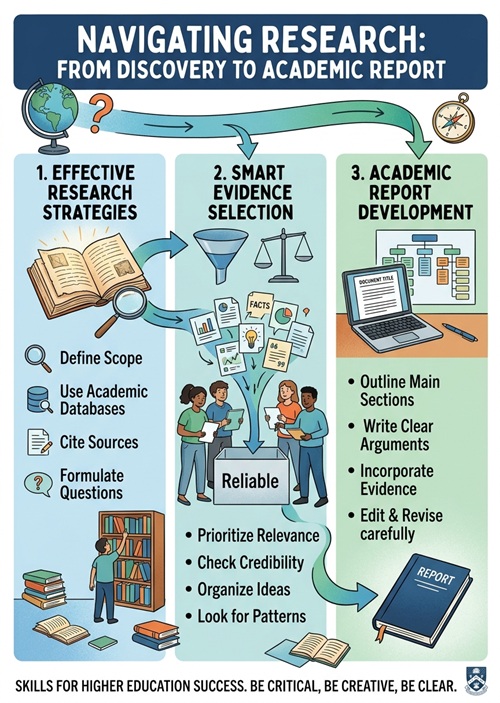
Learning how to write a report starts with the assessment brief. Students should identify the report purpose, audience, required sections, marking criteria, word count, referencing style and deadline before beginning detailed research.

Report planning can include analysing the assessment brief, organising sections, researching evidence and reviewing the final structure.
Identify the task words, learning outcomes, report type, required evidence and submission instructions.
Create headings and subheadings that reflect the assessment requirements and allocate the word count logically.
Collect relevant academic literature, professional evidence, case studies, research reports and reliable data.
Present the background, methods section, findings, discussion and other required sections in a logical sequence.
Summarise the main findings and develop recommendations that are supported by the analysis.
Check referencing, tables and figures, page numbers, formatting, proofreading and alignment with the marking criteria.
An academic report format UK universities expect can vary by subject and module. Students should familiarise themselves with the assessment brief and module handbook instead of assuming that every report follows the same template.
A typical structure may include a title page, executive summary, table of contents, introduction, background or literature review, methodology, findings, discussion, conclusion, recommendations, references and appendices. Only include sections that are relevant to the assessment.
Summarise the purpose, approach, key findings and recommendations.
Define the topic, context, scope and report objective.
Present evidence and explain what the findings mean.
Develop realistic actions supported by the report analysis.
Academic report guidance can be useful at different stages of an assessment. Some students need help interpreting the brief and planning sections, while others need support with research, analytical depth, referencing, proofreading or the final presentation.
Break down the brief, identify key points and create a workable report plan.
Select evidence that is relevant to the report question and academic level.
Compare evidence, identify patterns and explain the significance of findings.
Check whether sections are logically ordered and proportionate to the marking criteria.
Improve citation consistency and reference-list presentation.
Review readability, grammar, formatting and overall academic presentation.
Executive summary report writing is especially important in business, management and professional reports because decision makers may read the summary before reviewing the full document. It should communicate the report purpose, approach, main findings, conclusions and recommendations concisely.
The executive summary is normally written after the full report has been completed. It should reflect the final content accurately rather than introduce new evidence or arguments that do not appear in the report.
State why the report was prepared.
Briefly identify how evidence was gathered or analysed.
Present the most important results or issues.
Summarise the main actions proposed by the report.
Business report writing help can support reports involving organisational performance, strategy, marketing, finance, operations, human resources, leadership, risk and change. Business reports usually need clear evidence, practical analysis and recommendations that respond directly to the identified issue. An annual report assessment may also require students to interpret organisational performance, financial information and strategic priorities.
Management report writing help can support analysis of leadership, operations, organisational behaviour, change, performance and strategic issues.
Present financial evidence, performance measures, risk, budgeting or investment analysis clearly.
Evaluate markets, customers, competitors, campaigns, segmentation, positioning and performance.
Different report types use different conventions. The structure, evidence, terminology and presentation should follow the discipline, assessment brief and university guidance.
Lab report writing help can focus on aims, methods, results, tables and figures, discussion, limitations and scientific referencing.
Organise scientific evidence, methods, results and interpretation using clear discipline-appropriate reporting.
Present a technical document with clear specifications, methods, findings, constraints and evidence-based recommendations for the intended audience.
Evaluate evidence, identify relationships and explain the implications of findings rather than relying on description.
Structure reflective analysis around experience, evidence, learning outcomes and an appropriate reflective framework where required.
Review spelling, grammar, punctuation, academic tone, headings, citations, formatting and consistency in a completed draft.
Subject-specific report guidance reflects the terminology, evidence, analytical methods and reporting conventions used within each discipline.
Support with organisational, financial, strategic, marketing and management reports.
Support with policy, legal, social science and evidence-based analytical reports.
Support with healthcare, nursing, public health and life-science report structures.
Support with technical findings, data interpretation, system evaluation and research reporting.
Support with technical methods, design evaluation, risk, results and engineering recommendations.
Support with research-led reports across education, media, humanities and applied disciplines.
Our university report support can be adapted to undergraduate and postgraduate assessments. The level of support depends on the module requirements, learning outcomes, report type and depth of analysis expected at the student's academic level.
Students often ask how to structure a university report when their brief provides learning outcomes but no fixed template. In this situation, the structure should be developed around the assessment objective, required evidence and marking criteria rather than copied from a generic template.
University assignment report help can also focus on planning, analytical development, citations, proofreading and academic integrity. Students remain responsible for understanding their work and preparing their final submission.
Develop structure, research selection, evidence use, analysis and academic presentation at degree level.
Strengthen critical evaluation, synthesis, methodological reasoning and evidence-based recommendations.
Keep each report section connected to the learning outcomes and assessment criteria.
Apply the report format, terminology and referencing requirements specified by the university.
Students seeking professional assistance with report writing can use specialist guidance to understand discipline requirements, identify weaknesses in a draft and improve the way evidence, analysis and recommendations are presented.
Guidance can focus on structuring a critical report so that each section has a defined function and contributes to the overall analysis.
Support may identify appropriate referencing requirements, formatting conventions and presentation issues based on the assessment brief.
Providing the deadline and full assessment brief at the beginning supports realistic planning and timely delivery of academic guidance.
Management report guidance can cover strategy, leadership, organisational behaviour, operations, project management and performance. Students may need to interpret an assessment requirement, select relevant management frameworks and integrate academic evidence with practical business reasoning.
Useful business report structure tips include defining the business issue early, separating findings from interpretation and ensuring that recommendations respond directly to the evidence. Reports prepared for managers and other decision makers should make key points easy to identify without sacrificing academic analysis.
A strong business report justifies recommendations by connecting theory, case evidence, market data or organisational information to the problem being investigated.
State the business problem, scope, audience and report objective clearly.
Use relevant management theories and analytical frameworks appropriately.
Separate factual findings from evaluation and business implications.
Connect recommendations directly to the evidence and analysis presented.
Final review is not limited to spelling and grammar. A completed report should also be checked for logical sequence, objective alignment, consistency of evidence, academic tone and presentation.
Check whether each part of the report contributes to the stated objective and remains within the required scope.
Confirm that claims, conclusions and recommendations are supported by the report data, research and analysis.
Review headings and subheadings, tables and figures, graphics, page number references and section formatting.
Check spelling, grammar, punctuation, readability, paragraph structure, citations, academic writing and formatting consistency.
Review the sequence of ideas so findings lead logically into discussion, conclusions and recommendations.
Compare the final draft with the assessment instructions and marking criteria before submission.
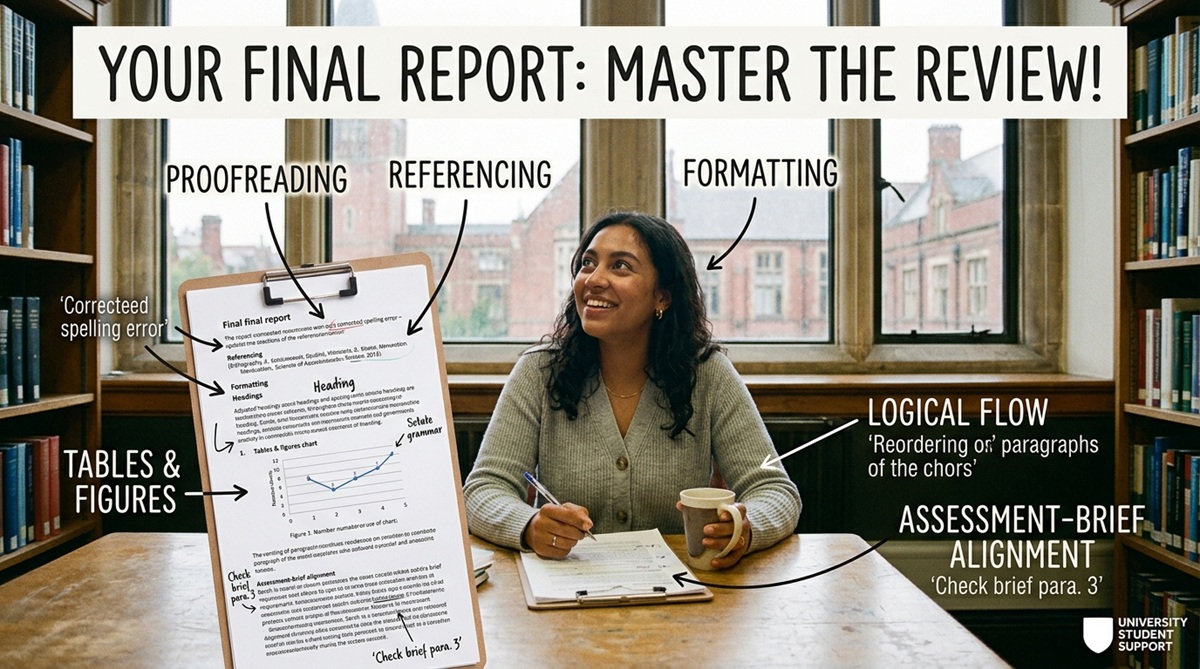
Final report review can cover proofreading, referencing, formatting, tables and figures, logical flow and assessment-brief alignment.
Online Academic Help covers a wide range of subject and qualification areas so report guidance can reflect discipline-specific terminology, research methods, evidence standards and academic conventions.
Accounting, Business & Management, Finance, Economics, Marketing, Human Resource Management, MBA, Project Management, International Business, Supply Chain Management, BTEC, CIPD and HND reports.
Law, Criminology, Politics, International Relations, Psychology, Social Work, Sociology, Education and Early Childhood Studies.
Nursing, Healthcare, Public Health, Medicine, Biomedical Science, Biology and Environmental Science reports using evidence-based and scientific reasoning.
Mathematics, Statistics, Chemistry and Physics support involving calculations, data interpretation, experiments and scientific reporting.
Computer Science, Information Technology, Data Science, Artificial Intelligence, Cybersecurity and Software Engineering reports.
Mechanical, Civil and Electrical Engineering reports involving methodology, calculations, results, design evaluation and recommendations.
English Literature, History and Media & Communication reports involving source interpretation and critical analysis.
Hospitality Management and Tourism Management reports involving operational evaluation, industry evidence and recommendations.
The reporting approach is adapted to the subject rather than applying one generic structure to every university assessment.
University reports should be logical, focused and easy to navigate. Clear headings and subheadings help readers understand longer reports, while selective bullet points can present concise information when the assessment format allows them.
Published research should be evaluated rather than inserted as unsupported quotation. Students should explain evidence in their own academic writing, identify limitations and show how the analysis supports the conclusions.
Referencing style and report formatting should remain consistent throughout the document. Academic integrity requirements also apply to planning, editing and proofreading support, so students should follow the rules specified by their university.
Keep sections ordered around one consistent report objective.
Assess the relevance, quality and limitations of published research.
Show how findings and analysis justify the conclusions reached.
Apply the university-required style consistently across citations and references.
Our approach focuses on planning, research, structure, analysis, referencing, editing, proofreading and formative guidance. Where originality is discussed, plagiarism free work means students should use sources responsibly, cite evidence correctly and submit work that follows their university's academic-integrity rules. Students remain responsible for their final submission and for following their university’s academic-integrity requirements.
The purpose of support is to strengthen academic writing, research, evaluation, analytical reasoning and report communication skills that students can apply to future assessments.
A structured process keeps report guidance aligned with the university brief and assessment requirements.
Provide the brief, subject, academic level, word count, deadline, rubric, referencing style and existing work.
The requirements are reviewed to identify the structure, research, analysis or editing support required.
Support is tailored to the report type, subject, academic level and assessment requirements.
Use feedback to strengthen analysis, recommendations, referencing, formatting and presentation.
Explore subject-specific academic support alongside report writing guidance.
Support is based on the report type, subject, assessment criteria, academic level and stage where assistance is needed.
Align the report plan with the actual assessment instructions and marking criteria.
Organise headings, sections, findings, discussion, conclusions and recommendations logically.
Use credible academic, professional and discipline-specific evidence.
Move beyond description by evaluating evidence and explaining why findings matter.
Guidance for undergraduate and postgraduate university reports.
Check referencing, formatting, proofreading and overall presentation before submission.
The final quotation depends on academic level, subject, complexity, word count, deadline and type of support required.
per 250 words
per 250 words
Use the coupon below when placing your order to receive the current promotional saving.
Subject to the coupon’s validity and usage limits.
Read what customers have shared publicly about their experience with Online Academic Help. The summaries below are shortened for readability and linked back to the independent source.
Ratings can change over time, so we link directly to the public review profiles for the most current information.
United States · January 2026
Karla highlighted the nursing expertise and said she would recommend the service.
United Kingdom · September 2023
Mimi described the team as professional, quick to respond and flexible when changes were needed.
United Kingdom · July 2023
Esther praised the team for being kind, professional and willing to help with requested revisions.
United Kingdom · June 2022
Uchechi highlighted quick replies, polite communication and timely support.
Answers about academic report structure, business reports, executive summaries, proofreading, referencing and requesting support.
Request a QuoteWe help students at all levels of their educational journey. From high school to grad school and everything in between. The help extends beyond just writing reports. It includes elements such as structuring, researching, analysis, formatting, referencing, editing and proofreading reports.
In general, reports comprise defined sections, while essays are more free flowing. Reports, for example, may contain an introduction, an executive summary, a table of contents, a list of figures, methodology, findings, conclusions, and recommendations. Reports may also contain numerous appendices. This structured approach is one of the main differences between report writing and conventional academic writing in essay form.
The first thing you should do is find your assessment brief and marking criteria. Your assessment may or may not have an executive summary. An assessment report generally consists of an introduction, review of literature, background (if needed), method, findings (with analysis if needed), recommendations, conclusions, and references. Other components may include appendices. Your university may also specify an academic report format UK students are expected to follow.
An executive summary will summarize the main points of the report including the purpose, the methodology, the main findings, and the recommendations. They are written after the body of the report has been completed. Good executive summary report writing gives readers and decision makers the key points of a report without requiring them to read the full document first.
Yes. Business report guidance can cover research, strategic frameworks, organisational analysis, market evidence, findings, recommendations, professional formatting and academic referencing.
Academic guidance can support laboratory and scientific report structure, methodology, data presentation, analysis, discussion, evidence evaluation and referencing. The student remains responsible for the accuracy of experimental data and final submission.
Yes, we do proofreading. This service checks spelling, grammar, punctuation, and overall presentation of your document. We can also check the logical flow of your document. A report proofreading service UK can additionally identify inconsistencies in formatting, headings, citations and overall presentation.
Different universities can use a different style. The Harvard style is the most popular style in UK universities. Other styles in use can be APA or OSCOLA. Use the style that your module team requires.
Add the assessment brief, your subject, your level, the word count, the due date, the marking criteria and the type of referencing to be used. If you have your own draft, research, or tutor/peer feedback this will help you see the gaps in your report.
Describe your report assessment and the areas where you need guidance, such as planning, research, structure, analysis, referencing, editing or proofreading. Your requirements are reviewed to identify the appropriate report format and level of academic support while you remain responsible for your final submission.
Provide your report brief, subject, academic level, word count, deadline, referencing style, marking criteria and any work already completed.