
Research Question
Develop a manageable research question and thesis statement that provide a clear direction for the project.
A dissertation is often the largest and final part of a postgraduate degree at a UK university. Writing a dissertation involves identifying a research question, analyzing bibliographical data, and defending the research methodology. At Online Academic Help, we assist students in the research, drafting and revising process of their dissertation, theses and other post-graduate research projects. We work within the boundaries and structures of your institution and provide academic help with research project topics, research proposals, Literature Reviews, research data, and other project drafts. Our goal is to enable you produce better academic documents that meet the standards of your University.
A dissertation is more than just a long research paper. It follows a similar structure, but also includes a section that presents the researcher’s findings, called the Results chapter. Additionally, it includes a chapter that summarizes and contextualizes the research, called the Conclusion chapter.
We assist clients with their dissertations by writing various chapters and by analyzing research data. Furthermore, we help clients with many aspects of the research process, including selecting the appropriate research strategy, assessing the quality of primary and secondary sources, and data analysis. We use statistical analysis software to perform descriptive and inferential statistics.
Develop a manageable research question and thesis statement that provide a clear direction for the project.
Evaluate and synthesise relevant research instead of simply describing individual sources.
Consider research strategy, sampling, data collection, analysis, limitations and ethical issues.
Our dissertation data analysis help supports students with research data, descriptive and inferential statistics, quantitative data analysis, interpretation and reporting.
Receive specific feedback on chapter structure, evidence, argument, academic tone and project requirements.
Review consistency, referencing, formatting, clarity and whether conclusions are supported by the evidence.
We provide assistance based on your requirements and the progress you've made with your project. Whether you need assistance developing your research idea or need more in-depth feedback on your project at an advanced stage, we can help.
Feedback can cover different components of your project. These may include your research question and thesis statement, the structure of your chapters, the types of evidence you’ve used and how well your evidence supports your argument. This service enables students to get specific feedback on their projects, as opposed to more general dissertation tips.
Students writing dissertations in the UK sometimes require assistance with various aspects of a project, other than the actual writing. These include research design, choice of source, justification of research methods, and analysis and interpretation of research data.
We, therefore, provide assistance with academic and research guidance, and editing of project drafts. We aid students to understand their academic project requirements, UK university marking criteria and the wider expectations of higher education.
Clarify the research problem, question and thesis statement.
Review how chapters connect to the central research purpose.
Assess the relevance and quality of evidence used in the project.
Keep the dissertation aligned with the university brief and marking criteria.

An undergraduate project focuses on the student’s capability to carry out structured independent research. A postgraduate project however requires the student to get immersed in a scholarly level critique of diverse research methodologies and bring to bear their understanding and critical appraisal of the same to a given research problem.
Support can cover reviewing and integrating literature, research frames and designs, and drawing and defending conclusions.
A dissertation can include literature review, methodology, findings, analysis, conclusion, appendices and bibliographies, depending on university requirements.
Research strategies, methodologies and institutional ethics requirements can affect how long a dissertation takes, so starting early allows time to integrate feedback.
Guidance can cover narrowing a research question, finding credible evidence, creating a chapter plan and understanding how research differs from standard coursework.
Develop the skills required to plan, evaluate and present a substantial independent research project.
Postgraduate work can require deeper critique of research methodologies and their application to a defined research problem.
Strong dissertations normally begin with a manageable question rather than a broad subject area. A focused question makes it easier to identify relevant literature, select an appropriate methodology and build a coherent argument.

A focused dissertation question helps connect the literature, methodology, evidence and final argument.
Define what you will investigate and establish a clear, manageable research problem.
Set out the purpose of the research and the objectives that will guide the project.
Develop focused questions that can be addressed using appropriate evidence and methods.
Identify existing ideas, recent scholarship, unresolved debates and limitations in the field.
Explain how you intend to create, collect or examine the evidence needed for the research.
Where research involves people or potential risk of harm, the ethics approval dissertation process should be completed in line with institutional requirements before conducting the research.
When students in the UK are trying to determine how to choose a dissertation topic, key factors include the topic’s relevance and accessibility within peer-reviewed literature, feasibility within the dissertation limits, and the student’s own subject knowledge. An ideal topic is sufficiently compact for thorough analysis but broad enough to support critical analysis or interpretation. Reviewing recent scholarly journals can help identify current knowledge, unresolved disputes and research limitations that may suggest potential dissertation topics.
A good dissertation needs more than a collection of references. The research chapters should show how previous scholarship, research choices and new findings relate to the central question.
Consider how ideas from peer reviewed journals and other scholarly sources relate to larger concepts, how evidence has been evaluated through peer review, and where the research contributes to ongoing discussions in the field.
Incorporate research without simply regurgitating information, focusing on larger concepts that connect individual studies.
Support covers qualitative research methods, quantitative research methods and mixed methods research.
Explain methodology, sampling strategy, data collection and analysis, limitations and relevant ethical issues.
Support can cover selecting statistical tests, organising variables, interpreting output and reporting findings.
Understand the implications of research findings through appropriate statistical analysis and quantitative data analysis in relation to the research questions rather than only producing statistical output.
Our dissertation introduction help supports students who need to establish a clear foundation for their research and connect the opening chapter logically with the rest of the dissertation. A strong introduction should explain the research context, define the problem, establish the theoretical framework, present the research aims and objectives, and show how the study relates to existing research.
We also provide dissertation abstract writing help for students who need to summarise their research question, methodology, key findings and conclusions accurately and concisely. Whether you are at the topic selection stage or have already completed your research, our expert guidance can help you present your original research more effectively.
Where data collected during the study influences the research direction or findings, we can also help ensure that the introduction, abstract and subsequent chapters remain consistent. This structured assistance supports students throughout their academic journey while keeping the research purpose clear from the opening section to the final conclusion.
Explain the research setting and establish the problem.
Connect the study to the relevant theoretical framework and existing research.
Present research aims and objectives clearly.
Summarise the question, methodology, findings and conclusions concisely.
Our dissertation help services are designed around the individual requirements of each student, rather than using the same approach for every research project. Through our custom dissertation writing service, support can be tailored to your academic level, subject, university guidelines, research stage and specific areas requiring improvement.
Students working close to a deadline can also request urgent dissertation writing help for eligible tasks, subject to the complexity of the work and the time available for appropriate academic review. Our specialists can provide expert guidance on research organisation, chapter development, interpretation of data collected, integration of existing research, and presentation of a suitable theoretical framework.
Where applicable to the agreed service, free revision can be used to address feedback or adjustments within the original requirements. The purpose is to provide focused academic assistance that helps students strengthen their research while maintaining consistency with their project objectives and university requirements.
Support can be adapted to your academic level, subject, research stage and university guidelines.
Eligible tasks may be reviewed on shorter deadlines, subject to complexity and available academic review time.
Where included in the agreed service, revisions can address feedback or adjustments within the original requirements.
Revision is an essential research stage. It provides an opportunity to remove repetition, strengthen transitions, correct inconsistencies and check whether conclusions are supported by the evidence presented.
Our team of UK-based professionals will proofread your dissertation and correct spelling, punctuation and grammar, providing a concise, clear and consistent version of your work.
Editing focuses on clarity, logical flow, appropriate academic tone and consistency while preserving your ideas and overall academic message.
Organise headings, tables, figures, contents pages, references and other presentation elements according to the required style.
Support can accommodate the Harvard referencing system and discipline-specific conventions. Law students should follow the OSCOLA referencing guide or the version of OSCOLA required by their institution.
Use quotations and paraphrases correctly and provide appropriate references in line with institutional requirements.
Students should check their university policy, academic integrity guidelines and any rules governing dissertation editing, proofreading and plagiarism check tools. A Turnitin similarity score should be interpreted in accordance with institutional guidance rather than treated as a standalone measure of academic integrity.
Online Academic Help currently provides academic support across 47 subject and qualification areas, allowing dissertation guidance to be matched more closely to the terminology, evidence and research practices of a student's discipline.
Our MBA dissertation help and business dissertation support can cover management, marketing, HRM, international business, project management, supply chain, strategy, leadership, operations, finance and applied business research.
Corporate finance, financial markets, investment, valuation and quantitative research, including data interpretation and statistical methods.
Law dissertation topics includes legal research, legislation, case analysis, critical argument and appropriate legal referencing, including OSCOLA where required.
A nursing student may need dissertation guidance with nursing theory, evidence-based practice, healthcare research and critical appraisal; academic guidance does not replace clinical judgement or medical advice.
Psychological theory, research design, literature evaluation, quantitative or qualitative analysis and presentation of findings.
Support also spans accounting, economics, social sciences, health, STEM, computing, engineering, humanities, hospitality and tourism.

Subject-specific dissertation guidance should reflect the terminology, evidence, methodology and referencing conventions of the discipline.
Our PhD dissertation support assists with advanced-level planning of research and responding constructively to doctoral supervisor feedback from supervisory units.
Each component of doctoral research should be integrally and logically related to the next. Support is offered to write research chapters in a logical and integrated manner and to assist with the adaptation and justification of methodology.
A key component of doctoral research is the originality of the contribution. Support is offered to assist the researcher to consider how each element of their research contributes to the overall answer to the research question and to justify elements of their research methodology.
The PhD Viva is designed to assess the candidate's expertise and knowledge of the research study and should not be interpreted to mean that candidates are required to memorize responses. Candidates should be prepared to provide an account of the research process, outcomes and limitations.
Plan advanced research and respond constructively to doctoral supervisor feedback.
Keep research chapters logically connected to the central question.
Consider how each research element contributes to the original contribution.
Prepare to explain the research process, outcomes, methodology and limitations.
When looking for the best dissertation help in the UK, it is important to consider a company's actual practices instead of focusing on the company's advertisements. Does the company have subject experts on staff? Are the company's practices and policies clear? Do they have a subject expert who is specifically familiar with the UK academic system? Do they have staff members who can and will explain their policies and practices? Will they keep student information and/or the student's University request confidential? If a company provides the kind of help described above, it will not raise any ethical concerns. Providing this kind of help will allow a student to learn how to identify and evaluate scholarly research instead of answering research questions for the student.
Look for support that understands the terminology and research practices of your discipline.
Understand what type of academic assistance is being offered and what remains your responsibility.
Support should account for UK university marking criteria, higher education standards and discipline-specific research expectations.
Requirements, scope, feedback and deadlines should be communicated clearly.
Consider how your information and academic documents are handled.
Any assistance should remain within your institution’s academic integrity guidelines and rules for assessed work.
Our online dissertation help gives UK university students access to research and academic guidance without requiring face-to-face appointments.
You can provide your dissertation brief, academic level, research topic, deadline, marking criteria and the specific area where you need assistance. This allows the support to be focused on your actual project rather than generic advice.
Provide the dissertation brief, university guidance and marking criteria.
Tell us whether you are choosing a topic, planning methodology, analysing data or revising a draft.
Include the due date so the scope of suitable support and expectations for timely delivery can be assessed realistically.
Students wanting to hire dissertation help in UK should look at the cost and the level of assistance provided. Cheap help may not be of any use if it does not relate to the research problem or if it does not meet the requirements of the university.
Last minute help may be provided for an additional cost, if the nature of the help required is for minor editing. More extensive help, requiring additional research and analysis may not be provided in a short time frame. Ample time should be provided to seek and incorporate feedback.
Consider whether the support actually relates to your research problem and university requirements.
Minor editing may be more feasible on a short deadline than extensive research and analysis.
Research-intensive tasks require sufficient time for appropriate academic review.
Allow enough time to receive, understand and incorporate feedback into your project.
There is a popular search phrase buy dissertation online UK. However, students should recognize the difference between legitimate academic help and cheating.
Academic help and editing services have limits. Although clients may ask for assistance with a particular activity, service providers may refuse help if they feel the activity crosses ethical or legal boundaries. Students are obligated to follow their university’s academic integrity guidelines and code of practice regarding academic dishonesty. A plagiarism check or Turnitin similarity score can support review of citations and source use, but the result should always be interpreted according to the university’s own policy.
Also, if you are considering pay someone to do my dissertation UK, you may want to consider using other people to do legal activities for you, such as research or statistics, and having your work edited or proofread. Cheating by outsourcing assessed work is unethical. You remain solely accountable for the final version of your academic work.
A useful dissertation structure guide UK normally includes the following core stages. The exact structure should still follow your university handbook and discipline requirements.
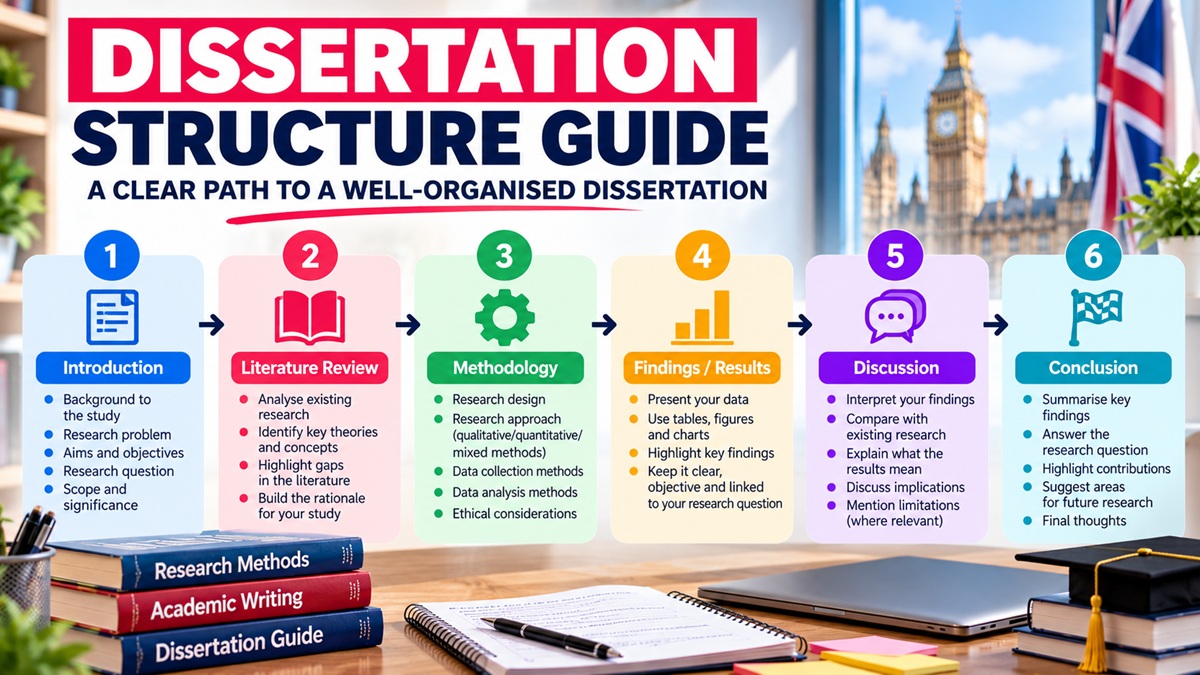
A coherent dissertation structure connects the research question, literature, methodology, findings, discussion and conclusion.
Define the research problem, context, objectives, research questions and scope.
Critically evaluate relevant scholarship and establish the theoretical or conceptual context.
Explain the research design, methods, data sources, ethics and analytical approach.
The results section should present the relevant evidence clearly, while the discussion interprets its meaning in relation to previous research and your research questions.
Answer the research question, summarise the contribution, acknowledge limitations and identify appropriate areas for further research.
Present supporting sources and supplementary material according to your institution’s required format.
A structured writing process keeps academic support focused on your actual research project, university requirements and current stage of progress. Guidance should build on your own research and ideas rather than presenting assessed work as if it were written from scratch on your behalf.
Provide your dissertation brief, research topic, academic level, marking criteria, current draft and deadline.
Clarify whether support is needed with the topic, proposal, literature, methodology, data, chapters or final revision.
Assess structure, evidence, research choices, analysis, academic tone, referencing and areas requiring improvement.
Use feedback to strengthen the dissertation while retaining responsibility for the final academic submission.
These disciplines commonly involve substantial independent research, literature evaluation, methodology, data analysis and dissertation-level academic writing.
Support is adapted to your academic level, subject, university guidelines, research stage, methodology, evidence, marking criteria and deadline.
Work from your actual dissertation brief, research question and university requirements.
Connect literature, methodology, evidence and findings to the central research question.
Understand statistical tests, SPSS output, findings and their implications for your research questions.
Consider qualitative, quantitative or mixed-method research design and justification.
Improve clarity, consistency, academic tone, grammar, formatting and referencing.
Check whether chapters connect logically and conclusions are supported by the evidence presented.
The final quotation depends on academic level, subject, research stage, complexity, methodology or data requirements, word count, deadline and the type of dissertation support required.
per 250 words
per 250 words
Use the coupon below when placing your order to receive the current promotional saving.
Subject to the coupon’s validity and usage limits.
Read what customers have shared publicly about their experience with Online Academic Help. The summaries below are shortened for readability and linked back to the independent source.
Ratings can change over time, so we link directly to the public review profiles for the most current information.
United States · January 2026
Karla highlighted the nursing expertise and said she would recommend the service.
United Kingdom · September 2023
Mimi described the team as professional, quick to respond and flexible when changes were needed.
United Kingdom · July 2023
Esther praised the team for being kind, professional and willing to help with requested revisions.
United Kingdom · June 2022
Uchechi highlighted quick replies, polite communication and timely support.
Answers about dissertation support, Masters dissertations, literature reviews, proofreading, SPSS, research proposals, topics and PhD viva preparation.
Request a QuoteThere is some grey area when it comes to whether it is legal to purchase dissertation help in the UK. Providing students are guided by an instructor and there is no academic infringement committed, then the service is completely legitimate.
What happens if you don't complete your dissertation in the UK will depend on the specifics of your program. Generally, you will be required to repeat the year. Check your program regulations to be sure.
Check your University Handbook to be sure, but usually a masters dissertation will have an introduction, literature review, methodology, findings, conclusions and implications, and references.
A UK masters dissertation should be no shorter than 12,000 words. The exact length will depend on your university. Aim to finish your research and analysis with time to edit and proofread your dissertation.
Utilize peer-reviewed journals to identify research relevant to your topic. Your review should contain a critique of the research rather than a rehash of each article.
It is often acceptable to have a dissertation proofread; however, different universities often have varying policies on dissertation proofreading and editing. It is best to check with your university to avoid any issues.
Statistics tutoring and SPSS help are available and can be beneficial for understanding selection of tests, assumptions and interpreting outputs. Ultimately, the goal is to understand what you are analysing and communicate it clearly.
Choose a topic that is focused, scholarly and appropriate. Make sure that the topic is researchable and has sufficient evidence within the constraints of your time. Your supervisor can also assist you in determining this.
A research proposal identifies and defines the research problem, justifies the research, reviews relevant literature, explains the proposed methodology, addresses potential ethical issues and outlines the anticipated results.
Know your thesis thoroughly, revisit your methodology and principal findings, identify the research contribution and limitations, review likely areas of challenge and practise explaining why you made important research decisions.
An academic dissertation is a long document, divided into sections, which review a research study. Online Academic Help provides specific help for sections including the proposal, literature review, methodology and statistical analysis, as well as citation, editing and proofreading. To receive assistance, mention your research topic, the stage you've attained and your due date. You remain solely accountable for the final version of your academic work.