
Research Questions
Refine your research question and maintain a clear connection between your research purpose, evidence and conclusions.
Writing a thesis is more than just composing a long document. You will need to establish an incisive research question, formulate a research design, compile and evaluate evidence, and construct a persuasive argument. Our thesis help UK service assists potential researchers (undergraduates, postgraduates and doctoral students) based in the United Kingdom with various aspects of their research studies including designing, conducting and analysing research.
Thesis writing help covers several activities related to thesis and dissertation research and writing including, but not limited to, planning, research, structure and formatting, and editing and proofreading. We provide help with dissertation and thesis research, writing and editing for UK and international postgraduates. The focus of the PhD thesis help is on interpreting, synthesizing, and evaluating research findings, and describing the methodological framework of a PhD study.
To guide you effectively in writing your thesis, we must evaluate your current situation and determine your main weaknesses.
Initially, we may assist you in the selection of your thesis topic, and help you in the preliminary search of the literature. We can help you develop research questions and provide feedback on your theoretical framework. Our evaluations of your research proposals can address the focus and feasibility of your research.
While you prepare your thesis, we can assist you to determine the main conclusions of your research and identify and analyze the evidence that supports your conclusions. We can assist you to critically evaluate your research and determine the ethical aspects of your research. We can help you develop your methodology and identify potential research gaps.
We can assist you to maintain an appropriate balance between your research questions, methodology and the conclusions of your research. Ultimately, your decisions will govern the research conclusions, and you will retain the responsibility for the final version of your research.
Refine your research question and maintain a clear connection between your research purpose, evidence and conclusions.
Conduct preliminary literature searches and identify relevant research, gaps and scholarly evidence.
Receive feedback on how your theoretical framework relates to the research question and study design.
Develop and justify an appropriate methodology while considering research ethics and limitations.
Identify and analyse evidence supporting the principal conclusions of your research.
Evaluate gaps, inconsistencies, research decisions and whether the study adequately addresses the research question.
Our thesis writing services focus on research guidance, structure, academic clarity and critical development rather than simply increasing word count. Experienced thesis writers can provide focused guidance on organisation, argument development and academic presentation while keeping your own research decisions and academic responsibilities at the centre of the project.
There are different aspects of this argument where you can receive assistance. For example, you can receive assistance with the articulation of your argument and the planning of the different components of your project.
You can also receive assistance with refining your research questions, identifying gaps and inconsistencies in your project, and clarifying the relationship between the different components of your project, such as methods and findings.
Lastly, the completeness of your research in answering your research question can be assessed.
When evaluating research projects that are predominantly review in nature, the focus may be on the design of a review of the literature, appraisal of sources and an integrative review rather than on a descriptive review.
Develop a logical and defensible academic argument.
Clarify how the different components of your research project connect.
Identify gaps and inconsistencies that may weaken the overall research.
Assess whether the research adequately answers the original research question.

Share your topic, research question or draft. We can help you identify the next steps for your research.
Consider a thesis consultation UK if you feel your research is lacking but you don't know the next steps to take.
These consultations cover various aspects of your research including but not limited to what your research encompasses, how your chapters are organized, feedback from your supervisor, gaps in the literature you’ve cited, the methods and frameworks of your research, and the analysis of your data.
Each case is reviewed based on the goals of the researcher and the academic level and standards of the researcher's field.
For additional support, students can use a thesis coach UK or an online thesis tutor UK.
Review what your study encompasses and whether its scope is manageable.
Identify weaknesses or gaps in the literature supporting your research.
Consider supervisor comments in relation to relevant chapters and research decisions.
Review how research methods and theoretical frameworks relate to your objectives.
Consider whether your analytical approach appropriately addresses your research questions.
Review the thesis according to the academic level and standards of the researcher's field.
Thesis literature review help can focus on the design and organisation of the review, the quality of scholarly sources, gaps in the literature and the relationship between previous research and your own study.
Research projects that are predominantly review-based require more than a descriptive list of previous studies. The literature should be critically evaluated, compared and integrated so that the review develops a clear scholarly context for the research question.
Evaluate the relevance, credibility and contribution of scholarly sources.
Connect individual studies to wider concepts, debates and themes.
Identify gaps, inconsistencies and unresolved questions within existing literature.
Move beyond description by comparing and evaluating previous research critically.
Keep the literature review connected to your central research question and objectives.
Organise literature logically according to themes, concepts, methods or scholarly debates.
Thesis support can be adapted to the academic level, research requirements and methodological expectations of postgraduate and doctoral research.
Our thesis help services are ideal for students in a research-based master's degree program.
Master's students are expected to analyse, interpret and synthesise literature in their field.
Develop a methodologically sound research plan and demonstrate appropriate data collection and analysis.
Specialized support for PhD candidates writing their thesis focuses on depth, originality and academic rigor.
Evaluate arguments, evidence, methodological considerations, structural deficiencies and repetitive passages.
An academic editor for a PhD thesis can identify inconsistent terminology, structural problems and areas requiring clearer academic presentation.
Editing a PhD thesis in the UK means going beyond mere spell-checking and punctuation. You will find arguments and chapters that need to be tied together. You may also find inconsistencies in the use of technical terms.
Since a PhD thesis is quite long, you may find instances where the same thing is expressed in many different ways, perhaps confusingly.
Things may need editing to show where a claim is not adequately supported, or to provide a more precise rationale for a finding.
There may be instances where the methodology is inappropriate to the questions being addressed, or the relationship between the findings and the literature is not clear.
Review whether major claims are adequately supported.
Identify inconsistent use of technical and disciplinary terminology.
Consider whether research methods align with the questions being addressed.
Strengthen the relationship between findings and existing literature.
Tell us about your methods, supervisor feedback and academic level to discuss focused methodology support.
We offer guidance on writing research methodology for scholarly works. This includes journals, theses and dissertations. When writing a dissertation or thesis, students need to explain how the chosen research design addresses the research problem and why particular methods are suitable for the study.
Researchers should describe their philosophy on research. They may also present details on the approach they took to sample selection and data collection. Further, they should address the ethical considerations and potential limitations of the research.
Support may include a rationale for the researchers’ decision-making process for theory and method selection. Students preparing to write a research proposal can also receive guidance on aligning the research problem, objectives, data collection strategy and statistical methods with the proposed methodology.

A clear methodology explains how research design, sampling, data collection, ethics and analysis relate to the research objectives.
Explain the philosophical assumptions and approach underlying your research.
Provide a rationale for participant, case or sample selection.
Explain how evidence or research data is collected and why the chosen approach is appropriate.
Address ethical considerations and institutional requirements relevant to the study.
Support may include rationale for selecting key informants, interviews, observations or other qualitative methods.
Consider variables, hypotheses, sampling, statistical tools and analytical decisions.
Thesis writing support helps students to conduct and analyze quantitative research. Depending on the student’s research design, different types of analysis may be covered, such as descriptive and inferential statistics, correlation and regression analysis, hypothesis testing and the selection of an appropriate statistical test. Guidance on dissertation statistics can also help students understand which statistical methods are suitable for their variables, hypotheses and research questions.
For students using SPSS, assistance may include creating and managing the datasheet, selecting appropriate procedures and interpreting results from SPSS outputs. Students may learn how to summarise and present research findings in an academic report while explaining what the results mean in relation to the original research problem.
Students using other methods, such as interviews or observations may be interested in learning qualitative analysis to identify key themes in their data.
Both types of analysis may be covered, depending on research needs and requests.
Understand how descriptive statistics summarise the characteristics of research data.
Consider appropriate inferential methods according to the research design.
Understand the application and interpretation of correlation and regression analysis.
Review statistical hypotheses, appropriate tests and interpretation of findings.
Assistance may include managing datasets, interpreting SPSS output and presenting results.
Identify and organise key themes in interviews, observations or other qualitative data.
Editing for clarity and scholarly presentation of theses allows editing professionals to familiarize themselves with the international standards and best practices in scholarly composition and formatting.
Editing may help authors recognize obscure expressions and amplifications, ill-defined and repetitive paragraphs, transitional deficiencies, inconsistencies in the use of terminology, and irrelevant paragraphs.
Editing may also provide suggestions and recommendations to help authors identify and analyze the deficiencies in their works vis-à-vis the research questions or objectives.
Furthermore, suggestions and recommendations may also be provided to help students identify inconsistencies and gaps in the interpretation of their research findings and recommendations. Editing may also focus on grammar and style.
Identify unclear expressions, unnecessary amplification and repetitive passages.
Improve connections between paragraphs, sections and chapters.
Review consistency in technical and disciplinary terminology.
Identify areas where the thesis does not adequately address the research questions or objectives.
Review inconsistencies and gaps in the interpretation of research findings.
Improve scholarly presentation, grammar and consistency in academic style.
Our proofreading service can be performed on the final draft of your thesis, once your research and substantive editing stages are complete.
The editing of thesis components is concerned with helping the author meet the conventions of language, style and presentation, as well as consistency, of scholarly writing.
In addition, editing identifies inconsistencies and omissions in referencing and references that are incomplete or misplaced.
The editing of the abstract provides a limited review of the research summary to determine if it adequately presents the research questions, approach and design, major findings and conclusions. Editing eliminates irrelevant detail.
Review grammar, spelling, punctuation and academic expression.
Check consistency of terminology, presentation and scholarly style.
Identify incomplete, inconsistent or misplaced references.
Review whether the abstract accurately summarises the question, approach, findings and conclusions.
Request help with academic clarity, consistency, proofreading and university presentation requirements.
Our thesis formatting service UK helps researchers correctly present their work according to the expected format of their institution.
Formatting helps in presenting different elements of the research work like headings, text, figures, tables, captions, page numbers, lists of contents and references in the prescribed way.
The service is flexible and can be customized to various format specifications of different research departments and schools.
Review heading hierarchy, margins, spacing, pagination and overall document organisation.
Present tables and figures consistently with appropriate numbering and captions.
Check contents pages and document navigation against the final thesis structure.
Review reference-list presentation and consistency with citations used throughout the thesis.
Apply formatting specifications supplied by the relevant university, department or graduate school.
Check technical presentation before final submission.
Consistent layouts for citations and references are easy to implement and give a finished look to academic documents.
Examples of citations may include any of the major styles, including Harvard or APA references, and other styles mandated by educational institutions. It is important to check consistency of all cited works against the bibliography. However, students should verify all details against the original work.
In the absence of a similar report mandated by the university, students can use a similarity report to self-evaluate their documents for potential areas that require further review.
It is recommended that students perform an integrity check to review whether the work adequately cited all ideas and expressed opinions of other authors.
Terms used for postgraduate research projects, especially the difference between a thesis and a dissertation, vary between universities and between countries.
In UK higher education, the word dissertation is usually used for research projects at undergraduate or taught master's levels. Doctoral research projects, or a significant part thereof, are usually called theses. However, some deviation from these rules is common.
Given the above, in providing thesis or dissertation help in the UK, the focus is on the level and nature of research rather than relying on the name of the document. Students comparing thesis writing services with dissertation writing services in the UK should therefore consider the academic level, research design and type of support required rather than the project title alone.
Online Academic Help currently covers 47 subject and qualification support areas, allowing thesis guidance to be matched more closely to the terminology, research methods and evidence standards of each discipline.
Support is available for Accounting, Business & Management, Finance, Economics, Marketing, Human Resource Management, MBA, Project Management, International Business and Supply Chain Management research.
Support covers Law, Criminology, Politics, International Relations, Psychology, Social Work, Sociology, Education and Early Childhood Studies.
Research support covers Nursing, Healthcare, Public Health, Medicine, Biomedical Science, Biology and Environmental Science.
Students working in Mathematics, Statistics, Chemistry and Physics can receive guidance with research structure, quantitative analysis and technical presentation.
Research guidance is available for Computer Science, Information Technology, Data Science, Artificial Intelligence, Cybersecurity and Software Engineering.
Support covers Mechanical Engineering, Civil Engineering and Electrical Engineering, including technical literature reviews and quantitative results.
Support covers English Literature, History, Media & Communication, Hospitality Management and Tourism Management.
Choosing a manageable research topic is an important starting point for a successful thesis. Our thesis topic selection help supports students in narrowing broad ideas into a focused question that is appropriate for their subject area, academic level and available evidence.
Once a topic has been established, thesis proposal feedback UK can evaluate the proposed research objective, scope, methodology and planned contribution.
Guidance may also consider whether a key journal article or wider body of literature provides a suitable foundation for the study.
Students who move from the proposal to the first chapter can receive thesis introduction help to develop the research context, problem statement, objectives and rationale clearly.
This approach helps establish a logical foundation before substantial data collection and analysis begin.
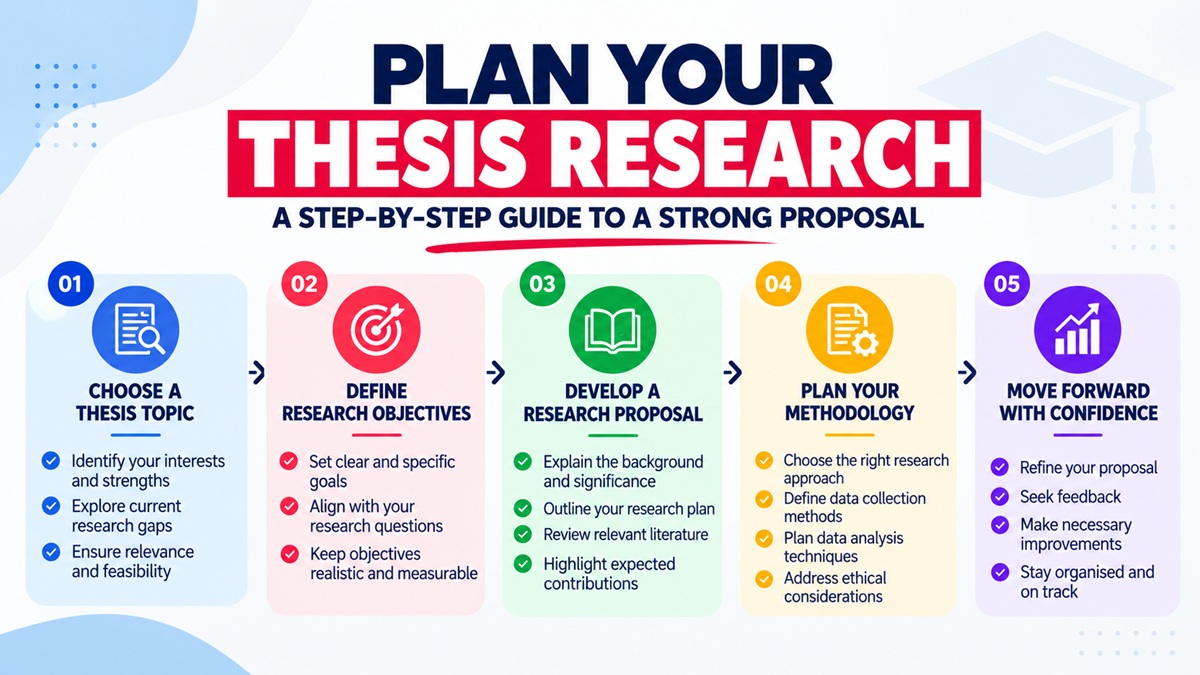
A focused research topic helps establish a clear research objective, appropriate methodology and manageable thesis scope.
Narrow a broad subject area into a manageable and researchable topic.
Evaluate whether the research topic is suitable for your academic level and available evidence.
Define what the study intends to investigate or achieve.
Review scope, methodology, feasibility and the planned research contribution.
Consider relevant journal articles and wider scholarly literature supporting the proposed study.
Develop research context, problem statement, objectives and rationale clearly.
Our master thesis proofreading support examines language, consistency and academic presentation while thesis structure feedback considers how effectively the complete study is organised.
A highly qualified academic specialist can review whether chapters follow a logical sequence and whether arguments remain connected to the original research objective.
Particular attention can be given to discussion chapters, where findings should be interpreted critically and related to relevant literature rather than simply repeated.
Students working with interviews, observations or textual datasets can also request thesis qualitative analysis help to improve the organisation and interpretation of themes.
Thesis discussion chapter support can help identify weak connections between findings and previous research, while thesis abstract editing checks whether the final abstract accurately summarises the research purpose, methodology, principal findings and conclusion.
Students seeking a masters dissertation proofreader UK can use this final-stage review to identify language and presentation issues before submission.
Review language, consistency and academic presentation before final submission.
Evaluate whether chapters follow a logical sequence and support the research objective.
Connect research findings critically to relevant previous literature.
Improve the organisation and interpretation of themes from qualitative data.
Identify weak connections between findings, theory and previous research.
Check whether the abstract accurately summarises the purpose, methodology, findings and conclusion.
Our university thesis formatting help focuses on presenting a completed thesis according to the requirements provided by a university, department or graduate school.
Formatting may cover heading levels, page numbering, margins, spacing, contents pages, tables and figures, captions and the reference list.
Citation consistency can also be reviewed according to the required citation style, including Harvard, APA or another system specified by the institution.
This final review helps ensure that citations, bibliography entries and document elements follow a consistent format throughout the thesis.
When combined with proofreading and structural review, university-specific formatting support helps students prepare a clear, professionally organised document that follows the technical presentation requirements for submission.
Send your university guidelines and current draft for a quotation tailored to your formatting and citation requirements.
The level of assistance you need changes at each stage of your thesis.
When you are first gathering information, you need assistance with things like topic selection and proposal development. During this stage, you may also need help with methodology.
Once you have a draft, the focus of your assistance needs changes to interpretation. This usually occurs at the chapter level.
As you get closer to the final stages of your work, you need assistance with things like editing, proofreading and formatting.
The more information you provide about your school, your particular academic needs, and the nature of your academic constraints, the better support can be tailored to your needs. Clear requirements and realistic deadlines also support effective planning and time delivery at each stage of the thesis process.
Define a manageable research topic and focused research question.
Develop the proposed research design, methods, objectives and scholarly foundation.
Work with literature, evidence, data and analytical methods appropriate to your study.
Review arguments, interpretation, structure and connections between chapters.
Improve clarity, academic language, consistency and presentation.
Review references, citation style, tables and figures, layout and institutional formatting requirements.
Thesis guidance, editing, proofreading, research consultation and formatting should support the researcher's own academic work rather than replace their responsibility for assessed research.
Researchers remain responsible for their research decisions, interpretation of evidence, conclusions, citations and the final version submitted to their institution.
Any thesis support should be used in accordance with university academic integrity policies, research ethics requirements and rules governing editing, proofreading and external academic assistance.
Where a similarity report is used, it should support a review of citation and source use rather than be treated as a standalone measure of academic integrity.
Thesis assistance should be based on your research stage, university requirements, academic level and the specific areas where you require guidance.
Provide your thesis topic, university requirements, academic level, current draft and deadline.
Clarify whether you need support with the topic, proposal, methodology, analysis, chapters or final review.
Assess literature, structure, methodology, evidence, analysis, academic presentation and relevant requirements.
Use feedback to strengthen your thesis while retaining responsibility for your final academic submission.
These disciplines commonly involve substantial independent research, literature evaluation, methodology, analysis and thesis-level academic writing.
Support is adapted to your academic level, subject area, research topic, methodology, university requirements and current research stage.
Work from your actual research question, objectives and academic requirements.
Connect scholarly literature, theory and research gaps to your study.
Consider qualitative, quantitative and other research methods appropriate to your study.
Understand quantitative, qualitative and SPSS-based research analysis.
Improve academic clarity, language, consistency, structure and scholarly presentation.
Review layout, tables and figures, reference lists and required citation styles.
The final quotation depends on academic level, subject, research stage, complexity, methodology or analysis requirements, word count, deadline and the type of thesis support required.
per 250 words
per 250 words
Use the coupon below when placing your order to receive the current promotional saving.
Subject to the coupon’s validity and usage limits.
Read what customers have shared publicly about their experience with Online Academic Help. The summaries below are shortened for readability and linked back to the independent source.
Ratings can change over time, so we link directly to the public review profiles for the most current information.
United States · January 2026
Karla highlighted the nursing expertise and said she would recommend the service.
United Kingdom · September 2023
Mimi described the team as professional, quick to respond and flexible when changes were needed.
United Kingdom · July 2023
Esther praised the team for being kind, professional and willing to help with requested revisions.
United Kingdom · June 2022
Uchechi highlighted quick replies, polite communication and timely support.
Answers about thesis research, Master's and PhD support, methodology, data analysis, editing, referencing, supervisor feedback and subject-specific guidance.
Request a QuoteWe provide different levels of help to suit your needs at every stage of your research. This help includes planning research, reviewing research proposals, literature, methodology and chapters, as well as data analysis, editing, proofreading, referencing and formatting.
Yes. We provide a range of services for Master's level theses including research and planning, literature synthesis, methodology, analysis, chapters and editing.
Yes. We provide help including planning, methodology, theory, chapter writing and editing for PhDs.
Yes. We review theses at this stage to identify and correct errors in structure and organisation. We check presentation and editing.
Yes. Help is available for designing and planning research, sampling, data collection and methods including ethics.
Yes. Help is available for interpretation of research data using different methods including qualitative analysis and SPSS.
Yes. We help clients to understand citation and referencing in the styles used by different universities.
We are able to review your supervisor feedback and relate it to the corresponding part of your thesis. Guidance may help you understand the feedback and consider potential changes.
Yes. We provide support for areas of study including business, finance, law, social sciences, health sciences, life sciences, computing, data science, AI, engineering, humanities, media, the arts and applied management.
The help available depends on the stage of your research. Methodology support is more appropriate during the proposal stage. During your research, structural support and overall review may be more useful. Editing, proofreading, citations and formatting are generally more appropriate during the later stages.
Online Academic Help provides thesis guidance for different stages of university research, including topic selection, proposals, literature reviews, methodology, statistical and qualitative analysis, chapter review, editing, proofreading, citations and formatting. Tell us your research topic, academic level, current stage and deadline so that support can be matched to your research requirements. You remain responsible for the final version of your academic work.