
Storyboard & Structure
Organise the presentation into a logical sequence so the audience can follow the argument from introduction to conclusion.
Creating a strong university or professional presentation involves much more than placing information on slides. Our presentation help UK focuses on structure, visual communication, evidence, confident delivery and the needs of the audience, helping you turn complex ideas into focused presentations that are easier to understand and deliver. Our presentation design services UK can also support students and professionals who need to create a presentation with a clear purpose, logical flow and audience-focused visual structure.
Professional help with PowerPoint presentation projects can provide a strong starting point when you have research and ideas but are unsure how to organise them effectively. PowerPoint presentation design can bring together structure, concise wording and visual consistency, while suitable PowerPoint templates can help maintain a coherent layout across the deck. The priority is high-quality communication: every slide should have a defined purpose and contribute logically to the overall presentation.
Organise the presentation into a logical sequence so the audience can follow the argument from introduction to conclusion.
Use consistent typography, colour, spacing and layout to create a clear visual hierarchy.
Present statistics, processes and complex information with visual aids that support understanding.
Separate what the audience needs to see from the detail the presenter needs to explain.
Keep academic claims connected to suitable evidence and references where the assessment requires them.
Keep wording concise and design each slide around the information the audience needs to understand.
A professional presentation design agency should do more than make slides look attractive. When a presentation contains complex information, research findings, statistics or detailed arguments, the design needs to establish a clear information hierarchy so the audience can identify the most important message quickly.
Charts, diagrams, infographics and carefully structured layouts can simplify difficult concepts without removing essential context. Effective presentation design balances text, evidence and visual elements so the audience can follow the argument while listening to the presenter.
This approach is particularly useful for academic, research, technical and business presentations where several ideas need to be communicated within a limited presentation time.
Give every slide one clear communication objective.
Make the most important information easiest to identify.
Use charts, diagrams and sources where they add meaning.
Connect each slide logically with the next.

Your presentation should take the audience through a series of ideas rather than require them to read a series of slides. Support considers what appears on the slide, what the presenter says and what belongs in the speaker notes.
Plan slide order and determine the purpose of each stage before polishing visual details.
Apply hierarchy, unity and consistency so headings, text and visual elements work together.
Review infographics, diagrams and charts to ensure they communicate the intended idea effectively.
Reduce unnecessary paragraphs so the audience can listen to the presenter instead of reading dense slides.
Move supporting explanation into notes when it does not need to appear visually on the slide.
Create or refine presentation templates for PowerPoint, Keynote or Google Slides within relevant brand guidelines.
Well-designed presentation slides combine concise wording, consistent formatting and relevant visual information. A structured approach makes academic and professional presentations clearer and more visually appealing while keeping the presenter's original evidence and ideas at the centre.
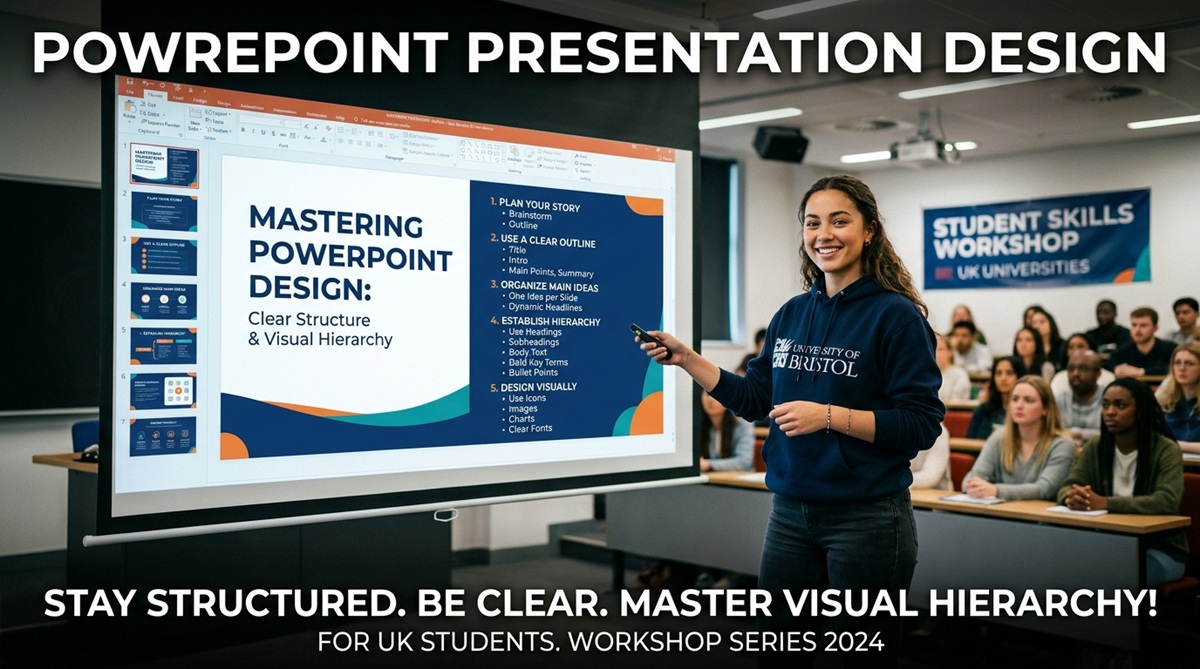
Strong slides use concise wording, consistent design and visual information that supports the presenter rather than competing with them.
Clarify what the audience should understand, remember or do after the presentation.
Arrange the introduction, evidence, analysis, findings and conclusion in a logical sequence.
Give each slide one objective and include only what is required to communicate it.
Use pictures, diagrams, flow charts, tables or charts when they explain information more efficiently.
Keep supporting detail in speaker notes so slides remain concise and readable.
Test timing, transitions, clarity and audience understanding before final delivery.
People seeking PowerPoint design agencies in London usually want stronger slide design, but the focus should remain on what the slides communicate rather than appearance alone. A good slide deck helps answer the audience's questions and moves logically towards the conclusion.
Slides with high information content need a strong visual hierarchy. In some cases a picture, diagram or flow chart can replace a text-heavy slide, while detailed explanation can be delivered through speaker notes.
PowerPoint design services should therefore consider both presentation structure and graphic communication instead of relying on visual styling alone.
Build each slide around a single communication purpose.
Use visuals when they explain an idea more clearly than paragraphs.
Move explanation into delivery and speaker notes where appropriate.
Maintain typography, spacing and visual conventions across the deck.
Pitch deck and business presentation support combines concise communication with evidence, analysis and clear visual representation. We can also help design pitch decks so the problem, solution, market, supporting evidence and next action are presented in a coherent sequence.
Explain the problem being addressed and the proposed solution clearly.
Identify the market, stakeholder or decision-maker the presentation is designed for.
Present financial information, research and claims with enough evidence to support the message.
Communicate how the business, project or proposal works without overloading slides.
Show relevant alternatives, market context or comparative evidence where required.
Finish with recommendations or the next action derived from the evidence presented.
Creating serviceable slides and presenting them effectively are different skills. Presentation skills coaching focuses on how material is delivered, including eye contact, audience engagement, pacing and practical rehearsal.
Rehearsal can reveal confusing sections, areas that require too much explanation and moments where the audience may lose focus. Students and professionals can use presentation delivery coaching or virtual presentation training to strengthen communication.
For presentation anxiety, structured preparation and realistic practice can help the presenter become more familiar with the sequence, timing and delivery demands of the final presentation.
Practise the full presentation under realistic timing conditions.
Use eye contact, pacing and audience-aware communication.
Identify sections that are confusing or require excessive explanation.
Adjust slides and delivery based on what rehearsal reveals.
Different tasks require different presentation techniques. Research presentations need methodological context, seminars may depend on critical discussion, and business pitches prioritise concise communication and persuasive framing. Presentation services can therefore be adapted to the purpose, audience, platform and communication requirements of each format.
Assessed, individual and group presentations aligned with university briefs.
Research presentations, dissertation summaries and viva-style presentations.
Management, marketing, consultancy, finance and project briefings.
Structure evidence, analysis and recommendations around a defined case.
Concise decks covering problem, solution, market, evidence and next action.
Microsoft PowerPoint, Google Slides, Canva and Keynote presentations.
Presentation guidance can be adapted to the evidence, terminology and communication conventions of business, social sciences, health, STEM, computing, engineering and humanities. Where presentations develop from essays, reports or other writing services, the key arguments and evidence can be reorganised into a concise visual format without losing their academic context.
Financial data visualisation, market analysis, strategy, business cases, project plans and recommendations.
Synthesise theory, evidence and critique within a constrained presentation time.
Present evidence-based information, research findings and clinical or laboratory work clearly.
Use graphs and diagrams to emphasise essential findings rather than raw data or lengthy formulas.
Explain architecture, logic and systems with flow charts, models and information diagrams.
Present designs, calculations, processes, technical projects and research findings with supporting diagrams.

Subject-specific presentation support should match the evidence, terminology and communication conventions of the discipline.
Provide your brief, marking criteria, research, existing slides, required slide count and presentation duration. Recommendations can address visual presentation, sequence, speaker notes and overall communication while keeping your own evidence, ideas and academic responsibility at the centre.
Presentation guidance is intended to help you improve clarity, academic quality and communication. This remains important when students explore presentations with AI, because generated suggestions, layouts or wording still need to be checked against the brief, evidence, references and academic-integrity requirements. You remain responsible for the final presentation, the accuracy of your evidence and references, and compliance with your university or organisation's requirements.
A structured process keeps presentation guidance aligned with your brief, audience, timing and assessment requirements.
Provide the brief, marking criteria, research, existing slides, slide count, duration and deadline.
Assess the objective, audience, slide sequence, evidence and communication priorities.
Refine visual hierarchy, wording, diagrams, charts, speaker notes and consistency.
Rehearse timing, transitions, audience engagement and the explanation supporting each slide.
These subject areas commonly require assessed presentations, research summaries, case presentations or professional-style briefings.
Support is adapted to your presentation purpose, academic level, slide count, duration, platform, evidence and marking criteria.
Work from the actual assessment or professional presentation requirements.
Structure slides around what the audience needs to understand and remember.
Use charts, diagrams and hierarchy to simplify complex information.
Keep claims, analysis and recommendations connected to appropriate evidence.
Strengthen speaker notes, pacing, rehearsal and audience engagement.
Check consistency, readability, references, timing and overall presentation flow.
The final quotation depends on academic level, subject, complexity, slide count, speaker-note requirements, deadline and the type of presentation support required.
per 250 words
per 250 words
Use the coupon below when placing your order to receive the current promotional saving.
Subject to the coupon’s validity and usage limits.
Read what customers have shared publicly about their experience with Online Academic Help. The summaries below are shortened for readability and linked back to the independent source.
Ratings can change over time, so we link directly to the public review profiles for the most current information.
United States · January 2026
Karla highlighted the nursing expertise and said she would recommend the service.
United Kingdom · September 2023
Mimi described the team as professional, quick to respond and flexible when changes were needed.
United Kingdom · July 2023
Esther praised the team for being kind, professional and willing to help with requested revisions.
United Kingdom · June 2022
Uchechi highlighted quick replies, polite communication and timely support.
Answers about PowerPoint design, slide structure, speaker notes, presentation platforms, pitch decks and delivery support.
Request a QuotePresentation help provides guidance with planning, slide structure, visual communication, speaker notes, evidence, referencing and delivery. Support can be adapted to university presentations, research talks, business presentations and professional slide decks.
Yes. You can provide an existing Microsoft PowerPoint file or your presentation brief for review. Guidance can focus on structure, slide layout, formatting, visual hierarchy, speaker notes and areas that need clearer communication.
Yes. PowerPoint presentation help is available at undergraduate and postgraduate levels for seminars, research presentations, case studies, group presentations, project briefings and other assessed presentations.
Yes. Presentation guidance can be applied to Microsoft PowerPoint, Google Slides, Canva and Keynote. The principles of hierarchy, readability, evidence, pacing and audience engagement remain relevant across platforms.
Notes can be reviewed to ensure they contain the main ideas for each slide and provide useful supporting detail for delivery. Concise prompts and bullet points can help the presenter speak naturally rather than read the slide.
A traditional format may include an introduction with the purpose or research question, context, evidence, analysis, findings, conclusion and references. The exact order should follow your brief and the logic of the subject.
Yes. Pitch deck support can consider the service or product, market, competition, operating model, financial information, supporting evidence and the visual structure of the deck.
Presentation coaching can improve delivery, clarity, conciseness and audience engagement. Slide construction and public speaking are related but distinct areas, so support can focus on either or both depending on your requirements.
Presentation guidance can be adapted across the subject and qualification areas supported by Online Academic Help, with attention to the evidence, terminology and communication conventions of the discipline.
Send your presentation brief, subject, academic level, deadline, required slide count, presentation duration and any existing slides or research material. The requirements can then be reviewed to identify the most appropriate presentation and delivery support.
Provide your presentation brief, subject, academic level, slide count, duration, deadline, marking criteria and any existing slides or research material.