
Identify the Experience
Choose an experience that is relevant to the assessment question, learning outcome or professional competency.
Reflective writing asks you to do more than describe what happened. You need to examine an experience, consider your response, connect it with relevant theory or evidence, and explain what you would do differently in the future. Our reflective writing help supports UK university students with planning, structure, critical reflection and academic presentation.
A useful reflective writing guide starts with one important distinction: reflection is not simply a record of events. Strong university reflective writing explores what happened, why it mattered, how your perception influenced your response and what insight you gained.
Choose an experience that is relevant to the assessment question, learning outcome or professional competency.
Consider your thoughts, assumptions, actions and decisions rather than simply describing events.
Link reflection with relevant academic sources, theories, standards or professional guidance where required.
Evaluate why the experience mattered, consider alternative perspectives and identify what changed in your understanding.
Apply Gibbs, Kolb or another framework when the assignment brief requires a structured reflective approach.
Explain what you will improve, how you will improve it and how future progress can be recognised.
Whether you need reflective essay help for an individual assessment or reflective assignment help for a professional module, support can be adapted to your brief, marking criteria and academic level. You can also get help with reflective writing when you are unsure how to turn personal experience into meaningful academic analysis.
Your lecturer may expect a first person narrative because you are discussing your own experience. However, personal writing still needs academic discipline. Depending on the assessment, you may need evidence, professional standards, academic sources or a recognised reflective framework.
The type of reflection required can vary. Some assignments focus on a single professional experience, while others require a reflective journal that records learning and development over several weeks.
Identify the event, context and your role.
Examine your thoughts, assumptions and decisions.
Connect theories and practice with relevant sources.
Explain learning and future improvement.

Reflective writing examples can show the movement from description to analysis, but your own work should remain specific to your experience and learning outcomes. Ask focused questions instead of relying on broad statements such as “I learned a lot from this experience.” Reflective writing prompts can be useful at the planning stage because they help you question assumptions, identify evidence and decide what the experience means for future practice.
What happened, what was I doing and which parts of the event are actually relevant?
Which assumptions, knowledge, values or professional expectations influenced my decisions?
What did I understand differently later and why did my interpretation change?
Which theory, evidence, policy or professional standard helps explain the situation?
Consider alternative perspectives and what you would do differently in a similar situation.
Explain how the learning will affect future practice, study or professional development. Where appropriate, turn these priorities into a practical personal development plan.
Reflective assignment help is useful if your assessment combines personal reflection with theory, professional practice or evidence. The precise methodology depends on the task. An example of a reflective account can help you recognise the expected balance between experience, analysis and learning, but examples should be used for guidance rather than copied into assessed work.
A nursing reflection may consider communication during placement. A business student may look at teamwork or leadership. An education student might think about a classroom activity, and a computing student could examine decisions made during a group development project.
Some assignments may also use a case study as the basis for reflection. You may need to analyse a specific situation, explain your involvement or perspective and connect the experience with relevant academic concepts. Reflective essay topics can also come from placements, group projects, presentations, classroom activities and professional situations. A suitable topic should give you enough scope to connect theories and practice while examining your decisions, assumptions and development.
Check whether marks are awarded for analysis, theory, evidence, evaluation or future planning.
Record purposeful learning and development over time rather than creating a simple diary.
Use the case to demonstrate learning rather than merely repeating case details.
Connect reflection with relevant competencies, standards and development needs.
A clear reflective essay structure gives each stage of reflection a purpose. Keep background information concise so there is enough space for critical analysis and learning. If you are asking how to start a reflective essay, establish the experience, academic or professional context and purpose of the reflection without narrating every detail at the beginning.
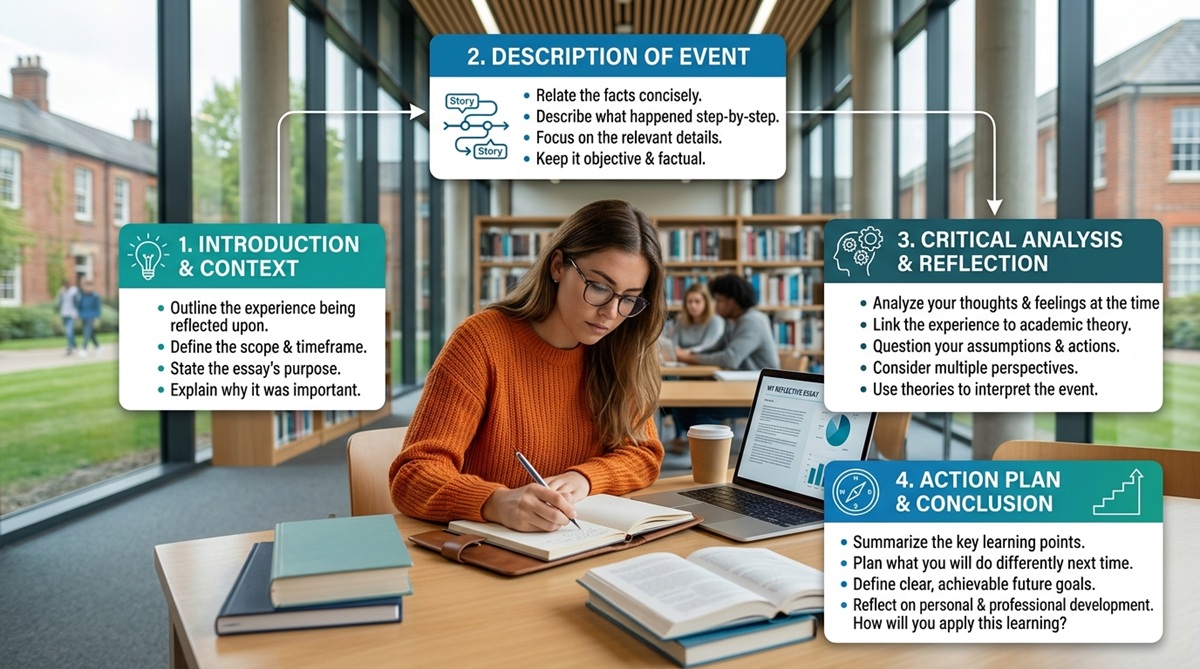
A reflective essay should establish context, analyse the experience, connect evidence and explain the learning gained.
Describe the experience or issue, the academic or professional context and the reflective framework being used. Set the focus without narrating every detail.
Explore the experience rather than simply narrating it. Link observations to relevant concepts, research or professional standards.
Show the relationship between the event, your response, supporting evidence and the lesson learned.
Where relevant, examine decisions and adjustments made while the event was taking place rather than only afterwards.
Bring together the main insight and explain its significance without introducing a completely new issue. A short reflective summary example would identify the original challenge, the most important learning and the practical change that follows.
Make each proposed change specific by explaining what will improve, how it will improve and how progress will be recognised.
If you want to learn how to write a reflective essay, follow a logical process that separates essential description from analysis and future development.
Choose an experience that directly relates to the assessment question or learning outcome.
Identify the required evidence, reflective model, professional standards and academic expectations.
Briefly state what happened, then examine your response, decisions and assumptions.
Identify learning outcomes, alternative perspectives and realistic areas for further development.
Different reflective model examples organise experiential learning in different ways. Your choice should reflect your discipline, assignment instructions and the depth of analysis required.
Briefly establish what happened and the context needed to understand the experience.
Consider relevant thoughts and feelings without allowing the section to become purely narrative.
Identify what worked, what did not and which aspects of the experience were significant.
Use evidence, theories and professional knowledge to explain why events developed as they did.
Identify the main learning and create a realistic plan for future improvement.
Move through concrete experience, reflective observation, abstract conceptualisation and active experimentation.
Students asking what is Gibbs reflective cycle are usually referring to Graham Gibbs' structured approach to learning through experience. The Gibbs cycle progresses through description, feelings, evaluation, analysis, conclusion and action planning.
Gibbs reflective cycle examples are particularly useful when an assessment requires a systematic review of a specific event. For example, a healthcare student might briefly describe a communication incident, consider their response, evaluate what went well, analyse the event using evidence and then develop an improvement plan.
The best reflective model for healthcare students depends on the assessment brief. Gibbs is useful for structured event-based reflection, but another reflective framework may be more appropriate when your module specifies a particular approach.
Establish the experience and relevant context.
Consider strengths, weaknesses and significant factors.
Connect experience with theories and practice.
Translate learning into future development.
Reflective assessments can use several formats. The structure should follow the assessment brief rather than assuming every reflection is a conventional essay.
If you are learning how to write a reflective report for university, begin by checking whether the brief requires headings, an executive summary, recommendations, appendices or a particular reflective model. The report may include context, experience, critical analysis, learning gained and action planning.
When learning how to write a reflective statement for assignment work, identify the competency or learning outcome, give a relevant example, explain what it taught you and show how the insight affects future practice.
Focus each entry on learning, development, decision-making or a change in perspective instead of creating a diary of events.
Use several purposeful entries to show how understanding or professional practice developed across a module or placement.
Concentrate on the significance and learning from the event rather than dramatic details.
Critical writing evaluates evidence and arguments, while reflective work combines evaluation with your own experience, learning and development.
Reflective assessments appear across many UK university disciplines. Subject-specific guidance can align reflection with the terminology, theories, professional expectations and assessment conventions of the relevant discipline.
Reflective practice may examine clinical communication, patient care, teamwork, professional development, ethics, safeguarding and placement learning while respecting confidentiality.
Reflection may cover leadership, teamwork, presentations, decision-making, organisational behaviour, management practice and professional competency.
Students may reflect on research, communication, teaching and learning methods, classroom activity, observation, perspective and professional practice.
Reflection can examine project methodology, technical decisions, collaboration, testing, problem-solving and project results.
Students may evaluate advocacy, research, communication, practical experience, professional skills and academic development.
Reflective tasks can also appear in finance, marketing, project management, hospitality, tourism and other practice-based disciplines.
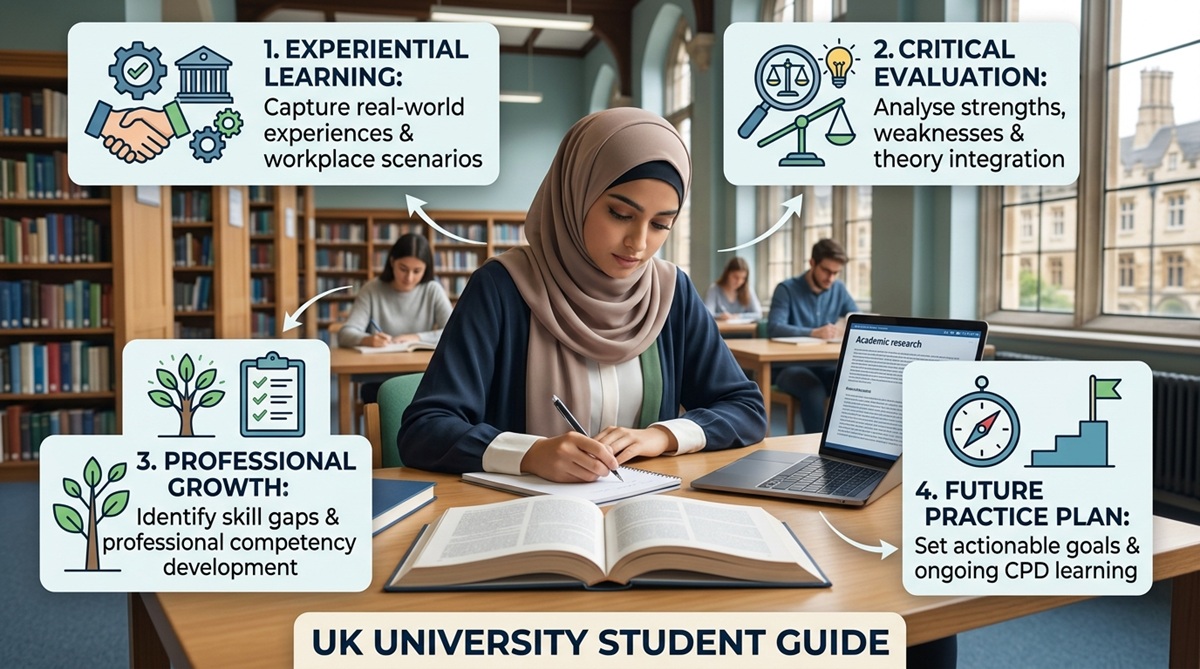
Subject-specific reflection should connect genuine experience with the theories, evidence and professional expectations relevant to the discipline.
Reflective practice nursing commonly examines clinical communication, patient-centred care, teamwork, professional development, ethical situations and placement learning. Examples of reflective writing in nursing may use a recognised framework to connect experience with evidence and future practice.
Healthcare students may also reflect on patient care, communication, teamwork and professional responsibilities. The emphasis should be on learning from practice while respecting confidentiality and linking reflection with appropriate evidence or professional standards.
Healthcare, medicine, public health and social work students may also need reflection connected with professional standards, safeguarding, ethics or practice development.
Reflect on communication, decisions and learning while maintaining confidentiality.
Connect reflection with relevant responsibilities and practice expectations.
Use evidence to examine the relationship between theories and practice.
Turn learning into realistic professional development actions.
Reflective writing is personal by nature. Academic guidance can help with planning, structure, reflective models, draft feedback, editing, proofreading and referencing, but the experience, interpretation and learning should remain genuinely yours. If your assessment specifies a reflective essay template, professional framework or university format, use that requirement as the basis for organising your work rather than forcing the reflection into a generic structure.
You are responsible for your final submission and for following your university's academic-integrity requirements. Where professional or clinical situations are discussed, protect confidentiality and follow the relevant institutional and professional rules. Self-assessment should focus on genuine learning, areas for development and realistic improvements rather than presenting an idealised account of the experience.
A structured process keeps guidance aligned with your assessment brief, reflective framework and learning outcomes.
Provide the brief, subject, academic level, word count, deadline, marking criteria and required reflective model.
The requirements are reviewed to identify the expected structure, depth of reflection, evidence and academic presentation.
Support is tailored to your subject, reflective task, academic level and assessment requirements.
Use the guidance to strengthen critical reflection, evidence links, learning outcomes and your action plan.
These subject areas commonly use reflective assessments, professional reflection, placement learning or reflective practice.
Support is adapted to the reflective format, subject, academic level, marking criteria and stage where you need guidance.
Work from the actual assessment instructions, learning outcomes and marking criteria.
Use Gibbs, Kolb or another reflective framework when your assessment requires one.
Connect relevant theory, research or professional standards with your reflection.
Move beyond description by examining assumptions, decisions, alternatives and implications.
Guidance can be adapted to undergraduate and postgraduate expectations.
Check structure, clarity, referencing, academic tone and presentation before submission.
The final quotation depends on academic level, subject, complexity, word count, deadline and the type of reflective support required.
per 250 words
per 250 words
Use the coupon below when placing your order to receive the current promotional saving.
Subject to the coupon’s validity and usage limits.
Read what customers have shared publicly about their experience with Online Academic Help. The summaries below are shortened for readability and linked back to the independent source.
Ratings can change over time, so we link directly to the public review profiles for the most current information.
United States · January 2026
Karla highlighted the nursing expertise and said she would recommend the service.
United Kingdom · September 2023
Mimi described the team as professional, quick to respond and flexible when changes were needed.
United Kingdom · July 2023
Esther praised the team for being kind, professional and willing to help with requested revisions.
United Kingdom · June 2022
Uchechi highlighted quick replies, polite communication and timely support.
Answers about reflective essay structure, reflective models, nursing reflection, critical analysis, academic references and action plans.
Request a QuoteReflective writing is an academic approach that examines an experience, response or learning process. It combines description with analysis, evaluation, insight and consideration of future development.
Begin with the context and focus, develop the main reflection through description and critical analysis, and finish by explaining the learning gained and its implications for future action.
Often, yes. A first person narrative is common because the writer is analysing personal experience. Always check your university brief because requirements can vary between modules.
Description says what happened. Reflection asks why it happened, how you responded, what influenced you, what you learned and what you might change in the future.
Your assessment brief should guide the choice. Gibbs can provide a structured event-based approach, whereas Kolb can be useful when the focus is experiential learning. Follow the model specified by your lecturer where one is required.
Many university reflective assignments require analysis to be supported with academic evidence, theories, policies or professional standards. Check the assignment brief and marking criteria to determine the required level of referencing.
Academic support can include structure, reflective models, critical analysis, evidence and presentation for nursing reflection. It should support learning and academic growth and should not substitute for clinical judgement or professional decision-making.
Ask why events happened, question your assumptions, consider alternative perspectives, connect the experience with evidence and explain the implications. Critical reflection should demonstrate development rather than simply narrate events.
An action plan should specify an area for development, the steps you plan to take, resources or support you may need and how you will assess improvement. Keep the actions realistic and related to the reflection.
Send your assessment brief, academic level, deadline, marking criteria and any required reflective model. Your requirements can then be reviewed to identify the most relevant type of academic guidance.
Provide your assignment brief, subject, academic level, word count, deadline, marking criteria, required reflective model and any draft already completed.