
Research Philosophy
Clarify the philosophical position underpinning the study and how it shapes methodological decisions.
Developing a defensible methodology requires more than choosing between qualitative and quantitative research. Our research methodology help supports UK university students in understanding research design, selecting appropriate methods, explaining methodological choices and connecting those choices to their research questions. Whether you are planning an undergraduate project, master’s dissertation or doctoral study, methodology decisions should follow a clear academic logic. We provide research methodology dissertation help, dissertation methodology help and thesis methodology help focused on research philosophy, sampling, data collection, analysis and methodological justification. Support can cover an epistemological position, ontological framework, ethical considerations, research validity and research reliability. The objective is to help you develop a methodology that is coherent with your topic, discipline and university requirements.
A strong research methodology guide should explain not only what methods are being used but why they are appropriate. Your methodology normally establishes the academic research paradigm, research philosophy, approach, design, population or data source, sampling process, data collection procedures and analytical strategy.
For primary studies, this can involve primary data collection through questionnaires, interviews, observations or experiments. Studies using existing evidence may instead require secondary data analysis or a systematic literature review framework.
Our research design and methodology guide support helps students examine whether each decision logically answers the research question. This creates a coherent scholarly inquiry framework rather than a disconnected description of methods.
Clarify the philosophical position underpinning the study and how it shapes methodological decisions.
Explain whether the study follows an inductive, deductive or other appropriate research approach.
Select and justify a design that can generate suitable evidence for the research question.
Identify the target population, sampling technique and rationale for sample selection.
Explain how interviews, surveys, observations, experiments, documents or datasets will be used.
Connect the analytical method to the type of evidence, variables, themes or research objectives.
Our research methodology assistance can help you understand positivism, interpretivism, pragmatism and other philosophical positions relevant to university research.
Students can explore how an inductive approach differs from deductive reasoning, how philosophy influences a research design, and why the chosen design needs explicit justification.
This research methodology framework help can also address a conceptual framework research help requirement where theoretical concepts need to guide variables, questions or interpretation.
Understand the assumptions that shape how knowledge is investigated.
Relate positivism, interpretivism, pragmatism or another position to the study.
Distinguish inductive and deductive reasoning and justify the selected approach.
Connect theoretical or conceptual concepts to variables, questions and interpretation.

A dissertation research methodology should create a transparent route from the research problem to the evidence needed to answer it. Examiners generally need to understand what you did, why you did it and what limitations follow from those decisions.
Our methodology chapter dissertation help and help writing dissertation methodology focus on this relationship. Guidance can examine research methodology formulation, the suitability of your methods and the strength of your methodological justification.
Attention is also given to methodological rigor. This includes explaining procedures sufficiently clearly, considering bias and limitations, and demonstrating why the selected methodology is appropriate for the proposed empirical study framework.
Keep the methodology connected to the central research problem and objectives.
Explain why each selected method is suitable for the evidence required.
Identify methodological limitations, possible bias and practical constraints.
Document procedures clearly enough to demonstrate a systematic research process.
Ensure practical research decisions support the proposed empirical study.
Support major methodological decisions with relevant research literature and disciplinary logic.
Qualitative research methodology help is suitable for studies investigating experiences, perceptions, behaviours, meanings or social processes. Guidance can cover interviews, focus groups, observations, case studies and document-based research.
Students can receive support with a suitable sampling technique, interview structure, coding and thematic analysis. Where multiple evidence sources are used, a triangulation method may strengthen interpretation.
Our qualitative methodology synthesis guidance helps connect research questions, participant selection, data collection and analysis into one defensible design.
Plan interview structure, participant selection and a defensible approach to gathering qualitative evidence.
Consider group composition, facilitation, ethics and how discussion data will be analysed.
Explain observational procedures, settings, researcher role and recording methods.
Develop a transparent process for coding qualitative evidence and organising categories.
Identify, interpret and report recurring themes and relationships within qualitative data.
Consider how multiple evidence sources can strengthen interpretation and research credibility.
Our research methodology tutoring is adapted to the academic level and methodological complexity of each project.
Understand core methodology concepts and apply them to a manageable university research project.
Design a manageable postgraduate study and establish clear links between objectives, methods and analysis.
Address advanced questions surrounding philosophy, originality, theoretical positioning, limitations and research design.
Use tutoring-style guidance to understand methodology concepts and apply them independently.
Relate methodology decisions to the brief, marking criteria and disciplinary expectations.
Build methodological understanding so you can justify your own research decisions clearly.
Quantitative research methodology help focuses on studies using numerical measurement and statistical analysis. Students may need guidance with hypotheses, variables, questionnaires, experiments, sampling and statistical procedures.
Support can include sample size calculation, survey design methodology, research instrument design and planning a suitable quantitative research strategy. Where appropriate, guidance may also cover quantitative data analysis and SPSS data analysis help.
The selected statistical approach should correspond to the research questions, variables, measurement level and characteristics of the dataset.
Define testable hypotheses that correspond to the research questions.
Clarify variables, measurement levels and how concepts will be operationalised.
Consider a defensible sample size and the assumptions behind the calculation.
Match statistical procedures to the design, variables and characteristics of the dataset.
Our thesis methodology help can address two decisions that frequently determine the quality of a study: how evidence will be obtained and who or what will provide it.
Data collection methodology help can examine interviews, surveys, observations, experiments, databases, documents and other data collection methods. The appropriate method depends on the research question and type of evidence required.
Sampling strategy methodology help covers probability and non-probability approaches, inclusion criteria, target populations and sample selection. Students should explain why a particular sampling strategy is suitable rather than merely naming it.
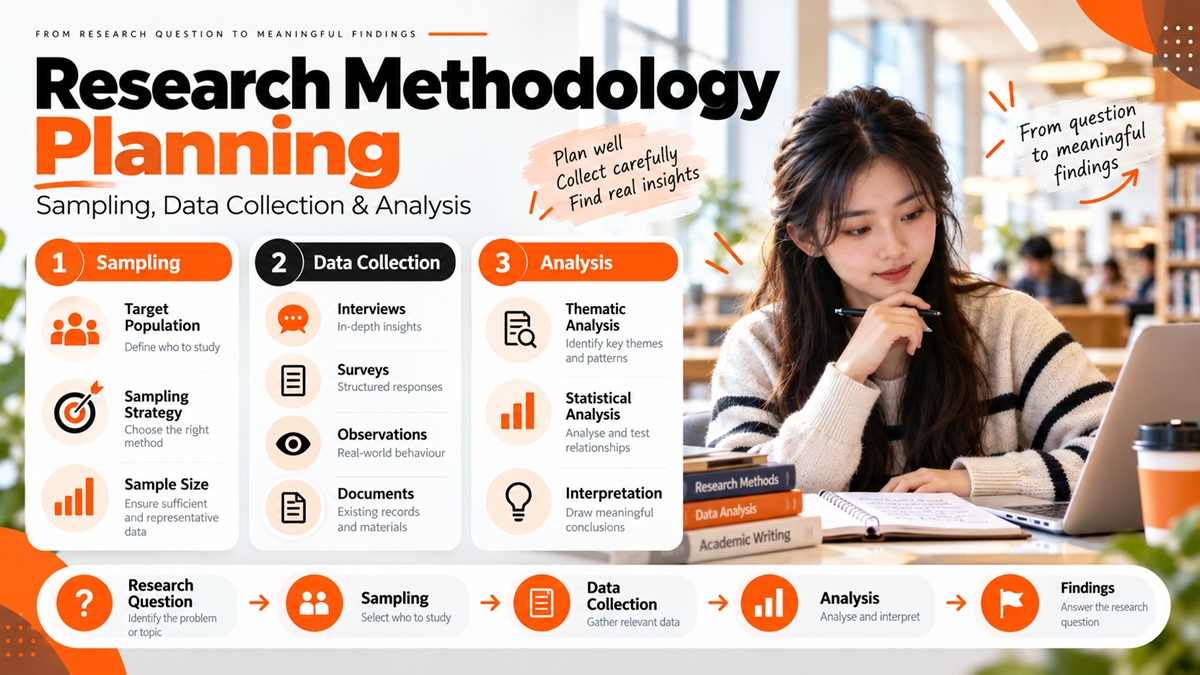
A defensible methodology explains what evidence is required, how it will be collected and why the sampling strategy is appropriate.
Plan questionnaire structure, response scales, sampling and subsequent analysis.
Align interview design, participant selection and analysis with the research question.
Explain observational settings, recording procedures and the role of the researcher.
Specify variables, controls, procedures and the evidence required to test hypotheses.
Justify probability or non-probability sampling and define inclusion criteria.
Evaluate existing databases, documents or datasets and explain their suitability.
Mixed methods methodology help supports projects combining qualitative and quantitative evidence. The central issue is not simply using two types of data but explaining why their integration improves the study.
Guidance can address sequential and concurrent designs, integration points, sampling decisions and triangulation. The resulting methodology should demonstrate how both components contribute to answering the same research problem.
Plan one phase of data collection and analysis to inform the next phase.
Explain how qualitative and quantitative evidence will be gathered within the same research stage.
Identify where findings from different methods will be connected or compared.
Explain how samples for different components relate to the overall research problem.
Use complementary evidence to strengthen interpretation and examine convergence or divergence.
Show how both forms of evidence contribute to answering the same research question.
Not every methodology task belongs to a dissertation. Research methodology assignment help can support university modules covering research philosophy, design, ethics, sampling, measurement and analytical approaches.
For students preparing a future study, research methodology proposal help can examine whether the proposed design is feasible and sufficiently detailed. This may include proposed participants, recruitment, instruments, analytical procedures and research ethics approval considerations.
Our methodology section writing help concentrates on structure, explanation and academic clarity so that methodological decisions are explicit rather than implied.
Understand philosophy, design, ethics, sampling, measurement and analytical approaches.
Evaluate whether the proposed research design is feasible and sufficiently detailed.
Clarify who will participate, how they will be recruited and why the approach is appropriate.
Plan questionnaires, interview guides, measures or other instruments suitable for the study.
Identify ethical issues and university approval requirements before data collection.
Present methodological decisions explicitly with a clear structure and academic rationale.
Academic methodology help can be adapted to the type of investigation being undertaken.
Case study research methodology help may cover case selection, boundaries, multiple evidence sources and analytical procedures. Empirical research methodology support can examine the practical relationship between research questions, observable evidence and analysis.
Methodology should also correspond with existing scholarship. Methodology literature review alignment helps establish whether the proposed methods are consistent with the research gap, theoretical basis and evidence identified in the literature review.
Explain why a particular case or set of cases is appropriate for the research purpose.
Define the scope, context and limits of the case study clearly.
Connect research questions to observable evidence and a suitable analytical strategy.
Relate methods to the research gap, theoretical basis and existing scholarly evidence.
Our research methodology consultancy UK support is learning-focused and can help students understand and improve key areas of research design and methodological reasoning.
Review research philosophy and paradigm selection in relation to the research problem.
Compare qualitative, quantitative and mixed-method designs and their suitability.
Develop sampling strategies and provide a defensible sample justification.
Plan research instruments, questions, response scales and data collection procedures.
Consider qualitative and quantitative analytical approaches appropriate to the evidence.
Address ethics, validity, reliability, trustworthiness and research limitations.
A methodology should explain how the study will generate credible evidence and how potential weaknesses will be managed. Depending on the design, this can involve validity, reliability, trustworthiness, transparency, reproducibility or triangulation.
Ethical considerations should be integrated into the methodology rather than treated as an afterthought. Research involving participants, personal data or sensitive topics may require informed consent, confidentiality procedures, data protection measures and formal university ethics approval.
The methodology should also remain aligned with the research questions, literature and analytical strategy. This alignment helps demonstrate that the evidence collected can genuinely address the original research problem.
The choice between qualitative, quantitative and mixed methods should be driven by the research question and the type of evidence required rather than by personal preference.
Qualitative methods are commonly appropriate when a study explores experiences, meanings, behaviours or complex contexts. Quantitative methods are useful when the research examines measurable variables, relationships, differences or hypotheses using numerical evidence.
Mixed methods can be appropriate when combining both forms of evidence provides a stronger answer to the research problem. In every case, the methodology should justify why the selected approach is more suitable than plausible alternatives.
Research methodology differs considerably between disciplines. A design appropriate for nursing may be unsuitable for finance, law or computer science. Our subject-specific support reflects the broad subject areas covered by Online Academic Help.
Support covers Accounting, Business & Management, Finance, Economics, Marketing, HRM, MBA, Project Management, International Business and Supply Chain Management. Common methods include questionnaires, interviews, organisational case studies, financial datasets, secondary company data, market research and mixed-method designs.
Guidance covers Law, Criminology, Politics, International Relations, Psychology, Social Work, Sociology and Education, including doctrinal analysis, policy analysis, interviews, surveys, experiments, observation and thematic analysis.
Support can cover clinical literature reviews, observational studies, epidemiological methods, laboratory designs, surveys, interviews and evidence synthesis, with particular attention to ethics, validity and reproducibility.
Methodological support can focus on experimental design, mathematical modelling, statistical testing, measurement, reproducibility and interpretation of quantitative evidence.
Support can cover experimental research, datasets, benchmarking, algorithm evaluation, system development and integration, usability testing and quantitative research, including justification of dataset selection and evaluation criteria.
Students may use simulations, laboratory experiments, mathematical modelling, prototype testing, measurements, optimisation or secondary technical datasets. Guidance can clarify variables, equipment, procedures and limitations.
Research can involve textual analysis, archival research, content analysis, interviews, surveys, case studies or mixed methods, depending on disciplinary conventions and the evidence being investigated.
Our university research methodology support helps students understand how each stage of the research process contributes to a well-planned research project. Before collecting evidence, researchers need to establish a suitable research approach, define the study objectives and determine which sampling method can provide relevant data.
Depending on the purpose of the investigation, descriptive research may be used to examine characteristics, behaviours or trends within a particular population. Previous research studies can also inform methodological decisions by showing which approaches have produced credible evidence in similar contexts.
A clearly organised methodology, reflected accurately in the table of contents, allows readers to follow the progression from the research problem and design through to data collection and analysis.
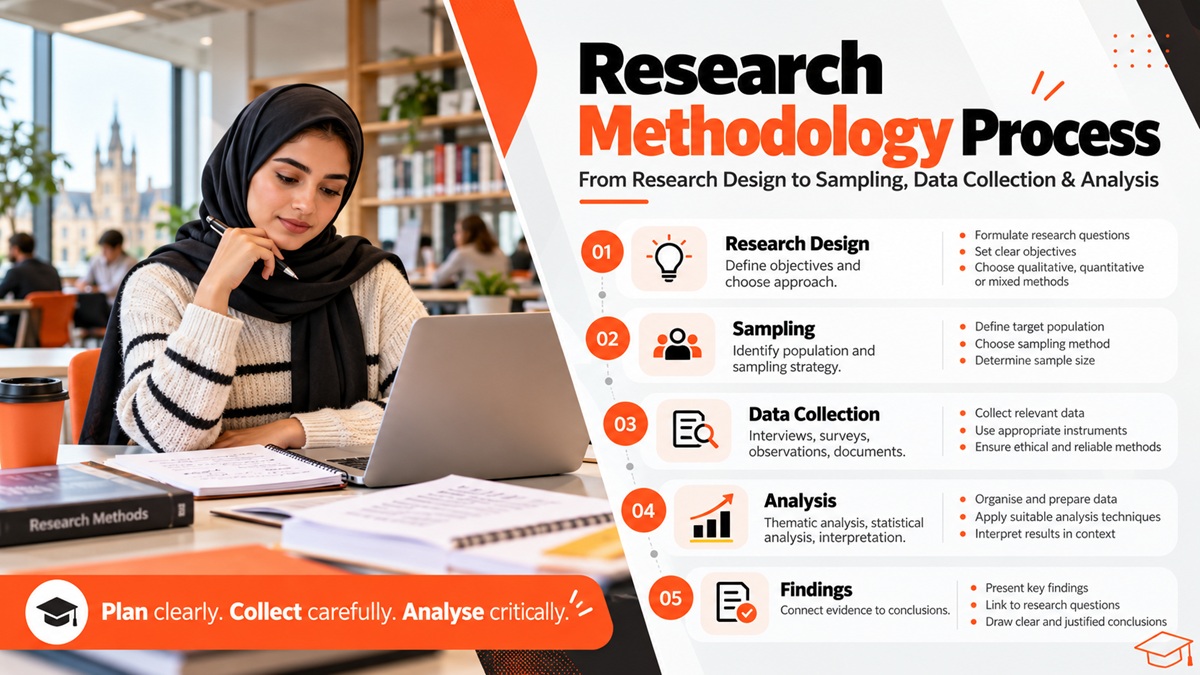
A clear research process connects the research problem, approach, sampling method, data collection and analysis in a logical sequence.
Define what the study is investigating and why the problem is academically relevant.
Select an approach that fits the study objectives and type of evidence required.
Identify who or what will provide the evidence and justify the selection strategy.
Explain the procedures used to obtain primary or secondary evidence.
Specify how qualitative or quantitative evidence will be analysed.
Organise the methodology clearly so readers can follow the complete research process.
Qualitative research methods can be particularly useful when a study aims to explore experiences, opinions, behaviours or complex social contexts that cannot be adequately represented through numerical data alone.
Interviews, focus groups, observations and document analysis can generate detailed evidence that researchers analyse to identify patterns, recurring themes and relationships within the data. The selected sampling method should match the research question and explain why particular participants, cases or sources are relevant.
Researchers must also consider reliability and validity when designing the study, collecting evidence and interpreting findings. Clearly documenting these methodological decisions makes the research process more transparent and helps demonstrate that conclusions are supported by an appropriate and systematically applied research approach.
Use interviews, focus groups, observation or documents to investigate complex experiences and contexts.
Analyse evidence to identify recurring themes, relationships and meaningful patterns.
Explain why particular participants, cases or sources are relevant to the research question.
Consider appropriate criteria for research quality, consistency, credibility and interpretation.
Document how data is collected, coded, interpreted and connected to the research objectives.
Show how conclusions emerge systematically from the evidence rather than from unsupported assumptions.
A methodology becomes convincing when every decision has a purpose. The research question should inform the design; the design should determine suitable evidence; and the analytical method should enable that evidence to answer the original question.
Our research methodology help provides structured academic guidance for students who need to clarify these connections, evaluate methodological options or improve an existing methodology draft.
Send your research topic, university brief, academic level, proposed methods and marking criteria for a review of the methodology areas where you need support.
The type of methodology support you need changes as your research develops. Early-stage work may focus on clarifying the research problem, philosophy, approach and design.
During proposal development, the emphasis may shift to feasibility, sampling, recruitment, instruments, ethics and a planned analytical strategy.
Once data collection is approaching or underway, support may focus on procedural clarity, research quality, limitations and how the analysis relates to the questions and evidence.
For a completed draft, methodology review can examine structure, justification, consistency, alignment with the literature and whether the chapter explains the research process clearly enough for the reader.
Clarify what the study needs to investigate and what evidence is required.
Select a coherent philosophical position, approach and research design.
Plan participant or data selection and the tools used to collect evidence.
Document ethical requirements and practical procedures before collecting evidence.
Match analytical methods to the research questions, variables, themes or evidence type.
Review justification, structure, limitations and alignment before final submission.
Research methodology tutoring, consultation, feedback and editing should support the student’s own academic work rather than replace responsibility for assessed research.
Students remain responsible for selecting and applying their final methodology, obtaining any required ethics approval, collecting data appropriately, interpreting evidence and submitting work that complies with their institution’s rules.
Any external methodology support should be used in accordance with university academic integrity policies, research ethics requirements and rules governing tutoring, editing and academic assistance.
The aim is to strengthen methodological understanding and help students make informed research decisions while remaining responsible for their own assessed work.
Methodology assistance should be based on your research question, academic level, university requirements, proposed methods and the stage of your project.
Provide your research topic, university brief, academic level, methodology draft, proposed methods and deadline.
Clarify whether you need support with philosophy, design, sampling, data collection, ethics, analysis or justification.
Assess alignment between the research question, literature, methodology, evidence and analytical strategy.
Use the guidance to strengthen your methodology while retaining responsibility for your final research decisions and submission.
These disciplines commonly require clear research design, sampling, data collection, analytical justification and discipline-specific methodological choices.
Support is adapted to your academic level, subject area, research question, methodology, university requirements and current research stage.
Start from the actual research problem, objectives and evidence required.
Connect methodology choices to the research gap, theory and existing evidence.
Consider qualitative, quantitative and mixed methods appropriate to the study.
Develop a defensible sampling strategy and clear inclusion or selection criteria.
Match analytical methods to the type of evidence, variables, themes and objectives.
Improve academic clarity and explain why major methodological decisions are appropriate.
The final quotation depends on academic level, subject, methodology complexity, research design, analysis requirements, word count, deadline and the type of support required.
per 250 words
per 250 words
Use the coupon below when placing your order to receive the current promotional saving.
Subject to the coupon’s validity and usage limits.
Read what customers have shared publicly about their experience with Online Academic Help. The summaries below are shortened for readability and linked back to the independent source.
Ratings can change over time, so we link directly to the public review profiles for the most current information.
United States · January 2026
Karla highlighted the nursing expertise and said she would recommend the service.
United Kingdom · September 2023
Mimi described the team as professional, quick to respond and flexible when changes were needed.
United Kingdom · July 2023
Esther praised the team for being kind, professional and willing to help with requested revisions.
United Kingdom · June 2022
Uchechi highlighted quick replies, polite communication and timely support.
Answers about research methodology, dissertation methodology chapters, qualitative and quantitative methods, mixed methods, sampling, surveys, literature alignment, ethics and requesting support.
Request a QuoteResearch methodology is the systematic rationale behind how a study is designed and conducted. It normally explains research philosophy, approach, design, sampling, data collection, analysis, ethics, validity and limitations.
A methodology chapter typically includes research philosophy, methodological approach, research design, population or data sources, sampling, data collection, analytical methods, ethics, validity or trustworthiness, limitations and justification for the major methodological decisions.
Methodology help can be adapted to UK undergraduate, master’s and doctoral levels, your university brief, marking criteria and your research topic.
The decision depends on the research questions and the evidence required. Qualitative methods are commonly used to explore experiences, meanings and contexts, while quantitative methods are used to examine measurable variables, relationships and differences using numerical data.
Mixed methods can be appropriate when a research problem benefits from both qualitative and quantitative evidence and the integration of both approaches adds value that one method alone would not provide.
Sampling depends on the research question, target population, research design and practical access to participants or data. The methodology should explain why a probability or non-probability approach is suitable for the study.
Yes. Guidance can cover survey objectives, question construction, response scales, sampling, pilot testing, validity, reliability and how questionnaire data will subsequently be analysed.
The literature review establishes the existing body of knowledge, research gap and theoretical context. The methodology should explain how the proposed study will generate appropriate evidence to address that gap or research problem.
This depends on your project and your university’s review processes. Research involving human participants, personal data or sensitive subjects commonly requires formal ethics review. Always follow your university’s procedures before collecting data.
Provide your research topic or question, academic level, university requirements, methodology draft if available, proposed research design, deadline and marking criteria. These details help identify the methodology areas where guidance is most useful.
Online Academic Help provides research methodology guidance for undergraduate, master’s and PhD research, including philosophy, research design, qualitative and quantitative methods, mixed methods, sampling, data collection, ethics, validity, reliability and analysis planning. Tell us your research topic, academic level, proposed methods and deadline so that support can be matched to your research requirements. You remain responsible for the final methodology and academic work submitted to your institution.