
Machine Learning Assignment Help
Classification, regression, clustering, feature engineering, evaluation metrics and transparent model comparison.
Get artificial intelligence assignment help with Python programming, neural networks, deep learning, computer vision, natural language processing and generative AI projects. Our AI assignment help UK guidance explains algorithms, debugging, experimental evaluation and technical reporting while supporting your independent coursework.
From artificial intelligence homework help to advanced university AI project guidance, explore core concepts, coding workflows and empirical evaluation. The aim is to build conceptual clarity and independently explain your own results.
Classification, regression, clustering, feature engineering, evaluation metrics and transparent model comparison.
Neural network layers, backpropagation, optimisers, regularisation and computational training workflows.
Python scripts, NumPy, pandas, scikit-learn, Jupyter notebooks, code refactoring and debugging.
Image classification, convolutional networks, image augmentation, object detection and error analysis.
Text preprocessing, sentiment analysis, tokenisation, entity recognition and transformer-based NLP.
Markov decision processes, agent-environment interaction, rewards, exploration and policy evaluation.
Python programming assignment help UK covers the foundations of building and testing artificial intelligence models. Work through data preparation, algorithm implementation, source code organisation, debugging and runtime efficiency.
TensorFlow assignment help online and PyTorch project help for students can explain tensors, training loops, gradient calculations and evaluation pipelines. We focus on understandable methods and verified results, not unexamined generated code.
Identify inputs, learning objectives, rubric grading and expected outputs.
Understand datasets, preprocessing, scaling and train-validation separation.
Trace architecture, loss functions, optimiser choices and training code.
Interpret metrics, inspect errors and document experiment settings.
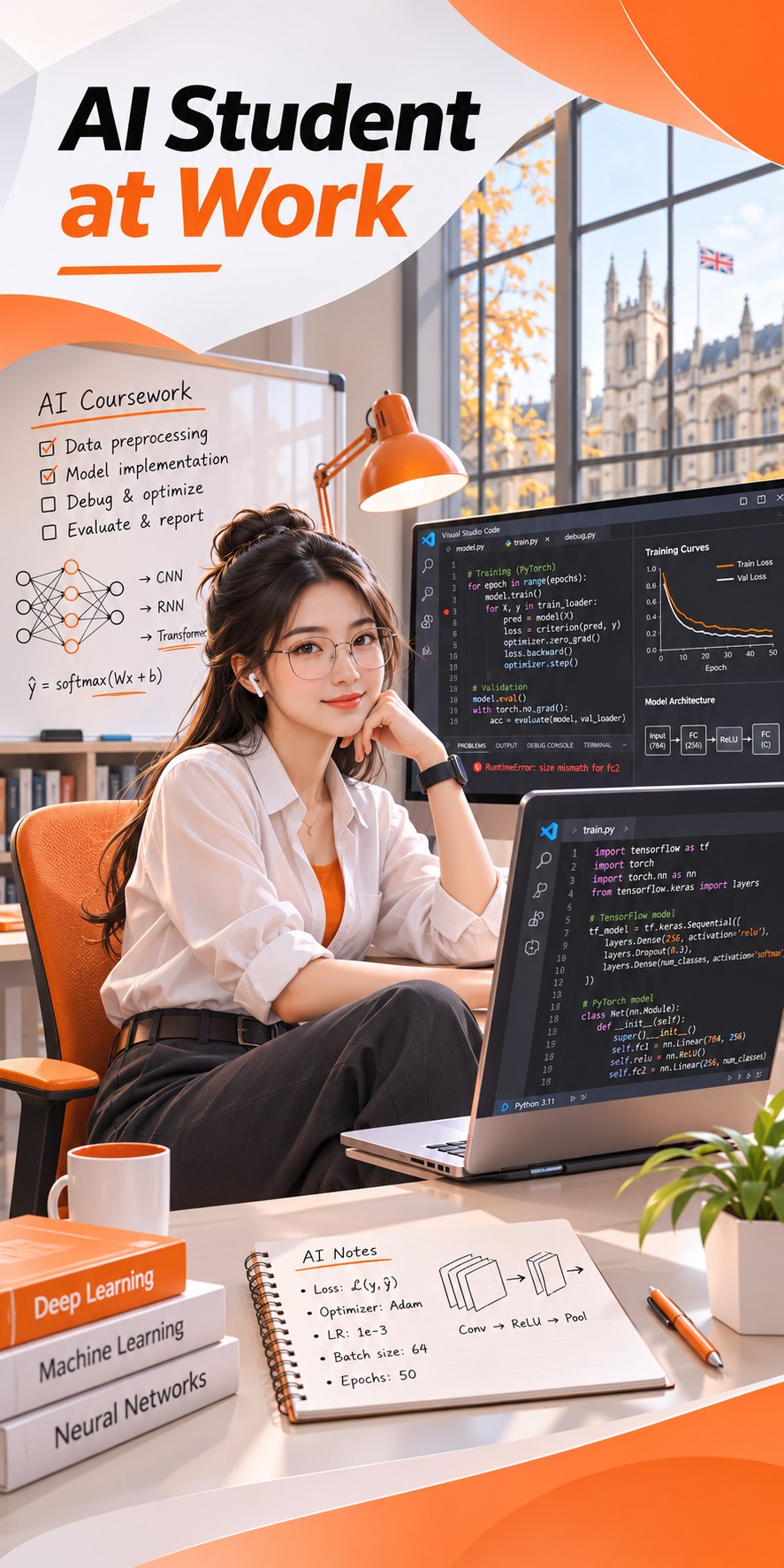
Share your Python error, neural network architecture or programming brief for clear debugging guidance and learning-focused feedback.
Effective computational thinking follows a structured problem-solving methodology. Translate the brief into a testable objective, choose suitable methods, validate outputs and explain the evidence behind each conclusion.
Identify university modules, grading rubrics, task constraints and required deliverables.
Define data, input-output requirements, assumptions and measurable success criteria.
Compare baseline algorithms, network architectures and appropriate evaluation techniques.
Implement in Python, run tests, inspect logs and refactor clearly.
Check generalisation, runtime efficiency, bias, error patterns and uncertainty.
Prepare concise technical documentation, citations, results and critical limitations.
Professional machine learning homework help and neural network assignment assistance focus on algorithmic reasoning, meaningful baselines and reliable experimental evaluation. Learn the principles behind models before interpreting their predictions.
Compare decision trees, support vector machines, ensemble methods, clustering and neural networks.
Understand activation functions, learning rates, batch sizes, optimisers and overfitting.
Interpret accuracy, precision, recall, F1, ROC-AUC, calibration and task-specific losses.
Select baselines, ablation studies and meaningful validation methods for research papers.
Evaluate CNNs, object detection workflows, classification errors and image dataset limitations.
Explore Q-learning, reward design, policy learning and experimental reproducibility.
Get guidance on training loops, TensorFlow, PyTorch, computer vision and how to explain your AI results.
NLP homework writing support can include practical instruction on text corpus preparation, language processing models, syntax parsing and evaluation. Test model outputs against annotated evidence and discuss limitations.
Compare rule-based and supervised sentiment classifiers, error classes and domain transfer.
Review sequence boundaries, subword tokenisation, part-of-speech tagging and parsing.
Understand entity spans, training annotations and precision, recall and F1.
Work with tokenisers, pipelines, text normalisation and linguistic features.
Learn attention mechanisms, embeddings, encoders and fine-tuning workflows.
Build baselines, inspect class imbalance and compare classifiers on the same test split.
Generative AI assignment help can cover large language models, transformer architecture, attention mechanisms and prompt engineering. Learn to describe the difference between model training, model fine-tuning and inference, and evaluate outputs systematically.
Retrieval-augmented generation (RAG) coursework explores document chunking, vector embeddings, vector databases, retrieval metrics and LLM deployment. Discuss model hallucinations, prompt injection, data privacy and source verification when reporting system performance.
Set instructions, task context and evaluation criteria transparently.
Understand vector similarity, indexing and source-grounded retrieval.
Compare parameter updates and task-specific adaptation with prompting.
Measure factuality, robustness, privacy risks and reproducibility.

Request guidance on experiment design, retrieval quality, prompt engineering, fine-tuning concepts and research reporting.
Artificial intelligence assignments include coding tasks, academic essays, literature reviews, research papers and dissertation support. Our approach emphasises credible peer-reviewed sources, independent reasoning and coherent documentation.
Develop hypothesis testing, baseline comparisons, ablation studies and reproducibility plans.
Structure literature reviews, research gaps, theoretical foundations and evidence-based discussion.
Improve topic outlines, technical terminology, arguments, academic citations and report clarity.
Discuss dissertation methodology, PhD-level research framing and experimental limitations.
Evaluate fairness, privacy, explainability, security and responsible model deployment.
Explore planning, sensors, optimisation, state representation and algorithmic reasoning.
Connect AI modules to foundational computer science, statistics, data analytics and information systems coursework.
Students searching for an AI homework writing service, artificial intelligence assignment writer, buy AI assignment help, online AI assignment helper, cheap AI assignment writing service UK or top-rated AI homework helper UK can request explanations and formative feedback. We do not promise plagiarism-free grades or submit assessed work on a student’s behalf.
Connect project deliverables to marking criteria without promising specific marks.
Explain models and computational decisions with step-by-step logic.
Check the correctness, limitations and reproducibility of AI-generated code.
Cite datasets, algorithms, libraries, papers and reused code according to university policy.
Remove credentials, private records, proprietary datasets and sensitive content before sharing.
Request scoped help early; urgent artificial intelligence assignment help depends on availability.
Share your brief, draft report, model evaluation, current code and rubric for a tailored support quotation.
AI tutoring and coursework feedback prices depend on academic level, model and coding complexity, required frameworks, report length and deadline. Project work may require a custom quotation.
per 250 words
per 250 words
Use the coupon below when placing your order to receive the current promotional saving.
Subject to the coupon’s validity and usage limits.
Read what customers have shared publicly about their experience with Online Academic Help. The summaries below are shortened for readability and linked back to the independent source.
Ratings can change over time, so we link directly to the public review profiles for the most current information.
United States · January 2026
Karla highlighted the nursing expertise and said she would recommend the service.
United Kingdom · September 2023
Mimi described the team as professional, quick to respond and flexible when changes were needed.
United Kingdom · July 2023
Esther praised the team for being kind, professional and willing to help with requested revisions.
United Kingdom · June 2022
Uchechi highlighted quick replies, polite communication and timely support.
Answers about Python, machine learning, TensorFlow, PyTorch, NLP, computer vision, RAG, generative AI, pricing and academic integrity.
Request a QuoteOur artificial intelligence assignment help offers concept explanations, Python debugging guidance, worked practice exercises, project planning, evaluation feedback and research support for university AI coursework.
Yes. We explain Python programming, scikit-learn workflows, model training, feature engineering, train-validation-test splits, performance metrics and reproducible code.
We can help you understand tensor shapes, neural network architecture, backpropagation, optimisation, regularisation and debugging in TensorFlow and PyTorch.
If you search for do my AI assignment or buy AI assignment help, our support is learning-focused. We explain methods and review your work; you should independently complete assessments in line with your university rules.
Yes. Topics include tokenisation, sentiment analysis, syntax parsing, named entity recognition, text classification, NLTK, spaCy and transformer-based NLP.
We explain transformer architecture, attention mechanisms, prompt engineering, GPT models, model fine-tuning, vector embeddings, RAG and evaluation of generated outputs.
Support can cover image preprocessing, CNN fundamentals, object detection metrics, reward functions, Markov decision processes and reinforcement learning evaluation.
We offer feedback on research questions, literature review structure, experimental methodology, baseline design, results discussion, citations and reproducibility for AI projects.
Yes. We can explain errors, review pseudocode, model pipelines, tests, data leakage and experiment logs, and suggest improvements for your own code.
Provide your brief, marking rubric, academic level, deadline, permitted tools, current code, sample errors and a description of your dataset. Remove API keys and confidential data.
Pricing and availability depend on the scope, complexity, required framework, academic level and deadline. Ask for a quotation; immediate turnaround cannot be guaranteed.
We encourage students to submit original work, cite datasets and model sources, verify generated outputs and follow their institution’s academic integrity and generative AI policies.
Share your AI coursework brief, Python or framework requirements, current code, permissible data description, marking rubric and deadline.