
APA Style Guide
Apply the assigned APA edition alongside your institutional guidelines.
Need help with APA 7 citations or your References page? Our APA referencing help supports UK students with author–date attribution, source details and academic paper formatting. Learn how to cite in APA for books, journal articles, websites and other sources. Get feedback on citation accuracy, reference list presentation and APA 7th edition formatting while preparing your own final work.
APA referencing help supports clear attribution, consistent citations and a reference list that readers can use to locate your evidence. Our guidance focuses on APA 7 and the requirements set by your institution.
American Psychological Association style covers more than a bibliography. It provides conventions for academic writing, source documentation and the presentation of a research paper.
Share your draft, assessment instructions and required guide for feedback on source details, citation matching and formatting. You retain responsibility for your analysis and final submission.
Apply the assigned APA edition alongside your institutional guidelines.
Match author–date citations with the intended source records.
Use source-specific examples to understand each entry’s components.
Check reference presentation and relevant paper-format requirements.
Confirm source existence, publication details and the evidence cited.
Understand corrections so you can improve future referencing.
To learn how to cite in APA, distinguish the citation within your writing from the fuller reference entry. The citation identifies the work; the reference helps readers retrieve it.
Record accurate author, date, title and source information as you research. Identify whether the material is a book, article, report, webpage or another source type.
Follow the publication manual and any assessment-specific directions. Keep citation details connected to the relevant claims as you revise.
Choose the APA reference category that describes the publication.
Record authorship, date, title and retrieval information where appropriate.
Add attribution where you use borrowed ideas or words.
Match retrievable works cited in the text with their reference entries.
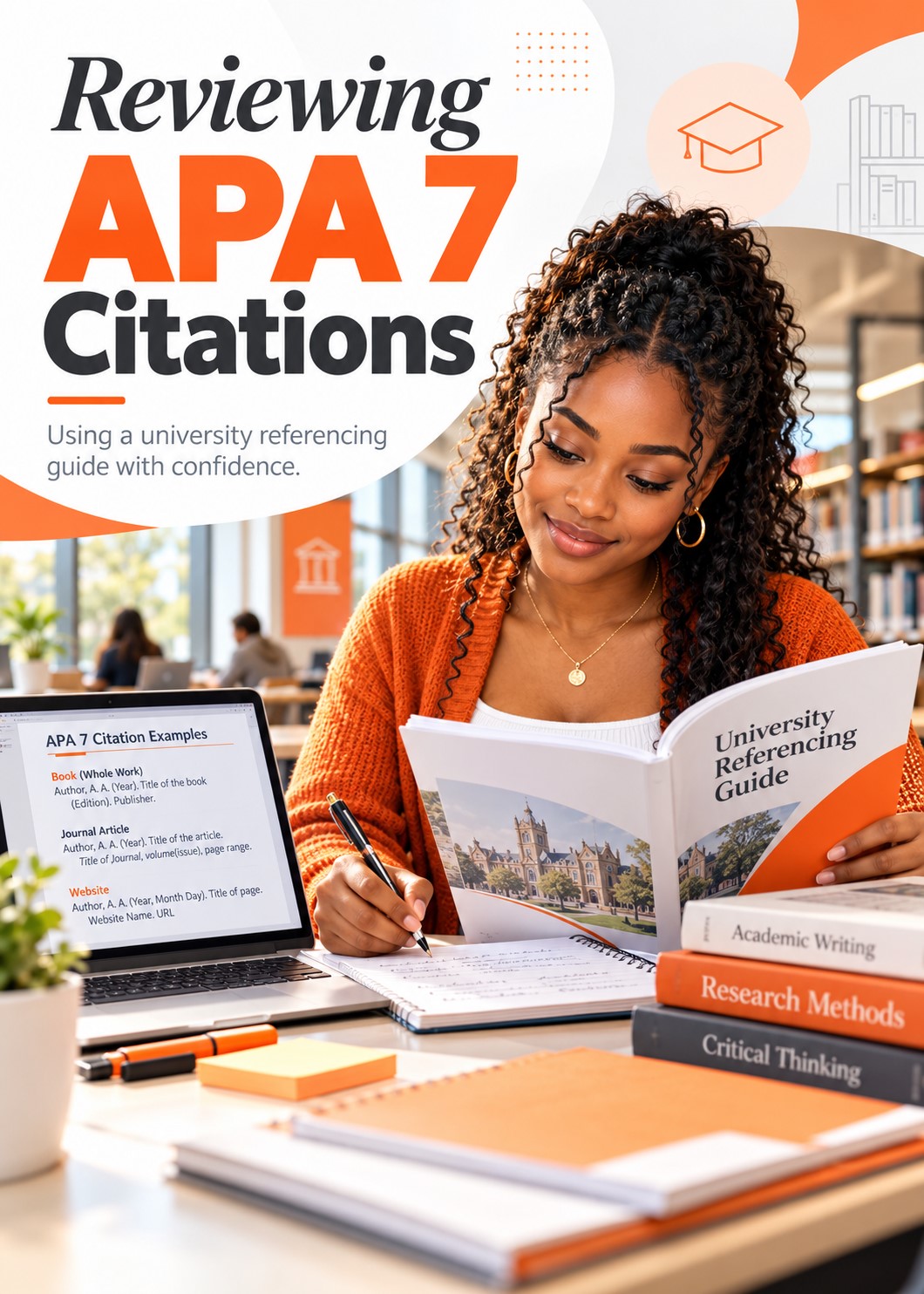
Check author–date citations and reference details against APA 7 and your assignment instructions.
An APA reference generator or APA citation maker can create draft entries from imported metadata. It cannot guarantee that the source is correctly identified or that every field is complete.
Check author order, dates, title capitalisation and the source category. A bibliographic database may export incomplete records or include details that do not belong in the final reference.
This page offers APA guidance and checking services; it does not contain a working generator.
Verify imported fields before using the generated entry.
Check that the citation points to the correct source.
Keep source records organised and review imports for accuracy.
Correct incomplete author, date, title and source fields.
Check which claim or passage a citation actually supports.
Confirm that the publication exists and is the version you consulted.
APA uses author–date citations. Narrative citations integrate the author into a sentence; parenthetical documentation places the identifying information in brackets.
A paraphrase still requires attribution. Direct quotations need a page number or another appropriate locator when pages are unavailable.
Keep textual evidence clearly connected to its source so readers can distinguish your argument from borrowed material.
For a placeholder example, Taylor (2023) introduces the author in the sentence.
A placeholder citation such as (Taylor, 2023) places author and year in brackets.
Include the required page or other retrievable locator.
Acknowledge ideas even when you express them in new wording.
Make it clear where the source-supported material begins and ends.
Use consistent author names and dates across text and reference entries.
APA paper format guidelines cover presentation as well as source documentation. Check whether you are preparing a student assignment or a professional manuscript.
Your dissertation APA style guide or institutional handbook may set additional requirements for chapters, front matter and submission. Confirm these before applying a general template.
Review the student title page and the information requested by your institution.
Organise sections around the assignment or research purpose.
Apply appropriate APA heading levels throughout.
Keep attribution accurate when comparing scholarly sources.
Check spacing, margins and page presentation using the assigned instructions.
Resolve assessment-specific formatting instructions with your supervisor or tutor.
Although students often search for APA bibliography format, APA papers generally use the heading References for the list of cited works.
The list should start on a new page, use a centred bold heading, be double-spaced and have 0.5-inch hanging indents. Apply APA 7 reference list order using the first element of each entry, usually the first author’s surname.
Review same-author and same-date ordering carefully. The name of the list and which sources belong in it are part of accurate scholarly communication.
Use the APA list heading rather than treating bibliography labels as interchangeable.
Alphabetise entries and apply additional rules for matching authors and dates.
Keep the first line flush left and indent subsequent lines by 0.5 inch.
Check the text against the reference list, allowing for APA’s exceptions.
Share your university guide and draft for practical feedback on citations, source details and reference list formatting.
Tailored guidance: Support follows APA 7, your assessment instructions and the sources in your draft. You verify corrections and prepare your own final submission.
An APA format website citation begins by identifying what the online material actually is. A journal article or report found on a website retains its own reference category.
For a webpage, verify the author or organisation, date, title and source information. Do not substitute a site-wide copyright year for a page’s publication date.
Under the retrieved from APA rule, retrieval dates are generally reserved for unarchived content designed to change over time. Do not add retrieval wording to every stable online source.

Identify the underlying source type and verify author, date, title and source information.
Identify the individual or organisation responsible for the page.
Use a meaningful publication or update date associated with the content.
Record the specific page rather than only its homepage.
Distinguish webpages from reports, ebooks and journal articles.
Check whether the content type requires a retrieval date.
Use the appropriate DOI or URL and verify its destination.
To understand how to reference a journal in APA, identify the article’s authors, date, title and journal publication details. Verify the volume, issue and page range or article number.
APA book citation format uses the book’s author, date, title and publisher, with edition or electronic-location details where appropriate. An edited chapter needs its own source-specific structure.
Record article and journal details from the original publication.
Check author, year, title, edition and publisher.
Distinguish chapter authors from book editors.
Use an available DOI in the prescribed link format and verify that it identifies the right work.
Select the category for the work rather than the device or file used to read it.
Use examples for the specific publication and retrieval context.
Multiple authors APA citation checks should distinguish the in-text author presentation from the author list in the reference entry.
Use the relevant APA 7 examples for two authors, larger groups and organisational authors. Check et al APA 7 rules and disambiguation where different works would otherwise shorten to the same citation.
Check the connector used in narrative versus parenthetical citations.
Apply the APA 7 shortened in-text author form and any ambiguity exceptions.
Follow the reference-list rules rather than copying the shortened in-text form.
Identify organisations accurately and introduce abbreviations where appropriate.
Use the prescribed suffixes to distinguish matching records.
Add the identifying detail needed to distinguish the intended sources.
Automated citation synthesis can produce a polished entry from incorrect source information. Check the underlying publication before accepting any output.
Style compliance verification and guideline adherence analysis are useful descriptions of systematic checks, not guarantees that a tool can verify the evidence or understand your argument.
Academic convention parsing and semantic reference formatting still need human review of source type, publication data and citation context. Our service explains corrections rather than offering an automated validator.
Check imported metadata against the original source.
Match the author–date citation with the correct full entry.
Select the APA format that fits the actual source category.
Ensure borrowed ideas and quotations have clear acknowledgement.
For a no author APA citation, first check whether an organisation is responsible. If no author can be identified, use the title in the author position as directed by APA.
For a no date APA reference, n.d. indicates that no publication date is available. Do not guess a year or use an unrelated website footer date.
Keep missing-data decisions consistent between the text and reference list and use the appropriate title presentation in citations.
Move the title into the author position when required.
Use a responsible group author when the publication identifies one.
Use the no-date notation when no reliable date is available.
Consult the APA instructions for a suitable description.
Order entries by the first element used in the reference.
Check the original source thoroughly before treating information as missing.
Secondary citation APA format applies when you know an original work through another publication. Consult the original source wherever possible.
When the original is unavailable, clearly identify the indirect relationship using APA’s as-cited-in approach. Include the source you actually read in the reference list.
Do not imply that you consulted an original publication if your knowledge comes only from a later author’s discussion.
A personal communication APA citation documents material readers cannot retrieve, such as a private conversation or email. It is cited in the text rather than added to the reference list.
Check whether the material is truly nonretrievable for your audience before classifying it. Research participant quotations have their own treatment.
APA footnotes may provide additional content or copyright information; they do not ordinarily replace the author–date citation system.
University referencing help UK should connect the assigned APA style with the actual source material used in your subject.
We review source identification and citation consistency across academic fields while following your assessment requirements.
Review research articles, assessment instruments and theory sources.
Check policy documents, studies and professional guidance.
Review reports, organisational authors and published research.
Check clinical publications and guideline references.
Document evidence from varied research designs and source types.
Identify datasets, software and technical publications correctly.
Apply the assigned format consistently across the project.
APA reference list examples work best when they show the source category and the role of each field. The following framework is illustrative and does not invent a real publication.
A basic book template contains author initials and surname, year, book title and publisher. A journal article template also needs the journal title and relevant volume, issue, pages or article number, plus an available DOI.
Use official source-specific examples to determine punctuation and italicisation rather than assuming that all entries share one template.
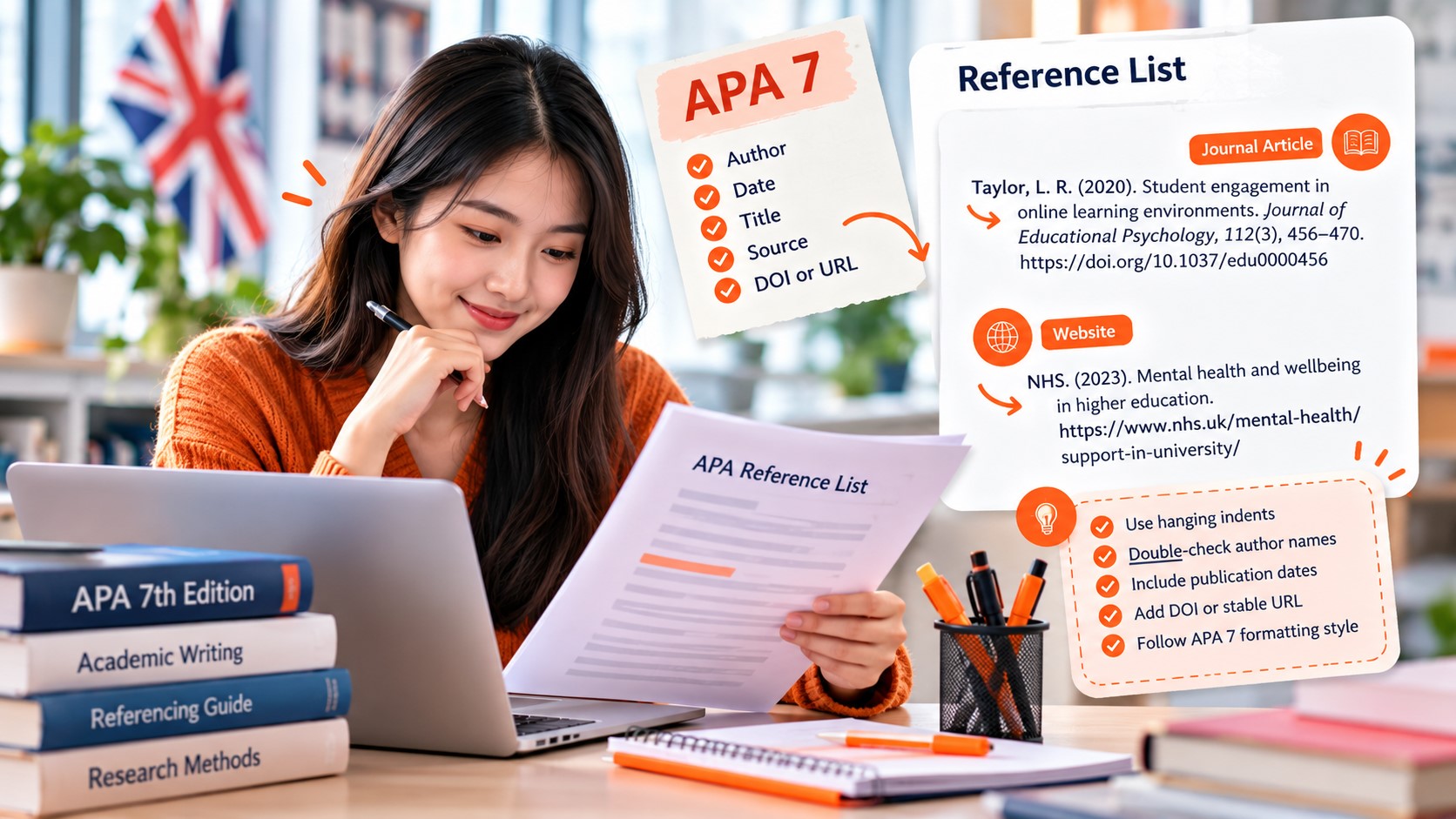
Review APA reference order, title styling and hanging indents before submitting your work.
Record the published author or responsible group.
Use the publication date appropriate to the source.
Apply sentence case or title case to the correct element.
Identify publisher, journal or other retrieval context.
Use electronic-location information where APA requires it.
Ensure the citation leads to this exact reference entry.
Capitalization in APA titles depends on the element being formatted. Article and book titles in reference entries use sentence case, while journal titles use title case.
Check proper nouns, subtitles and italics as well as the order of information. Apply syntax guidelines to citation wording without changing the source’s meaning.
Reference accuracy depends on both metadata formatting and consistent presentation. A correctly punctuated entry may still describe the wrong work.
Review article and book titles using the relevant APA examples.
Preserve the required capitalisation and journal identity.
Style the correct source elements rather than every title.
Check order, initials and separators.
Review brackets, page ranges and article identifiers.
Check link syntax and correspondence with the source.
APA block quote rules use a block format for quotations of 40 words or more. Begin on a new line, indent the block and omit quotation marks; retain the required citation and locator.
Before submission, check quotation accuracy, paraphrase attribution and reference matches. A plagiarism checker cannot establish that every citation is correct or every source supports its associated claim.
Send your draft, reference list and deadline to discuss the final referencing checks you need.
Urgent support: Shorter-deadline reviews depend on availability, source count and complexity. Share complete requirements early so the scope can be confirmed.
For a running head APA 7th edition check, first identify the paper type. Student papers do not need a running head unless the instructor or institution requests one; professional papers use the professional setup.
To apply a hanging indent APA Word format, select the references and use the paragraph settings to set a hanging indent of 0.5 inch. Use paragraph formatting rather than manual spaces.
Check structural formatting alongside the title page, headings and assessment-specific directions. APA table and figure formatting also requires consistent numbering, titles and notes, with source attribution where needed.
Include the information required for student papers and your course.
Use the professional header and title-page requirements when applicable.
Apply the indentation to complete reference paragraphs.
Use double spacing without extra space between entries.
Maintain a consistent hierarchy across the document.
Check paper presentation against APA and institutional instructions.
Academic integrity requires accurate attribution and honest representation of source material. Cite a paraphrase as well as a direct quotation.
Peer reviewed publications and other scholarly sources still require evaluation. Read the relevant material before using it as evidence.
Use reference management and feedback to improve your own work, following university rules on external support and AI use.
Share your assessment instructions, required APA guide and draft to receive a quotation for the checks you need.
Send your draft, source list, academic level and deadline.
Agree whether you need citation checks, reference formatting or paper-format guidance.
Review explanations of missing details, mismatches and style issues.
Apply corrections and confirm source accuracy before submitting your own work.
Explore support for source-specific referencing across your subject and academic level.
Our feedback connects APA conventions with your actual sources, institutional guidelines and requested scope of support.
Check references against the required edition and source category.
Understand why an entry or citation needs a correction.
Compare records with the publication you used.
Identify inconsistencies between the text and reference list.
Review layout and source presentation consistently.
Retain responsibility for your writing and assessed submission.
Get a quotation based on your draft, reference count, required checks and deadline. Scope and price are confirmed before work begins.
Send the referencing guide, source list and deadline so we can confirm the appropriate checks, price and availability. Shorter deadlines are subject to capacity and the complexity of your sources.
Starting rate per 250 words; APA reference checking is quoted by scope.
Get a quotation based on your draft, reference count, required checks and deadline. Scope and price are confirmed before work begins.
Starting rate per 250 words; urgent availability is confirmed with your quote.
Get a quotation based on your draft, reference count, required checks and deadline. Scope and price are confirmed before work begins.
Read what customers have shared publicly about their experience with Online Academic Help. The summaries below are shortened for readability and linked back to the independent source.
Ratings can change over time, so we link directly to the public review profiles for the most current information.
United States · January 2026
Karla highlighted the nursing expertise and said she would recommend the service.
United Kingdom · September 2023
Mimi described the team as professional, quick to respond and flexible when changes were needed.
United Kingdom · July 2023
Esther praised the team for being kind, professional and willing to help with requested revisions.
United Kingdom · June 2022
Uchechi highlighted quick replies, polite communication and timely support.
Consult the official APA Style guidance and your university instructions for detailed rules and examples. Online Academic Help is independent and is not affiliated with the American Psychological Association.
Answers about APA 7 citations, reference lists, generators, websites, quotations and paper formatting.
Request a QuoteAPA referencing help explains source attribution and reviews citations, references and relevant paper formatting against APA and your assignment instructions.
Yes, if your university permits it. Verify the source details and APA output manually. This page provides guidance and review rather than a working generator.
APA papers generally use a References page for cited sources. Use alphabetical order, double spacing and a 0.5-inch hanging indent, with APA’s source-specific rules and exceptions.
Record the authors, year, article title, journal title, volume, issue and pages or article number as applicable. Include an available DOI in APA link format.
Identify the actual source category first. For a webpage, check the author or organisation, date, page title and source details. Retrieval dates apply to certain changing, unarchived content.
A quotation of 40 words or more uses a separate indented block without quotation marks. Include the required author–date attribution and a page or other appropriate locator.
Student papers do not need a running head unless the instructor or institution asks for one. Professional papers follow the professional header setup.
Check for a responsible organisation before treating the author as missing. If there is no author, use the title as instructed. Use n.d. when no reliable publication date is available.
Nonretrievable personal communications are cited in the text, not in the reference list. Confirm the material’s accessibility to the intended readers before classifying it.
Send your required APA edition, assessment brief, draft or reference list, academic level and deadline through the quotation form or WhatsApp. We confirm the review scope and price.
Get a quotation based on your draft, reference count, required checks and deadline. Scope and price are confirmed before work begins.