
Harvard Style Guide Checks
Use the handbook assigned to your module rather than mixing examples from different variants.
Need to check your citations or organise a reference list? Our Harvard referencing help supports UK university students with author–date citations, source details and formatting against their institution’s assigned guide. Learn how to do Harvard referencing for books, journal articles, websites and ebooks. We review missing information, citation matches and formatting differences so you can verify and improve your own academic writing.
Harvard referencing connects an author–date citation in your text with a fuller entry in the reference list. Correct source details help readers trace the evidence behind your work.
Our Harvard referencing help focuses on the specific variant required by your university. There is no single Harvard format used identically by every institution.
Submit your draft and institutional guidelines for practical feedback on missing references, inconsistent author names, publication years and punctuation.
Use the handbook assigned to your module rather than mixing examples from different variants.
Connect each author surname and publication year with the intended reference.
Check completeness, ordering and consistent presentation.
Compare source material with original publications or publisher records.
Review imported details before relying on automatically created references.
Understand the corrections so you can apply them to future academic writing.
To learn how to do Harvard referencing, first find the university Harvard referencing rules assigned to your assessment. Identify the source type before choosing an entry format.
Record the author surname, publication year, title and source-specific publication details while reading. Add the appropriate citation where you use the source’s ideas or words.
Check the final reference list against the complete document. Every citation should identify the intended source, and each list entry should meet the task’s inclusion requirements.
Confirm the required Harvard variant and any module instructions.
Capture accurate authorship, title, dates and publication information.
Place attribution close to the claim, paraphrase or direct quote.
Match citations and references and resolve missing details.

Use your university’s Harvard guide to check citation details and reference list consistency.
A Harvard citation generator can create a draft entry from entered or imported details. It cannot guarantee that the record is correct or that the chosen variant matches your institution.
An online Harvard reference generator may misidentify a webpage as an article, import the wrong edition or omit an author. Verify the output against the source you actually consulted.
This page provides guidance and checking services; it does not contain a working reference generator.
Check the selected variant and source type before exporting.
Verify references even when the service is free and the output looks complete.
Confirm ordering and whether your task requires a bibliography or reference list.
Use automation for organisation while retaining manual source checks.
Treat fast results as draft entries rather than verified evidence.
Check imported fields and refresh the final list after editing.
Harvard in text citation rules usually identify a source by author and year. A narrative citation integrates the author into a sentence; a parenthetical citation places identifying details in brackets.
For a direct quote, include the page numbers or other locator required by your guide. A paraphrase still needs attribution even when you change the wording.
Use the author as part of the sentence and add the year as instructed.
Present the author and year in the format required by your variant.
Record the page or suitable alternative location of quoted words.
Acknowledge the source of borrowed arguments and findings.
Make it clear which claim each citation supports.
Check that author names and years correspond to list entries.
A long research paper may draw on many source types across its literature review, methodology and discussion. Referencing consistency needs to extend across all chapters.
Whether you are preparing an undergraduate assignment or dissertation, record source details early and keep citations attached to the claims they support.
Check attribution for theories, evidence and arguments.
Ensure descriptions of earlier research point to traceable publications.
Cite published frameworks, instruments and methods where appropriate.
Review source notes for borrowed data and adapted illustrations.
Keep names, dates and repeated references consistent.
Update references after revisions, removals and new citations.
Harvard reference list formatting depends on the assigned guide. Check alphabetical order, author presentation, title styling, punctuation and source-specific information.
A reference list generally includes cited works, while a bibliography may also include consulted material if the assessment requires it. Follow the brief for the correct heading and inclusion rules.
We help you structure bibliography entries accurately and format sources correctly without inventing missing publication details.
Sort entries using the author and secondary ordering rules in your guide.
Verify dates, editions, publishers and article details.
Apply consistent styling to equivalent source types.
Identify citations without entries and unexplained list items.
Share your university guide and draft for practical feedback on citations, source details and reference list formatting.
Tailored guidance: Support follows your institution’s required Harvard variant, source types and draft. You verify the corrections and prepare your own final submission.
To understand how to reference a website in Harvard, identify the specific page, responsible author or organisation, title and meaningful publication date.
Use the website example in your institution’s guide for URL and access-date presentation. Do not assume that a site-wide copyright year is the publication date of an individual page.

Identify the source type and verify authorship, dates and retrieval details before formatting a reference.
Use the author named for the material when appropriate.
Identify the responsible organisation if the page has no individual author.
Reference the exact page rather than only the website homepage.
Distinguish publication or revision dates from unrelated footer dates.
Apply the guide’s instructions for absent authors or dates.
Use stable links and the access information required by your style.
Different source types need different reference details. Referencing a book in Harvard style requires the correct edition and publisher; journal records need the article and journal information.
Citing an ebook Harvard style may involve a DOI, stable URL or platform details depending on the edition and your institution’s guidance.
Verify the author, title, publication year, edition and publisher.
Follow the guide for the electronic version you actually used.
Record article title, journal, volume, issue, page range or article number and DOI as applicable.
Distinguish chapter authors from the editors of the collection.
Verify the DOI against the intended publication and use the prescribed presentation.
Reference the underlying document type; PDF describes a file format.
If your question is “can someone check my references?”, share the complete draft as well as the list. Formatting checks alone cannot reveal every missing in-text reference.
Our feedback helps resolve referencing errors such as mismatched years, incomplete source records and inconsistent names. We explain how to correct punctuation in citations against your assigned guide.
Find cited sources that lack a corresponding entry.
Check surnames and organisation names against original records.
Compare citation dates with the edition or version used.
Separate duplicate imports from genuinely different works.
Review brackets, separators and locators using institutional examples.
Check consistent presentation alongside reference accuracy.
An AI citation assistant may help organise source records or suggest formats. It can also generate inaccurate titles, author names or publications that do not exist.
To automate referencing responsibly, verify each source against the original publication and check that it supports your claim. A polished entry is not proof of a reliable source.
Review reference manager tool imports for missing fields before applying your selected Harvard output style.
Locate the publication through a publisher or trusted catalogue.
Review author order, dates, titles and source classification.
Compare the generated entry with your university’s examples.
Check the relevant passage before using it in your work.
Multiple authors Harvard referencing rules vary between guides. Confirm how many names to show in the text and how many to include in the reference list.
Check et al formatting, author order and the rules for publications with the same author and year. Do not apply a rule from another Harvard variant by default.
Use the prescribed connector and name presentation.
Apply the guide’s threshold for abbreviated in-text authors.
Check whether full author lists or abbreviations are required.
Use the guide’s letter suffix and ordering rules when needed.
Keep organisational authors consistent across text and list.
Use one accurate source record consistently throughout the document.
Secondary referencing Harvard style applies when you discuss an original work through a source that quotes or describes it. Consult the original publication where possible.
If you cannot access the original, make the indirect relationship clear using your guide’s instructions. Do not imply that you personally read material you have not consulted.
Follow the institutional rules on which work belongs in the reference list and how the original author is named in the text.
In a footnote vs endnote comparison, footnotes appear at the bottom of a page and endnotes appear later in the document. Their permitted use depends on the required system.
Harvard generally uses author–date citations in the text linked to a reference list. Explanatory notes may still be allowed, but they do not automatically replace the required citations.
Harvard referencing can be used in different subjects when prescribed by the assessment. The required source details depend on the material cited.
Our guidance applies your institution’s citation style to the sources used in your own research.
Review company reports, market data and organisational authors.
Check technical papers, software documentation and datasets.
Review research articles, edited chapters and source attribution.
Check clinical publications, guidelines and institutional reports.
Confirm whether Harvard or a legal citation system is actually required.
Review editions, translations and primary source identification.
Maintain the assigned style across varied source types.
A basic illustrative Harvard referencing example is Taylor (2023) in a narrative sentence or (Taylor, 2023) in brackets. These are placeholder citations, not claims about a real publication.
The corresponding list entry needs verified details from the actual source you used. For quotations, add the page or other locator required by your guide.
Use this relationship to understand the system, then follow the precise punctuation and source-entry examples in your university handbook.
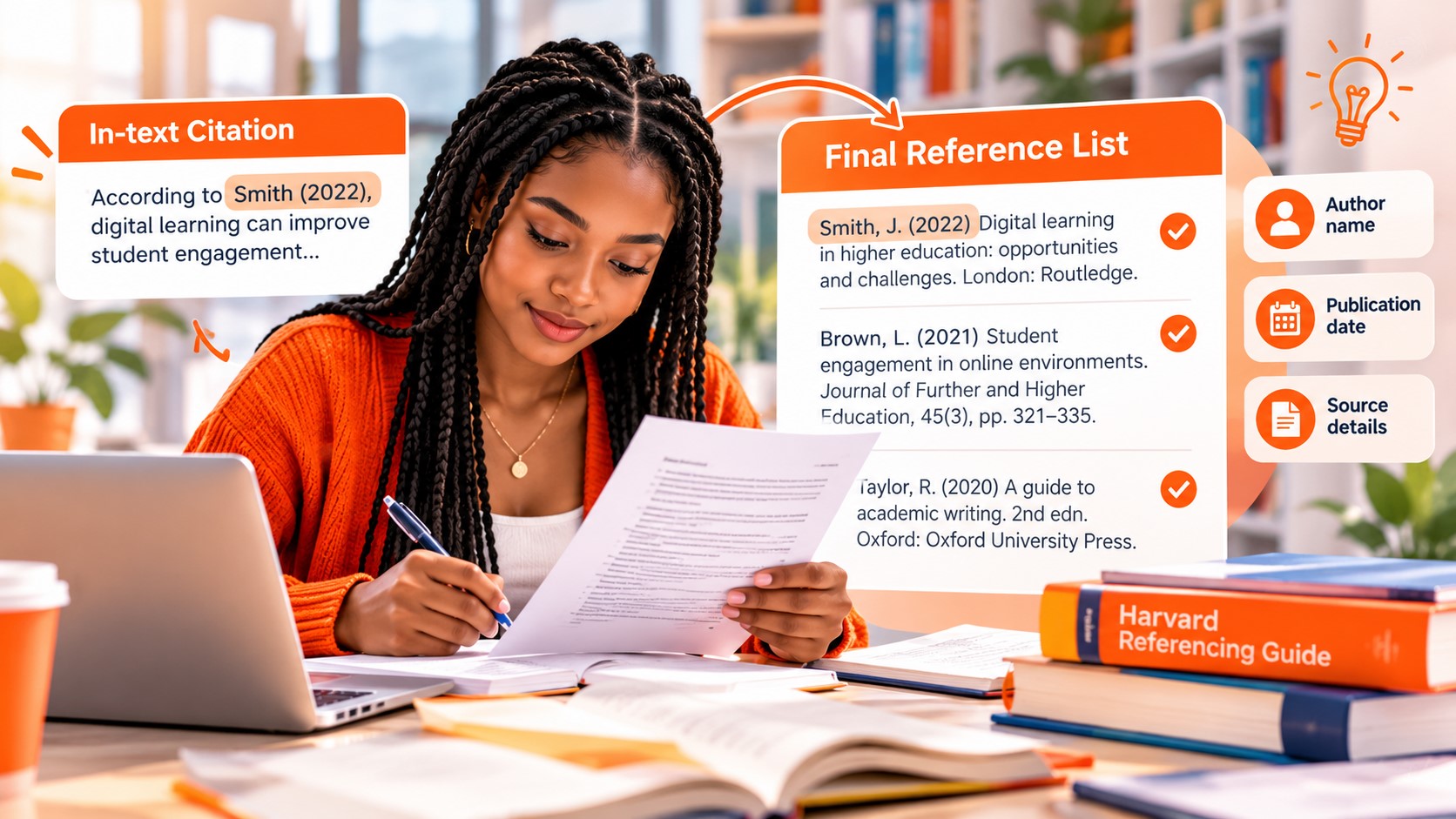
Cross-check every author–date citation with its complete source entry before submission.
Determine whether the material is a book, article, report or webpage.
Use verified authorship rather than a guessed name.
Check the relevant edition or publication date.
Place it close to the borrowed information.
Include the fields required for that source type.
Make sure the reader can connect the citation and reference.
Cite Them Right Harvard may be the variant prescribed by your institution. Check the version and any local amendments before using its examples.
Our support is independent and is not affiliated with Cite Them Right. We help students interpret the guide they have been assigned and apply it consistently.
A Harvard style guide is most useful when you select the example for the actual source type rather than copying a generic entry.
Use the guide named in the assessment instructions.
Review department or module requirements alongside general examples.
Choose the right example for the publication being cited.
Check author, year, locator and placement.
Confirm order, punctuation and source details.
Avoid combining conventions from different guides.
Compare every in-text citation with its source entry. Review quotations, paraphrases, captions, tables and appendices as well as the main text.
Check authors, publication years, page numbers, ordering, italics and links. Resolve unclear records before completing the final submission.
Send your draft, reference list and deadline to discuss the final referencing checks you need.
Urgent support: Shorter-deadline reviews depend on availability, source count and complexity. Share complete requirements early so the scope can be confirmed.
A Harvard referencing guide UK students use should match their institution’s requirements. Start with the university library’s referencing pages and your module handbook.
If you need a Harvard referencing PDF download, check whether your library provides an official downloadable guide. This page does not offer a PDF download or a free generator.
Use library advice and feedback to build referencing habits that support future assignments.
Locate the university’s current Harvard instructions.
Record the publication details while researching.
Save page or section locators with your reading notes.
Verify generated and imported reference data.
Seek guidance when no standard example fits.
Check citation accuracy after the last edit.
Accurate referencing acknowledges the origin of borrowed words, arguments and data. Changing the wording of a source does not remove the need to cite it.
A plagiarism checker may identify text overlap, but it cannot establish that every citation is correct or that each source supports your claim.
Use referencing feedback to strengthen your own work and follow your university’s rules on external support and AI use.
Send your university guide and draft so we can assess the reference checks you need and confirm a quotation.
Send the guide, draft or source list, academic level and deadline.
Agree the scope for source details, citation matching and formatting review.
Review explanations of missing data, mismatches and style corrections.
Apply corrections and check the final work against original sources.
Explore subject support for the source types and referencing needs in your university work.
Our feedback focuses on your assigned guide, the sources you used and clear corrections you can verify.
Apply the required university Harvard variant.
Understand the reason for each suggested correction.
Compare details with original publications.
Connect borrowed evidence with the correct source.
Review punctuation, ordering and equivalent source types.
Retain responsibility for your analysis and submission.
Get a quotation based on your draft, reference count, required checks and deadline. Scope and price are confirmed before work begins.
Send the referencing guide, source list and deadline so we can confirm the appropriate checks, price and availability. Shorter deadlines are subject to capacity and the complexity of your sources.
Starting rate per 250 words; reference checking is quoted by scope.
Get a quotation based on your draft, reference count, required checks and deadline. Scope and price are confirmed before work begins.
Starting rate per 250 words; urgent availability is confirmed with your quote.
Get a quotation based on your draft, reference count, required checks and deadline. Scope and price are confirmed before work begins.
Read what customers have shared publicly about their experience with Online Academic Help. The summaries below are shortened for readability and linked back to the independent source.
Ratings can change over time, so we link directly to the public review profiles for the most current information.
United States · January 2026
Karla highlighted the nursing expertise and said she would recommend the service.
United Kingdom · September 2023
Mimi described the team as professional, quick to respond and flexible when changes were needed.
United Kingdom · July 2023
Esther praised the team for being kind, professional and willing to help with requested revisions.
United Kingdom · June 2022
Uchechi highlighted quick replies, polite communication and timely support.
Answers about Harvard citation rules, generators, books, websites, multiple authors and reference lists.
Request a QuoteHarvard is an author–date referencing approach linking citations in the text with fuller source entries. Exact conventions vary, so follow your assigned university guide.
Identify the required variant, record the source details, add citations where you use the material and create matching reference entries. Review the final list against your document.
Yes, if your institution permits it. Verify the source details and compare generated output with the assigned Harvard guide before submission.
This page explains referencing and offers guidance and checking services. It does not include a working free generator or instant reference creator.
Identify the specific page, responsible author or organisation, title and publication date. Follow your guide for URLs, access dates and missing information.
Check your guide’s threshold for listing authors and using et al. Rules for in-text citations and full reference entries may differ between variants.
It describes referring to an original work through another source. Consult the original where possible; otherwise make the indirect relationship clear using your institution’s instructions.
Use it if your institution prescribes that variant, including any local amendments. Online Academic Help is independent and is not affiliated with Cite Them Right.
We can review citation matches, source details and punctuation against your assigned guide. Send your draft, reference list, university requirements and deadline for a quotation.
This page does not provide a PDF download. Check your university library for its official downloadable guide and share it with your request if available.
Get a quotation based on your draft, reference count, required checks and deadline. Scope and price are confirmed before work begins.