
Course Motivation
Explain why you want to study the chosen course using specific academic interests and experiences rather than broad statements.
Applying to university can feel simple until you reach the point where you need to explain why you are suited to a course. Our personal statement help is designed for UK and international students who need to present their motivation, academic background and preparation in a clear, relevant and convincing way. We can help you express your personal history, academic achievements, qualifications and career goals using evidence from your own experience. The focus is on identifying what you have genuinely achieved, selecting the details that support your application and structuring them effectively. For UCAS applications from 2026, applicants answer three personal statement questions rather than one continuous essay, with an overall limit of 4,000 characters including spaces and a minimum of 350 characters for each answer.
We help you understand and respond to the exact requirements of the UCAS application process. Personal statement guidance should therefore be structured around the application questions rather than treated as generic essay help.
The three UCAS questions ask you to explain why you want to study the subject, how your qualifications and academic experience have prepared you, and what you have done outside formal education to support your application.
Strong answers connect your motivation with relevant evidence. Instead of simply describing an activity, explain what you learned from it and how that learning connects with your chosen course.
The aim is to build a focused application that presents your own academic interests, preparation and experiences clearly while remaining within the required character limits.
Explain why you want to study the chosen course using specific academic interests and experiences rather than broad statements.
Connect qualifications, modules, projects, reading and other learning to the knowledge and skills required for the course.
Use work, volunteering, placements and relevant activities to show how you have prepared outside formal education.
Explain what an experience taught you and why the learning matters for your university application.
Organise evidence logically across the three UCAS questions while avoiding repetition between answers.
Keep examples focused on the course, academic potential and relevant skills rather than unrelated achievements.
A clear plan can help you decide which evidence deserves space before you begin writing. Useful planning areas include your reasons for choosing the course, relevant academic learning, work experience, volunteering, extracurricular activities, super-curricular engagement and the skills developed through those experiences.
Evidence becomes stronger when you explain its meaning. If a placement, simulation, research activity, book, project or course influenced your interest in the subject, explain what changed in your understanding and how that experience helped you prepare for further study.
A personal statement should not become a list of achievements. Your strongest examples are the ones that reveal academic engagement, relevant skills, reflection and a clear relationship with the course you want to study.
Planning also makes it easier to avoid repetition across the three UCAS questions and to reserve enough space for the evidence that best supports your application.
Identify the strongest evidence explaining why you want to study the subject.
Select study, projects and wider learning that show readiness for university-level work.
Choose work, volunteering and activities that add meaningful evidence rather than simply filling space.
Connect each example to a skill, insight or stronger understanding of your chosen subject.

When writing a personal statement, focus on evidence rather than opinion. Stating that you are passionate about psychology, law, nursing or another subject is less persuasive than showing how reading, projects, work experience, voluntary work or independent study developed that interest. Your personal experiences should support the reasons for choosing your course rather than appear as unrelated background information.
Your statement should show subject engagement, analytical ability and independent learning. Admissions teams already have access to your formal qualifications, so the personal statement should explain what your academic experiences reveal about your readiness for higher education.
Use examples to demonstrate how you think, what you have learned and how your preparation connects with the demands of the course. Rather than simply articulate passion, use substantive evidence to demonstrate motivation, subject enthusiasm and critical thinking skills.
Strong personal statements are specific enough to show genuine engagement while remaining concise enough to make effective use of the available characters. A clear academic profile, relevant qualifications and independent study skills can help admissions teams understand your academic suitability for higher education.
Show how reading, projects, lectures, competitions or independent exploration developed your interest.
Replace broad claims with examples that demonstrate academic preparation and relevant ability.
Explain how each experience affected your understanding, skills or future academic direction.
Show how previous learning and experience lead naturally to your chosen university course.
Keep your examples relevant to the course rather than treating the statement as a general biography.
Present academic potential in direct, readable language that sounds natural and remains easy to follow.
Good personal statement examples can demonstrate how applicants reflect on their experiences, organise evidence in a logical order and maintain an appropriate level of formality. The best personal statement examples UK applicants review should be used to understand structure, reflection and evidence rather than as wording to copy.
Examples should be used to understand technique rather than copied as templates. An application needs to reflect your own preparation, motivations and evidence. If wording is too similar to another statement, originality becomes a concern.
When reviewing UCAS personal statement examples, pay attention to how applicants connect experiences to the skills and knowledge required for the course. The useful lesson is the relationship between evidence and reflection, not the exact wording.
Your final statement should therefore remain personal, course-focused and grounded in experiences that you can genuinely discuss if asked during the admissions process. UCAS personal statement examples and personal statement conclusion examples can be useful for studying technique, but they should never replace your own reflection on experience.
Study how strong examples organise evidence and reflection without borrowing their wording.
Use your own reading, projects, work, volunteering and academic experiences.
Explain how each example supports the knowledge or ability required for your chosen course.
Write in clear language that reflects how you genuinely communicate and understand your experiences.
Our university personal statement help can be adapted to the subject specialisation, course requirements and application guidance provided by UK universities. For undergraduate admissions, review the course entry requirements, higher education entry requirements and your relevant qualifications before deciding which evidence deserves space.
Strong grades are more useful when they are contextualised. Applicants can discuss extended projects, reading, competitions, academic societies, online courses, volunteering, employment, extra curricular activities and super curricular activities when those examples strengthen the application. This evidence can also clarify course choice motivation and show how academic achievements connect with the intended programme.
For competitive courses, use academic and subject-related evidence to demonstrate genuine engagement beyond the standard curriculum. Avoid adding information simply because it sounds impressive; every point should strengthen the case for your chosen course.
Applicants to Oxford and Cambridge generally benefit from greater emphasis on academic exploration, analytical thinking and intellectual curiosity than on unrelated general achievements. For competitive university applications, an Oxbridge personal statement should connect wider reading, subject exploration and relevant evidence directly with the chosen course.
Masters personal statement help needs to reflect postgraduate expectations. Applicants should explain previous study, specialist interests, relevant experience and the academic or professional direction they intend to pursue.
A postgraduate personal statement can discuss modules, research interests, projects and dissertation topics, as well as professional experience when it is directly relevant to the programme. Postgraduate personal statement help should build a persuasive narrative around academic progression, specialist interests, career aspirations and long term career goals. Admissions teams are usually more interested in how these experiences support your next step than in the total number of achievements you can list.
PhD personal statement help may overlap with a statement of purpose or research proposal because the application can require evidence of previous research experience, specialist interests and readiness for independent research.
Oxbridge personal statement help should place strong emphasis on wider reading, independent subject exploration, analytical thinking and evidence of intellectual curiosity. Across these applications, the strongest statements explain why particular experiences matter and how they demonstrate progression.
Connect undergraduate study, specialist interests and relevant experience to the programme.
Explain academic progression, research interests and long-term academic or professional direction.
Prioritise subject engagement, wider reading, intellectual curiosity and analytical evidence.
Demonstrate research readiness, specialist interests and relevant dissertation or project experience.
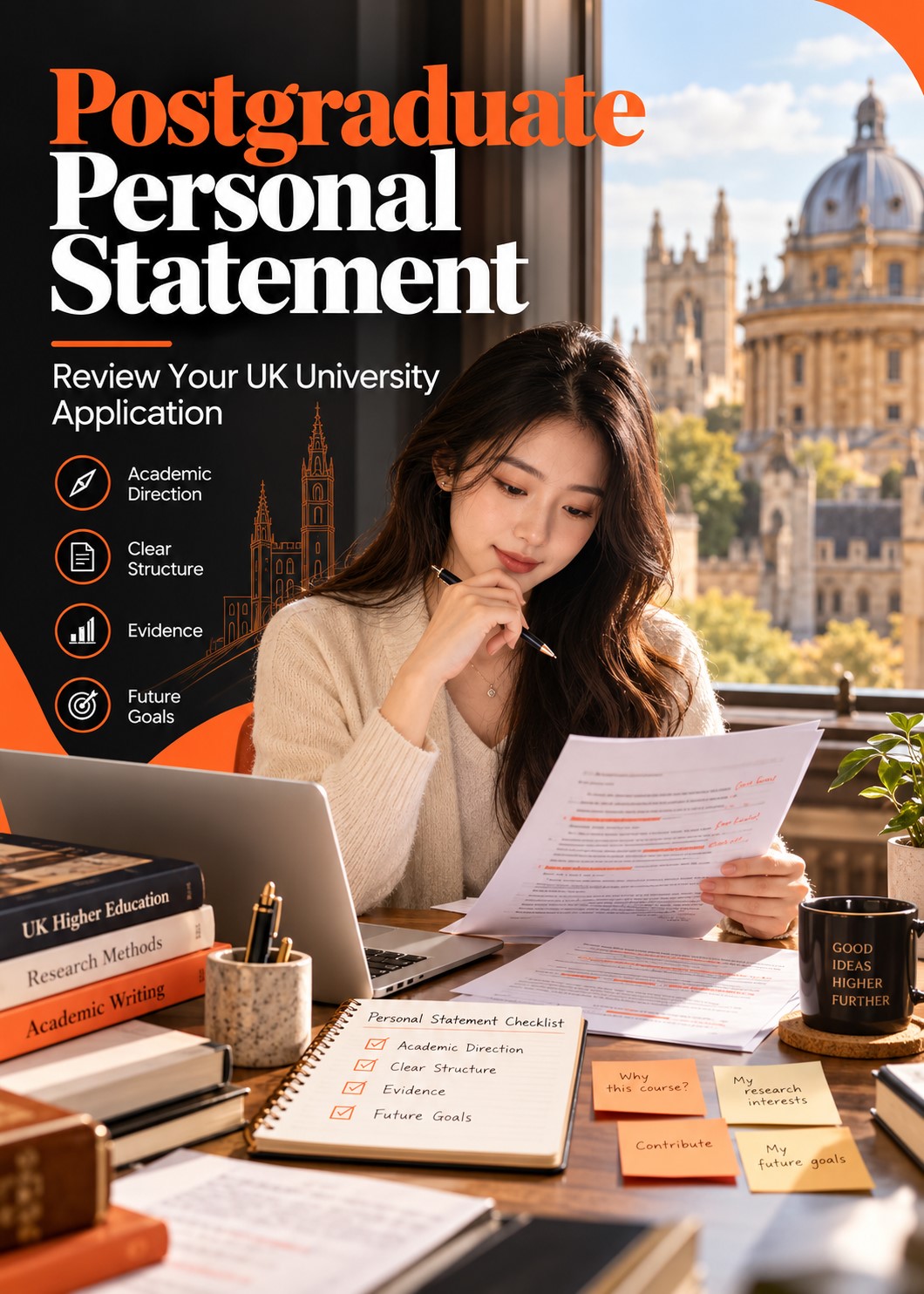
Spelling checks are useful, but a personal statement checker should do more than identify surface-level language errors. A strong statement checker should also assess relevance, structure, evidence and whether the applicant's personal experiences clearly support the chosen course.
A useful review should check whether the application explains motivation, includes relevant evidence, follows a logical structure and avoids unnecessary repetition. It should also assess personal statement opening lines, the strength of any compelling introduction, structural coherence and whether the complete response contributes to a holistic application.
The checker should also consider whether the statement remains within the required personal statement character limit, stays relevant to the chosen course and uses clear opening lines. Applicants asking how long should a personal statement be should focus on the current UCAS character allowance rather than a fixed essay word count. The final part should reinforce the applicant’s direction without repeating points already made.
A structured review can therefore help identify both language issues and application-level weaknesses before submission.
Check whether your reasons for choosing the course are specific and supported by evidence.
Review whether ideas are organised logically across the required UCAS questions.
Identify duplicated examples, claims or conclusions that use valuable character space.
Check that the final application remains within the overall UCAS character allowance.
Confirm that examples support the academic and practical expectations of the chosen course.
Review whether the ending reinforces your future direction without simply repeating earlier content.
Applicants should structure their evidence around the three UCAS questions rather than using the traditional continuous personal statement essay format.
The first question focuses on why you want to study the course or subject. The second asks how your qualifications and studies have prepared you. The third asks what you have done outside formal education and why those experiences are useful preparation.
Each answer should contain at least 350 characters, while the overall limit remains 4,000 characters including spaces. Applicants do not need to make each answer exactly the same length; stronger evidence may reasonably require more space in one section than another.
Effective structure means allocating space according to the quality and relevance of the evidence rather than trying to divide the character allowance equally.
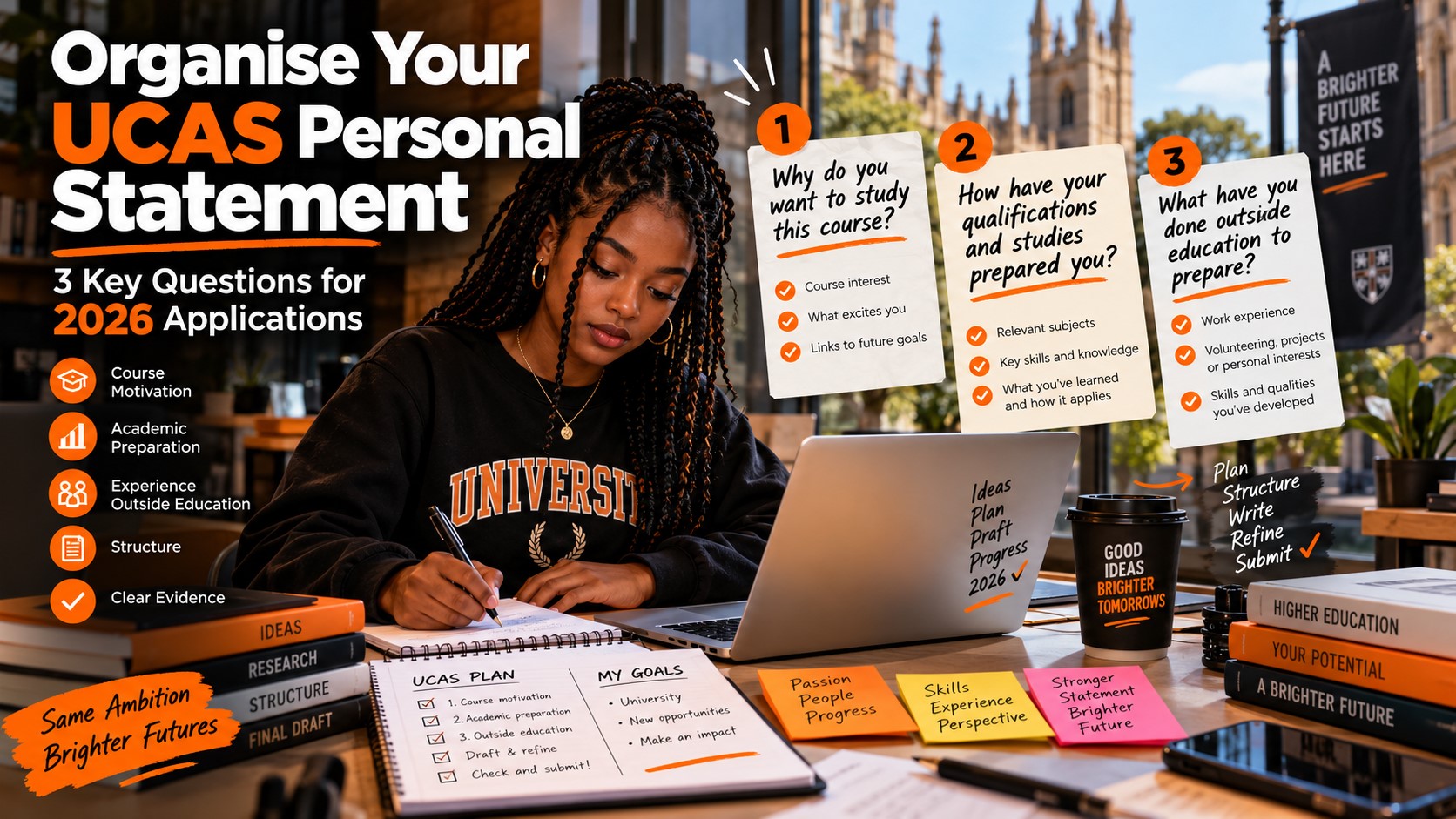
A clear UCAS plan helps applicants distribute evidence across the three questions without unnecessary repetition.
Our focus is on editing your personal statement rather than replacing your experiences or rewriting your application as if it were someone else’s work. Effective personal statement editing improves structural coherence, concise phrasing and the persuasive narrative of your own application.
Editing can identify unclear sentences, repetition, weak transitions, vague claims and long passages that use valuable space without strengthening the application.
A good edit also helps you assess whether your reflection is strong enough. Describing what you did is less useful than explaining what the experience showed, what you learned and why it matters for the course.
The aim is to make your own evidence clearer, more concise and more relevant while preserving the meaning and direction of your application.
Reduce unnecessary wording while protecting the strongest evidence and reflection.
Improve the connection between ideas so the application reads as a coherent academic narrative.
Identify places where an activity is described without explaining what it taught you.
Remove information that does not strengthen your suitability for the chosen course.
Preserve language that sounds like you while improving clarity and academic appropriateness.
Improve sentence-level meaning so admissions readers can understand your strongest points quickly.
A personal statement proofreading service UK applicants use should identify grammar, punctuation and spelling issues and improve consistency throughout the application while preserving the applicant’s own voice.
Personal statement feedback goes further by considering where an example is convincing and where additional explanation is needed. Feedback can review the opening, academic preparation, transferable skills, reflection on experience, institutional fit and whether the application contains enough substantive evidence.
A personal statement review service is particularly useful when you have a near-final draft but want to check whether it communicates your strengths effectively.
The review should keep your own experience at the centre of the application while helping you present that experience more clearly and precisely.
Check grammar, punctuation and spelling throughout the application.
Review tense, terminology, tone and presentation for a smoother final draft.
Identify where examples are strong and where reflection or explanation needs development.
Consider whether your evidence supports the expectations of the university course.
A clear personal statement outline helps applicants decide which evidence deserves space before they begin drafting.
Start by reviewing the requirements of your chosen course and identifying the academic interests, experiences and relevant skills that connect directly with it. For competitive university applications, avoid adding information simply because it sounds impressive.
A useful outline can separate academic preparation, subject-related activities, work or volunteering, and what you have done to prepare outside of education.
One of the most useful top tips is to connect every example with a clear outcome, such as knowledge gained, a skill developed or a stronger understanding of the subject. This approach helps produce a good personal statement that remains focused on specific university courses rather than becoming a general biography.
Start with the course requirements and identify the evidence that directly supports them.
Select reading, projects and subject exploration that demonstrate genuine engagement.
Connect each skill to a concrete experience rather than making unsupported claims.
Use employment, volunteering and activities where they show useful preparation for the course.
Explain the outcome of each example and what it changed in your understanding or ability.
Give more space to the strongest evidence and remove points that do not improve the application.
Understanding personal statement length UCAS requirements is important because applicants have limited space to present relevant evidence.
Rather than treating the available characters as a traditional essay word count, plan how much space each important example genuinely needs. Your strongest academic evidence and reasons for choosing the subject should usually receive more attention than general background information.
Ask whether each sentence helps explain how you prepare for this course, supports your academic interests or demonstrates relevant skills. Concise writing does not mean removing useful detail; it means removing repetition and replacing broad claims with specific evidence.
Before submission, review the complete response and remove information that does not strengthen the application. Effective space management helps communicate motivation, preparation and experience without forcing unrelated examples into a restricted format.
Applicants seeking Oxbridge personal statement help, postgraduate personal statement guidance or PhD personal statement help generally need to place greater emphasis on academic direction than on general extracurricular achievements.
For Oxbridge-related university applications, applicants can strengthen their case by discussing academic interests developed through wider reading, lectures, competitions, research or independent subject exploration.
Postgraduate applicants should explain how previous study and experience connect with the chosen course and their next academic or professional step. At PhD level, the statement may need to demonstrate research readiness, specialist interests and relevant skills gained through dissertations, research projects or professional work.
Across these university courses, strong statements do more than describe achievements. They explain why particular experiences matter and how they have helped the applicant prepare for the course or field of research.
Our personal statement help can be matched to the subject you plan to study. Online Academic Help covers 47 subject and qualification areas across seven main groups, allowing applicants to move from general admissions guidance to subject-relevant support. This includes medical school personal statement help, law personal statement help and nursing personal statement help where subject-specific expectations require careful evidence and reflection.
Support covers Accounting, Business and Management, Finance, Economics, Marketing, HRM, MBA, Project Management, International Business, Supply Chain Management, BTEC, CIPD and HND applications. Relevant evidence can include commercial awareness, analytical ability, leadership, numerical skills and career direction.
Guidance is available for Law, Criminology, Politics, International Relations, Psychology, Social Work, Sociology, Education and Early Childhood Studies. Law personal statement support can help applicants explain why they are studying law, connect reading and work experience with legal interests, and demonstrate analytical reasoning, argument and communication skills. Other social sciences may require evidence of research, observation and critical evaluation.
Support covers Nursing, Healthcare, Public Health, Medicine, Biomedical Science, Biology and Environmental Science. Nursing personal statement guidance should help applicants explain their interest in the nursing profession and reflect on work experience in healthcare settings, including what they learned about patient care, communication skills and patient centred practice. Medical school applicants can similarly connect relevant experience, academic preparation and career goals with the demands of medicine. Nursing and medical applicants should give particular attention to professional awareness, meaningful reflection and suitability for demanding study.
Applicants in Mathematics, Statistics, Chemistry and Physics can use evidence from problem-solving, competitions, laboratory work, extended study and independent subject exploration.
Guidance covers Computer Science, Information Technology, Data Science, Artificial Intelligence, Cybersecurity and Software Engineering. Strong evidence can include coding, technical projects, competitions and independent learning.
Mechanical, Civil and Electrical Engineering applicants can discuss technical projects, quantitative skills, design thinking, practical problem-solving and relevant academic exploration.
Support is relevant to English Literature, History, Media and Communication, Hospitality Management and Tourism Management, where reading, cultural engagement, research, communication and reflection can demonstrate academic suitability.
International students may need to explain their qualifications and experiences clearly because higher education systems differ between countries.
A personal statement review can help applicants understand UK university expectations and present academic evidence in a way that is easy for admissions teams to follow.
Applicants sometimes try too hard to sound formal. Strong personal statements are usually direct, readable and natural enough for the applicant’s personality and interests to remain visible. For students comparing higher education UK options, clarity is more useful than unnecessarily complex vocabulary.
The statement should explain academic background, preparation and motivation for the chosen course without relying on vocabulary that the applicant would not normally use or fully understand. This helps admissions teams assess the applicant’s academic profile and course choice motivation in context.

International applicants can strengthen clarity by explaining qualifications, preparation and motivation within the context of UK admissions expectations.
Be truthful when constructing your UCAS personal statement. Use real experiences that demonstrate your readiness for the course and give clear examples of what you learned.
Review the complete application to check for repeated examples and confirm that each point supports your decision to study the course. For work experience UCAS applicants should explain what they learned rather than only naming the role or placement.
Check the character allowance before submission. A UCAS personal statement builder can help organise the three responses and monitor the minimum and overall character limits. If you later consider the clearing process UCAS guidance and individual university requirements should still be checked carefully before making application decisions.
Before finalising, confirm that your strongest academic evidence has enough space and that general background information has not displaced more relevant course-focused content.
Use genuine experiences and evidence you can confidently discuss.
Check whether the same example or skill appears unnecessarily in multiple answers.
Confirm that each response meets the minimum and that the full application stays within the overall limit.
Remove general material that does not improve your suitability for the course.
Online Academic Help can assist with planning, reviewing, editing and proofreading if you have ideas but are having difficulty organising them, or if you already have a draft and need help improving it.
Provide your chosen course, academic level, application requirements and current draft if you have one.
The review can focus on structure, clarity, relevance, the strength of the evidence you present and how effectively you explain your suitability for the course.
The application should remain based on your academic journey and personal experience. Guidance is intended to help you communicate those experiences more effectively rather than replace them.
The type of support you need changes as your personal statement develops.
At the planning stage, you may need help identifying your strongest academic interests, relevant experiences and evidence for each UCAS question.
Once you have a draft, the focus shifts to structure, relevance, reflection, character limits and whether your examples communicate enough meaning.
Near submission, proofreading, consistency checks and final course-focused feedback become more useful.
The more information you provide about your chosen course, university requirements, academic background and current draft, the more accurately the review can be aligned with your application.
Identify the course expectations, UCAS format and any university-specific guidance.
Select academic preparation, experiences, relevant skills and activities that support the application.
Organise evidence across the UCAS questions while keeping the response focused and original.
Improve structure, reflection, clarity and the connection between evidence and course suitability.
Review grammar, punctuation, spelling, consistency and readability.
Check character limits, repetition, relevance and whether the complete application supports your intended course.
Personal statement guidance, feedback, editing and proofreading should help applicants communicate their own experiences and preparation more clearly rather than invent achievements, motivations or evidence.
Applicants remain responsible for the truthfulness of the information in their application, the experiences they describe and the final version submitted to UCAS or a university.
Examples should be used for learning rather than copying. Your final application should remain original and should reflect experiences, interests and goals that are genuinely yours.
Any external support should be used in accordance with UCAS guidance and the admissions requirements of the universities or programmes to which you are applying.
Personal statement assistance should be based on your chosen course, academic level, application format, existing evidence and the specific areas where you require guidance.
Provide your chosen course, academic level, university requirements, current draft and deadline.
Clarify whether you need planning, structure, feedback, editing, proofreading or a final review.
Assess motivation, academic preparation, experience, relevant skills, reflection, structure and character use.
Use feedback to strengthen the application while keeping responsibility for the final submission and its accuracy.
These subject areas commonly require applicants to explain academic motivation, course preparation, relevant experience and evidence of subject-specific skills.
Support is adapted to your chosen course, academic level, university requirements, application stage, evidence and existing draft.
Work from the actual expectations of your chosen course rather than generic personal statement advice.
Use qualifications, projects, reading and other learning to demonstrate preparation for higher education.
Connect work, volunteering and activities to relevant skills and meaningful preparation.
Move beyond activity lists by explaining what you learned and why each example matters.
Improve clarity, grammar, consistency and structure while preserving your own application voice.
Review the three-question structure, minimum response requirements and overall character allowance.
The final quotation depends on academic level, chosen course, application type, current draft, complexity, amount of editing or feedback required, word or character volume and deadline.
per 250 words
per 250 words
Use the coupon below when placing your order to receive the current promotional saving.
Subject to the coupon’s validity and usage limits.
Read what customers have shared publicly about their experience with Online Academic Help. The summaries below are shortened for readability and linked back to the independent source.
Ratings can change over time, so we link directly to the public review profiles for the most current information.
United States · January 2026
Karla highlighted the nursing expertise and said she would recommend the service.
United Kingdom · September 2023
Mimi described the team as professional, quick to respond and flexible when changes were needed.
United Kingdom · July 2023
Esther praised the team for being kind, professional and willing to help with requested revisions.
United Kingdom · June 2022
Uchechi highlighted quick replies, polite communication and timely support.
Answers about UCAS questions, character limits, medical and Oxbridge applications, postgraduate support, extracurricular activities, international applicants and editing your draft.
Request a QuotePersonal statement support can include planning, reviewing an existing draft, improving organisation, proofreading language and identifying where stronger evidence or reflection is needed.
Applicants for the 2026 and subsequent cycles are required to respond to three questions covering why they want to study the course, how their qualifications and studies have prepared them, and what they have done outside formal education to prepare.
The current overall limit is 4,000 characters including spaces. Each of the three answers must contain at least 350 characters.
Examples can show how applicants connect evidence to future aspirations, but the exact wording should not be copied. Your response should remain original and based on your own experience.
Yes. Medical applicants can receive guidance on structure, reflection, academic motivation, relevant experience and how individual examples demonstrate suitability for the course.
Yes. Oxbridge applicants can receive guidance on academic engagement, wider reading, analytical skills, subject-related evidence and other areas relevant to their application.
Yes. Support can be adapted for Master’s, postgraduate and PhD applicants and may consider previous study, research experience, professional experience and future plans.
Include extracurricular activities when they demonstrate a relevant skill, insight or preparation for the course. Focus on what you learned or developed rather than simply listing the activity.
Yes. A review can consider clarity, structure and how effectively an applicant presents academic evidence and explains their motivation for studying in the UK.
Yes. When you provide your course and application details, we can review your statement for clarity and advise on how to express your ideas, experiences and motivation in an academically appropriate way.
Online Academic Help provides personal statement guidance for undergraduate, Master’s, postgraduate, Oxbridge and PhD applications, including UCAS planning, course-focused evidence selection, personal statement outlines, draft review, feedback, editing, proofreading and final character-limit checks. Tell us your chosen course, academic level, application requirements, current draft stage and deadline so that support can be matched to your application. You remain responsible for the accuracy and final version of your university application.