Students grasping strategic management models is crucial for UC assignments, analyzing business contexts, and resolving case studies. The models help students deal with the inner workings, the outer interactivity, and the competition on an advanced level. This instructional piece breaks down the models into easier terms relevant to the context.
What Are Strategic Management Models?
These models offer analysis, opportunity and risk assessment, and guidance towards future decisions of the business world. They teach students how to gain a competitive edge, optimize organizational performance, and react to shifts in the market.
Why Strategic Models Matter for Students
Pragmatic methods and tools are made available through the models of the business world. Models help students identify and articulate real-life business issues.
- Lends to better structured and concise academic answers
- Strengthens critical thought and decisive analysis
- Strengthens the evaluative and analytic aspects of case studies
- Strengthens the grasp of business constructs
- Finally, organizes thoughts and resolves issues
These models are found in almost every business-based academic institution in the UK and around the world.
Key Strategic Management Models List
A common request from students is a clear key models list so they know exactly what to revise for exams and assignments
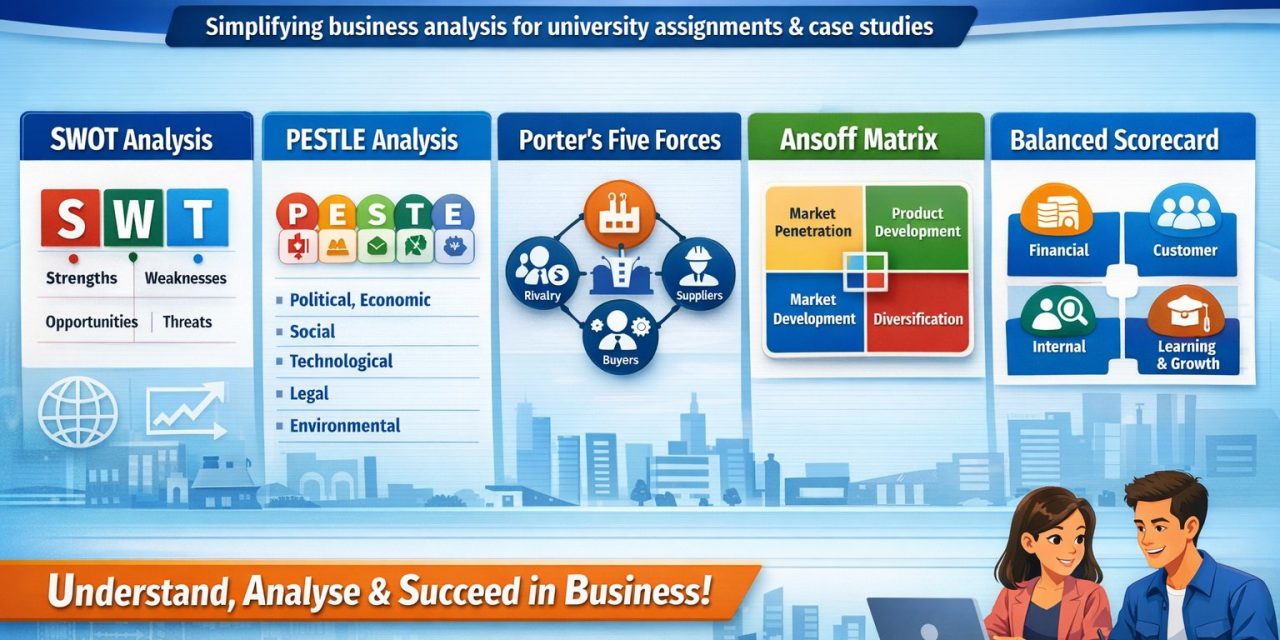
- SWOT Analysis
- PESTLE Analysis
- Porter’s Five Forces
- Ansoff Matrix
- Balanced Scorecard
- VRIO
These are the most common examples of strategic management frameworks in both theory and practice.
1. SWOT Analysis (Simple and Powerful)
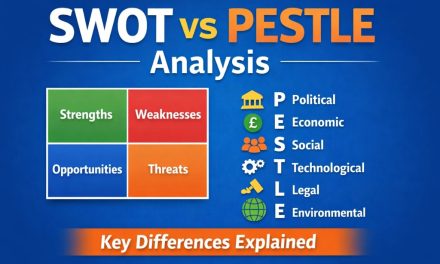
SWOT Analysis is a strategic technique to assess a company’s Strengths, Weaknesses, Opportunities, and Threats.
SWOT is a common technique in beginner strategic management models.
These are the components of SWOT Analysis:
- Strengths (Internal advantages)
- Weaknesses (Internal limitations)
- Opportunities (External growth factors)
- Threats (External risks)
UK Example
Aldi is a competitor of Tesco. Tesco uses SWOT Analysis to assess both online shopping (opportunity) and rising operational cost (weakness).
Why students should use SWOT Analysis:
- Easy to use in assignments
- Gives a complete picture
- Can be used in combination with several other models
2. PESTLE Analysis (External Environment Focus)
PESTLE Analysis focuses on the external macro-environmental factors that affect a business.
This model is essential in strategic planning models because it allows for a focus on external factors.
Factors:
- Political (Government policies)
- Economic (Inflation, interest rates)
- Social (Consumer behaviour)
- Technological (Innovation, AI)
- Legal (Regulations)
- Environmental (Sustainability issues)
Example of the UK:
A UK healthcare organisation like the NHS takes into account the following factors:
- Political (Funding policies)
- Economic (Budget constraints)
- Technological (Digital health)
Value for the Students:
- Provides an understanding of external factors that influence the organisation
- Provides support for research-based responses
- Integrates easily with SWOT analysis
3. Porter’s Five Forces (Competition Analysis)
Porter’s Five Forces model examines the industry’s competitiveness and profitability of the market.
It is one of the most used models of strategic management in business management assignment.
The Five Forces:
- Industry rivalry
- New entrants
- Supplier’s bargaining power
- Buyers’ bargaining power
- Substitutes
Example of the UK:
In the UK Telecom sector:
- Providers have High rivalry
- Consumers have High bargaining power
Why students need it:
- Enhances analysis of an industry
- Enhances answers to the provided case study
- Clearly outlines the market structure
This model is one of the most fundamental for strategic management for beginners.
4. Ansoff Matrix (Growth Strategy Model)
Porter’s Five Forces model examines the industry’s competitiveness and profitability of the market.
It is one of the most used models of strategic management in business.
The Five Forces:
- Industry rivalry
- New entrants
- Supplier’s bargaining power
- Buyers’ bargaining power
- Substitutes
Example of the UK:
In the UK Telecom sector:
- Providers have High rivalry
- Consumers have High bargaining power
Why students need it:
- Enhances analysis of an industry
- Enhances answers to the provided case study
- Clearly outlines the market structure
This model is one of the most fundamental for strategic management for beginners.
5. Balanced Scorecard (Performance Measurement)
The Balanced Scorecard considers business performance in both the financial and non-financial domains.
For execution, it wraps up the easy guide to strategic management frameworks.
Perspectives:
- Financial
- Customer
- Internal processes
- Learning and growth
UK Example:
A UK university may measure:
- Student satisfaction
- Operational efficiency
- Financial performance
- Staff development
Why it is important:
- Links strategy to outcomes
- Helps in improving evaluative skills
- Very important for higher level assignments
6. VRIO Framework (Internal Resource Analysis)
VRIO framework is a model of strategic management that analyzes the organization’s internal resources and capabilities to identify if they yield a sustained competitive advantage.
The VRIO model is a classic in the examples of strategic management frameworks and its reason is that it internalizes external opportunities and focuses on internal strengths.
What Does VRIO Stand For?
The VRIO framework analyzes resources based on four key questions:
Value: Does the resource help the company be more efficient, save money, or add value to customers?
Rarity: Does the resource have value unique to the company and not available to its competitors?
Imitability: Is the resource easy to imitate or replicate?
Organisation: Is the company designed to take full advantage of the resource?
How VRIO Works (Simple Explanation)
- A resource offers competitive advantage when all four questions are positive:
- If value, but not rare, the resource leads to competitive parity
- If the resource is valuable and rare, the advantage is temporary
- If hard to imitate the advantage is strong
- If the organisation is fully engaged the advantage is sustained
This makes VRIO one of the most practical models of strategic management with examples for internal analysis.
UK Example (Tesco)
Tesco offers a good real world example of the VRIO framework:
Value: Sophisticated supply chain systems save costs and improve efficiency
Rarity: Clubcard data offers unique views of customers
Imitability: Competitors find it hard to match Tesco’s data and scale
Organisation: Adequate systems help management to utilize resources
This combination gives Tesco a sustained competitive advantage in the UK retail market.Benefits of VRIO for Students
- Clarifies internal strengths of the organisation
- Enhances evaluation of case studies
- Deepens understanding of competitive advantage
- Improves quality of writing
Strategic management students must use the VRIO framework as it guides them in integrating theory with practice in real business situations.
How to Use Strategic Models in Assignments
Using strategic management models for students effectively requires more than definitions.
Step-by-step approach:
- Define the model briefly
- Apply it to a real company (UK-based if possible)
- Analyse findings using evidence
- Link results to the question
- Provide clear conclusions
This method improves academic writing and marks.
Common Mistakes Students Should Avoid
- Writing theory without application
- Using outdated or irrelevant examples
- Overcomplicating explanations
- Ignoring UK context
- Not linking models to business strategy
Clear and simple explanations always perform better.
Quick Comparison of the 5 Models
| Model | Purpose | Focus Area |
|---|---|---|
| SWOT | Internal + External analysis | Overall business view |
| PESTLE | External environment | Macro factors |
| Porter’s Five Forces | Industry competition | Market structure |
| Ansoff Matrix | Growth strategy | Expansion decisions |
| Balanced Scorecard | Performance measurement | Strategy execution |
When to Use Each Model
• Use SWOT for overall analysis
• Use PESTLE for external factors
• Use Porter’s model for competition
• Use Ansoff for growth strategies
• Use Balanced Scorecard for performance evaluation
Combining models gives stronger academic answers.
Quick Summary
• Strategic models simplify business decision-making
• SWOT and PESTLE are best for analysis
• Porter’s model explains competition
• Ansoff focuses on growth
• Balanced Scorecard measures performance
These models form the foundation of modern strategic management.
Strategic Planning Process and Business Environment
The strategic planning process is the foundation of effective decision-making in any organisation. It begins with analysing the business environment, including internal strengths and external factors such as competition, market trends, and economic conditions. Students must understand how elements like competitive rivalry and the bargaining power of suppliers influence strategic choices. A well-structured planning process helps organisations identify opportunities, reduce risks, and align actions with long-term direction. For students, learning this process builds clarity in approaching case studies and real-world business problems.
Strategic Goals, Short Term Planning, and OKRs
Clear strategic goals guide organisations toward success by defining what needs to be achieved over time. These goals are often supported by short term targets that ensure steady progress. One effective method used in modern organisations is objectives and key results (OKRs), which connect measurable outcomes with broader business strategies. This approach allows companies to track performance, improve accountability, and stay focused. For students, understanding goal-setting techniques helps in writing structured and result-oriented academic answers.
Strategic Planning Frameworks and Business Models
Various strategic planning frameworks help businesses design and evaluate their strategies. Concepts like blue ocean strategy focus on creating new market spaces instead of competing in saturated markets. These frameworks are part of broader strategic management frameworks examples that guide decision-making. Students studying business strategy models for students should learn how organisations use these tools to enter the market, position themselves effectively, and achieve competitive advantage. A simple strategic management model explained clearly can make complex theories easier to understand and apply.
Strategy Execution, Tools, and Project Management
Planning alone is not enough; effective strategy execution ensures that ideas turn into results. This is where project management and strategic planning tools play a key role. Businesses use structured tools to allocate resources, monitor progress, and manage performance efficiently. Successful execution requires coordination, clear communication, and continuous evaluation. For students, understanding how execution works completes the learning cycle, linking theory with practical implementation in real business scenarios.
Get Expert Help with Strategic Management Assignments
If you find strategic models confusing or need help applying them in assignments, expert academic support can make a difference. At Online Academic Help UK, students get structured, plagiarism-free, and well-researched solutions tailored to university requirements.
Final Thoughts
Mastering strategic management models for students is essential for academic success and real-world business understanding. These frameworks help you analyse companies, evaluate strategies, and make informed decisions.
Focus on clarity, real examples, and structured answers. With practice, these models become powerful tools for both exams and professional growth.
Frequently Asked Questions FAQs
What are strategic management models in simple terms?
Strategic management models are tools that help businesses plan, analyse, and make decisions. They provide a structured way to understand markets, competition, and internal performance.
Why are strategic management models important for students?
They help students simplify complex business concepts, improve analytical skills, and write well-structured assignments. These models are also widely used in exams and case studies.
Which strategic management model should beginners start with?
Beginners should start with SWOT analysis because it is simple, easy to understand, and widely used in academic assignments.
How do strategic management models help in assignments?
They provide a clear structure for answers. Students can use them to analyse companies, support arguments, and present logical conclusions.
What is the difference between SWOT and PESTLE analysis?
SWOT looks at both internal and external factors, while PESTLE focuses only on external factors like political, economic, and social influences.
Which model is best for analysing business competition?
Porter’s Five Forces model is best for analysing competition. It helps understand industry structure and competitive pressure.
How does the Ansoff Matrix help businesses grow?
The Ansoff Matrix helps businesses choose growth strategies such as entering new markets, developing new products, or expanding existing offerings.
What does the Balanced Scorecard measure?
It measures performance across four areas: financial results, customer satisfaction, internal processes, and learning and growth.
Can students use multiple strategic models in one assignment?
Yes, using multiple models like SWOT and PESTLE together provides deeper analysis and improves the quality of the assignment.
What are common mistakes when using strategic models?
Common mistakes include writing only theory, not using real examples, overcomplicating answers, and failing to link the model to the question.
Are strategic management models used in real businesses?
Yes, companies use these models to make decisions, analyse markets, and improve performance. They are not just academic tools.
How can I improve my understanding of strategic management models?
Practice applying models to real companies, use UK-based examples, and focus on understanding how each model works instead of memorising definitions.