
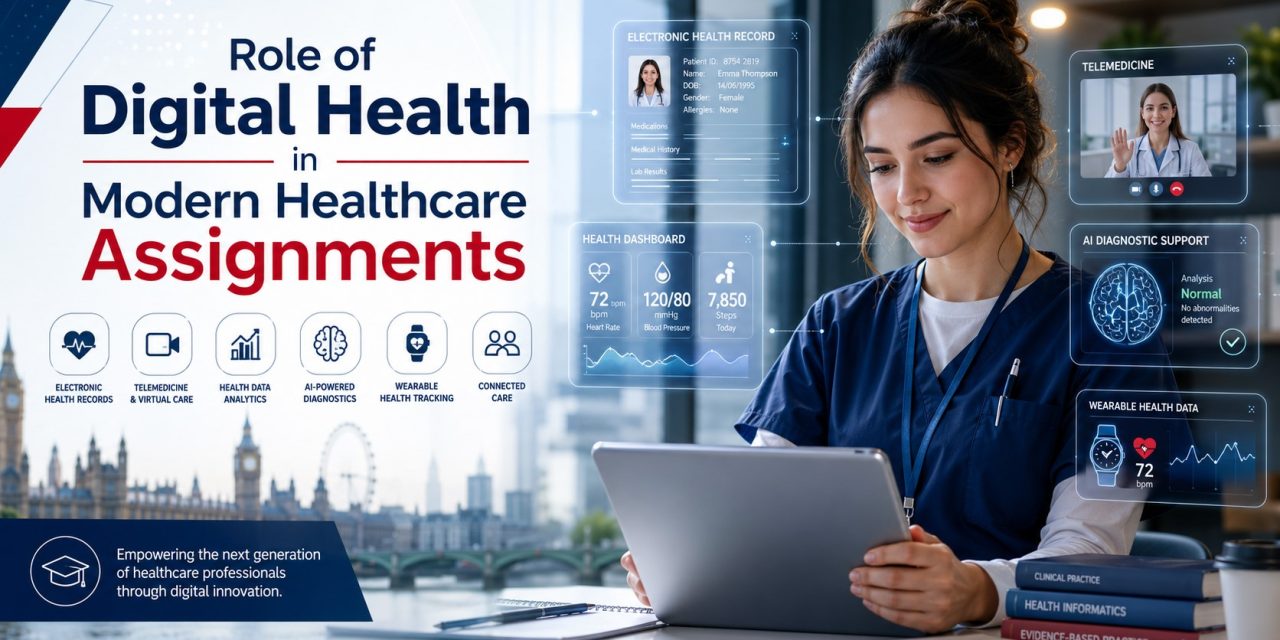
Digital health technologies restructure both the delivery of care and the service management aspect of the health profession. For students in the UK, digital health and modern health care assignments are significant because they host health care technologies and the direct connection to users, as well as considerations for the safety and construction of care and treatment workflows and health care outcomes. Additionally, this topic helps students picture the functionalities and supportive roles of digital health technologies regarding electronic health records, telehealth, digital health and wellness technologies, health care system transformations, and active health care participation. From an academic perspective, this subject enables students to discuss the advantages and disadvantages of digital health technologies in a variety of clinical contexts.
What Is the Role of Digital Health in Healthcare?
The primary aim of digital health in the health care system is to foster the enhancement of critical activities such as the diagnosis and treatment of illness, prevention, consultation, follow-up and care coordination, using technology. Digital health encompasses a variety of fields, including, but not limited to, eHealth, mHealth, virtual health care, telemedicine, mobile health applications, wearable health technologies, patient portals, electronic health records, clinical software and health information systems.
Digital health technologies facilitate the collection of health data and the management of patient records, while enhancing communication among health care providers and bolstering the safety of clinical decisions. These technologies also assist the administration of hospitals, the scheduling of appointments, medication reminders, digital notes, workflow automation and the precision of treatment.
In a digital health assignment, students have the opportunity to elaborate on the technological advancements in health care and their impact on accessibility, convenience, and safety of care, efficiency in the delivery of care and the attainment of better health outcomes for patients. They can also examine privacy concerns, data security, the digital divide, and the cost and level of staff preparedness and training.
Why Digital Health Matters in UK Healthcare
The UK faces an overburdened healthcare system, caused by an ageing population, longer waiting lists, pressures from chronic diseases, a workforce shortage, and increased demand for rapid services. Digital healthcare can alleviate the burden by promoting better access, improved care, greater clinical workflow, and enhanced patient engagement.
Supporting NHS and UK Healthcare Services
The majority of UK digital healthcare offerings have been integrated into the healthcare service framework to promote efficient, patient-centered care with the use of Electronic healthcare records. Telehealth and telemedicine enable clinicians and patients to attend health consultations without the need to be present in a hospital or healthcare facility.
This is a relevant topic area for students in the UK from a practical point of view because it connects real world clinical research issues in multiple domains, such as nursing and healthcare, public health and clinical medicine, health informatics, and health systems/hospital administration.
Improving Healthcare Access
Digital healthcare can be used to overcome barriers to the provision of healthcare that is caused by geography, mobility issues, or the need for frequent follow up care. Virtual care employs the use of video calls or telehealth, and in some cases mobile apps to facilitate the delivery of healthcare to patients in a more time efficient manner.
Digital health can be used to increase access to healthcare services. Students can introduce digital healthcare concepts to healthcare assignments and discussions based on clinical research, while incorporating the barriers to healthcare improvement such as the digital divide and lack of devices.
Key Digital Health Technologies
Modern healthcare employs a variety of digital healthcare technologies. Although these technologies are broad, they support the delivery of connected and integrated care through the provision of improved health outcomes.
Electronic Health Records
Digital patient records are now referred to as electronic health records. They contain patient demographics, diagnostics, patient history, therapy, allergies, lab results, medications, and plans. They provide an avenue to document important clinical information and provide an avenue for communication between clinicians.
In your healthcare assignment, describe how electronic health records transform digital documentation, improve patient safety, therapy, and care coordination. In your assignment, describe the challenges of cybersecurity, data privacy, and the ethical challenges surrounding patient data, documentation, and records.
Telemedicine and Virtual Care
Telemedicine is the ability to provide care over the phone, via video, and over the internet. It also provides an avenue to manage chronic illnesses and provide care for follow-up visits, mental health, and wellness care.
Virtual care is an improvement in access and convenience; however, it fails to meet the needs of many patients and many conditions. The inability to provide a physical diagnosis or to perform an exam or to provide a service that is an urgent clinical need provides an opportunity for students to perform a critical analysis for a health care technology assignment.
Mobile Health Apps
Mobile health or mHealth is the field of mobile applications that assist patients in tracking symptoms, managing medications, monitoring exercise, tracking blood pressure, and adhering to prescribed treatments. These applications promote care that is patient-centered, engaged, and preventive.
In nursing and medical assignments, students should describe how mobile health applications encourage communication and self-care. They should address the limitations and concerns regarding the accuracy of the applications and the safety of patient data and the excessive reliance on digital information.
Wearable Devices
Wearable health devices, such as smartwatches, fitness trackers, smart glucose and heart rate monitors, and other connected devices, are tools used to gather data and conduct health monitoring in real time.
Wearable health devices have the potential to make health changes more easily identifiable and promote a more predictive approach to health changes, thereby addressing the needs of chronic health conditions, the elderly, and rehabilitation. Long-term health monitoring also has its benefits. However, students should understand the implications of privacy, the cost of devices, the accuracy of the data, and the comprehension of the data by the patients.
Artificial Intelligence in Healthcare
In healthcare, artificial intelligence manifests in the use of smart diagnostics, clinical decision support tools, predictive analytics, and advanced machine learning to evaluate healthcare. The potential of AI to recognize patterns in images, understand the risks associated with patients, support formal diagnosis, and make more accurate healthcare decisions is changing the predictive paradigm in healthcare.
The modern healthcare assignment topic of digital health allows students to explore the advantages and disadvantages of artificial intelligence. The benefits of AI in healthcare from faster and more efficient care and advanced treatment accuracy to the concerns of bias in clinical healthcare, the loss of accountability and transparency, and the ethics of whom and when to care for patients are issues that are consistently evolving.
Digital Transformation in Healthcare
Digital transformation in healthcare is the use of a digital system to not only incorporate a new technology, but improve the methods and systems used by healthcare organizations to deliver care, manage health records, communicate with patients, and support integrated clinical services.
Improving Clinical Workflow
Digital systems can greatly enhance the clinical healthcare workflow by eliminating many of the manual tasks, such as scheduling and documenting patient visits, automating a majority of the clinical tasks, and making patient data more readily accessible, thereby allowing more contact time between the healthcare professional and patient and reducing the time required for administrative tasks.
Clinical software and cloud computing can bridge communication gaps across varied health services, including hospitals, pharmacies, labs, and community care.
Supporting Smart Hospitals
‘Smart’ hospitals utilize the Internet of Things (IoT), along with cloud computing and automation, to streamline patient care and the physical administration of the hospital. Some of the resources they utilize are digital patient monitoring, automated scheduling, and electronic care record systems.
‘Smart’ hospitals can optimize care and engender safe practices for better patient outcomes. However, they are an investment requiring data security, infrastructure, and staff training.
Benefits of Digital Health in Healthcare Assignments
Digital health offers students a relevant, easy to understand connection to developing and applying healthcare theory. Constructing a relevant and well thought out modern healthcare assignment requires description of digital tools and assessment of their impact on patients, employees, and the healthcare organization as a whole.
Better Patient Care
Digital health offers quicker and more accurate communication and documentation, along with remote monitoring, medication and treatment reminders. It can lead to the earlier detection of health issues and subsequently the delivery of customized care.
Stronger Patient Engagement
Patient engagement is on the rise with portals, mobile health applications, wearables, and telehealth. Patients can now access their health information, track their health, and attend virtual visits. Digital health applications can lead to increased patient satisfaction and improved follow up.
Improved Care Coordination
Digital health systems enhance care coordination by giving healthcare providers the ability to access a shared patient record. This is especially important when patients are cared for by multiple services.
Better Decision-Making
Clinical decision support systems, predictive analytics, artificial intelligence, and health data analytics provide mechanisms for healthcare practitioners to arrive at better-practice decisions. These can all support a range of activities from diagnosis, treatment, and prevention to prediction and evaluation within healthcare.
Challenges of Digital Health
Critical analysis is a necessary component of a robust digital health assignment. In addition to documenting healthcare technology-related benefits, students must address technology-related risks and limitations.
Data Privacy and Cybersecurity
Given that digital health technology results in the collection and storage of vast amounts of patient data, the protection of that data and digital security become primary concerns. Where digital health technologies are poorly protected, patient data can be stolen, leaked, or abused.
Systems security, user access controls, staff training, and digital health technologies protection through data encryption and a range of security policy frameworks and standard operating procedures become necessary to sustain patient trust, support the data protection and digital security frameworks, and fulfill the ethical and legal obligations of practice.
Interoperability Problems
Interoperability refers to the ability of different digital health technologies to communicate effectively and exchange data accurately. Where this is not achieved, healthcare practitioners may lack complete patient data and this may compromise treatment safety and effectiveness, as well as health care service delivery.
Digital Divide
Digital exclusion is a rapidly growing concern in virtual healthcare. Not all patients have access to the Internet, smartphones, digital literacy, or the confidence to engage digital healthcare. These concerns are particularly acute in older patients, low socioeconomic patients, patients with disabilities, and patients from rural communities.
Given that equitable access to health care is integrally related to improving healthcare service delivery and patient health care outcomes, this concern must be addressed in assignments related to the UK healthcare system.
Implementation Cost and Staff Training
The digital transformation of services in any sector, including healthcare, comes at a price. Organizations need to procure and implement new software, hardware, pay for cloud and cyber security services, engage technicians, and equip and train the employees.
The lack of appropriate training places employees at a disadvantage when new digital systems are introduced. Consequently, the systems can become a burden, as they may not help streamline processes, and may even worsen workload issues. When students discuss digital healthcare solutions, they should address training, leadership, and management of change and users.
Ethical Issues in Digital Health
In any digital health-related study, ethics is a key area of focus. The answers lie at the intersection of healthcare, technology, and the wellbeing of users with respect to privacy, informed consent, security, fairness, and automated decision-making.
While artificial intelligence enhances diagnosis and predictive healthcare, it has the potential to introduce bias where the underlying dataset is flawed. While remote health technology may aid in health management, in the process it can infringe on users’ privacy.
Students should determine whether a digital health initiative is safe, fair, and accessible, and if it promotes equity and user-centric design. A responsible discourse should address both the necessity for innovations and the need for accountability.
How to Write a Strong Digital Health Assignment
A concise yet comprehensive definition of both digital health and contemporary healthcare should be presented first. Next, the major components of modern digital health including telehealth; electronic health records; mobile health; wearables; artificial intelligence; remote patient monitoring; and patient portals should be described.
The discussion should then move to the implications of digital health on all aspects of the healthcare sector and, in particular, healthcare delivery and outcomes, customer safety, and process improvement. Students are encouraged to cite relevant examples and case studies, and to engage in pertinent scholarly and clinical discourse.
The last section should assess hurdles such as cybersecurity and data privacy and the digital divide. The last section should also assess implementation cost, staff training, and ethical issues. Following this structure develops a clear and organized health care technology assignment.
Example Topics for Healthcare Students
When students write about digital health in contemporary healthcare, they can cite many applicable examples. They can use telehealth to treat rural patients, heart monitors and wearables, health apps for diabetic patients, AI for radiology, electronic health records, and the remote monitoring of patients with chronic illness.
Nursing students can incorporate digital health to analyze patient safety, medication reminders, care coordination, and patient engagement, as well as analyze the digital documentation implications. Public health students can address digital health to analyze accessibility, prevention, the digital divide, health informatics, and the health care evaluation. Medical students can expand on digital health to address diagnosis, treatment, the clinical divide, and smart and safe diagnostics.
Future of Digital Health
In the coming years, modern healthcare will focus on connected care, the predictive paradigm of healthcare, digital therapeutics, precision medicine, smart hospitals, and integrated care systems. The healthcare system will be shaped by real-time data, machine learning, cloud computing, IoT, blockchain, mobile applications, and analytics.
For UK students, digital health in modern healthcare will be an academic topic in high demand because it deals with real world changes in healthcare practice. It also enables students to analyze how digital systems enhance patient care and outcomes, and allows students to challenge the digital systems’ ethics, cost, safety, and accessibility.
How Digital Health Improves Patient Care
Digital technologies are changing modern medical practices by helping healthcare professionals and health professionals manage health information, patient data, test results, treatment plans, and patient records more accurately. Tools such as electronic health records EHRs allow a health organization to store patient information safely and use large amounts of data for evidence based decisions. This supports public health, strengthens health systems, and improves patient safety by making information easier to access during diagnosis and treatment. As health technology continues to grow, it improves patient communication, supports improved patient care, and shows how advancements in healthcare are creating faster, safer, and more connected services.
Conclusion
Fundamentally, digital health technologies have the potential to enhance numerous facets of healthcare including access, the quality of services, the coordination of care, patient involvement, and the speed of clinical decisions and interventions. Examples of technologies that can help include: electronic health records; tele-health; mobile-health and wearable devices; AI-based diagnosis; remote patient monitoring; and health digital platforms.
However, it is just as important for students to understand the challenges of digital health in the context of cybersecurity, data privacy, and ethics; the cost and burden of training staff and ensuring system interoperability; and the consequences of digital exclusion. Strong assignments should include critical evaluations of literature and examples that represent both the positive and negative aspects.
As such, the topic of digital health in modern healthcare has considerable importance for UK healthcare students in that it encompasses healthcare technologies and their impact on patient care, clinical services and future healthcare delivery, as well as teaching students the importance of academic writing.
Frequently Asked Questions FAQs
Q1. What is digital health in modern healthcare?
In modern healthcare, digital health encompasses the use of technology in healthcare to enhance the quality of services through improved communications, diagnosis, and interventions, as well as healthcare outcomes.
Q2. Why is digital health important for healthcare assignments?
In healthcare assignments, discussing digital health allows students to consider the implications for contemporary healthcare technology, clinical services, patient safety, and the coordination of care, as well as access to healthcare and the ethical and data privacy issues associated with the digital transformation of healthcare.
Q3. What are examples of digital health technologies?
Digital health technologies include an ever-growing list of tele-health and telemedicine systems; mobile health and wearable devices; remote patient monitoring; electronic health records and health information systems; AI diagnostics and clinical decision support systems; and patient portals.
Q4. What advantages does digital health provide?
Digital health has advantages related to access to healthcare, patient engagement, communication and documentation speed, cohesion of care, planning of treatment, safety of patients, and the efficiency of clinical practices.
Q5. What obstacles need to be addressed in a digital health assignment?
Students should address obstacles in cybersecurity, data privacy, interoperability, ethical issues, AI bias, digital divide, cost of implementation, training the staff, patient consent, and disparities in access to digital health care services.